
Heat Mat for Caudex Rooting: Winter Import Soil Temperature
Heat mat for caudex rooting means holding the substrate near 77 F so bare-root winter imports root without cold-wet rot or heat overshoot.
Rachel Torres · 2026-10-12 · 14 min read
Key Takeaways
- Root-zone temperature, not air temperature, controls rooting. Heat the substrate to about 77 F.
- A bare mat only offsets the room. A thermostat with a root-depth probe is the real control.
- Keep the root zone under about 86 F, because past that point rooting is inhibited.
- Verify with a soil thermometer, then move a bad probe instead of raising the setpoint.
- Use a sharp 3 to 6 mm gritty or pumice mix so warmth roots the import instead of rotting it.
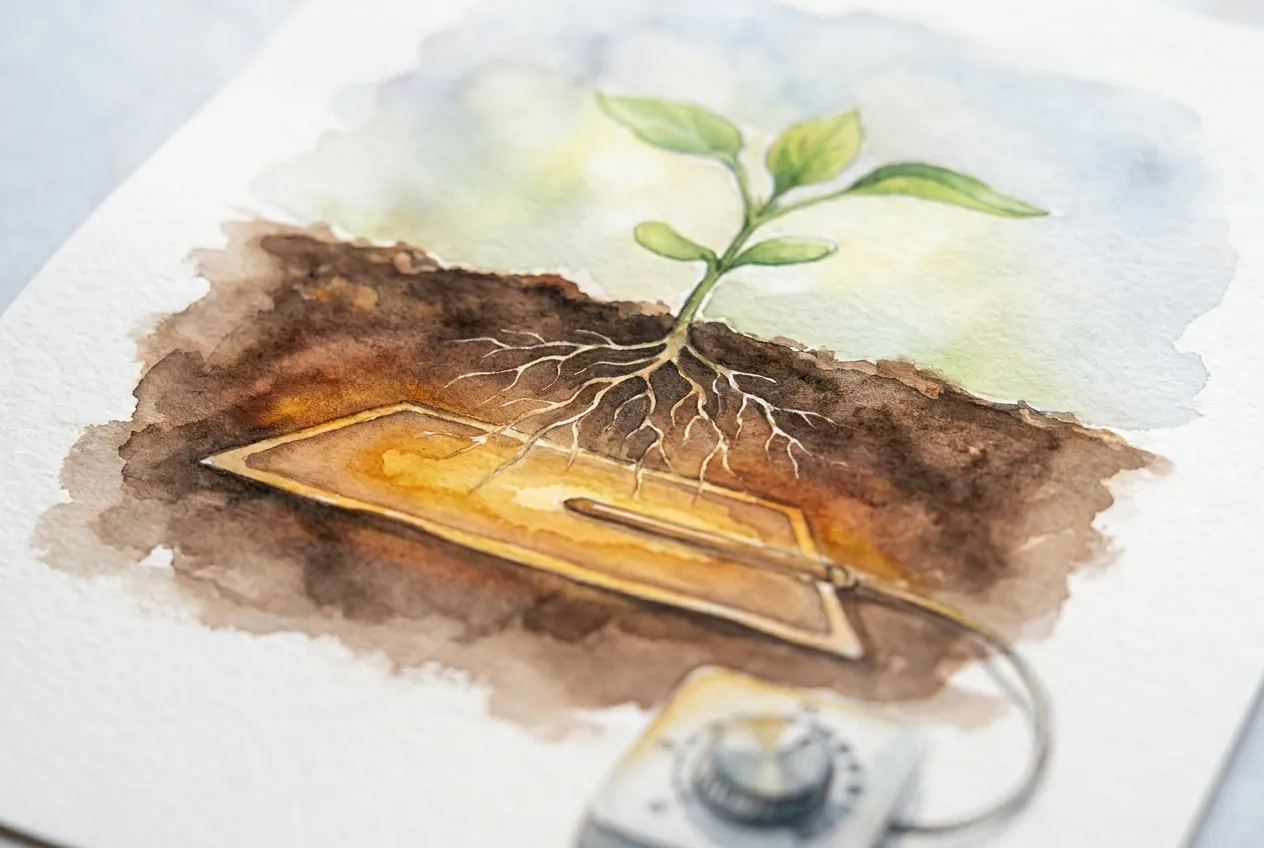
A bare-root caudex that lands on your doorstep in January is not waiting for warm air. It is waiting for warm soil. Rooting is a temperature-driven process at the stem base, and the room temperature almost never reaches it.
That single fact decides what you buy. You are not shopping for a heater. You are shopping for a way to hold the substrate at a known temperature while the rest of the room stays cool.
What to buy to root a winter import, in one answer
Buy a propagation heat mat, a thermostat with a remote probe, a soil thermometer, and a gritty inorganic substrate.
The mat supplies bottom heat while the thermostat holds a setpoint. The thermometer verifies the real root-zone temperature, and the substrate keeps warmth from turning into rot.
If you want one package that covers the two hardest parts, start with the VIVOSUN mat and thermostat combo
It pairs a 20 by 20.75 inch mat with a controller that regulates from 40 to 108 F. It is the one higher-tier item worth centering a rooting setup on, and everything else on this page stays in the low-cost tier.
The buying decision is really a temperature-control decision, so spend on regulation first and decoration never.
The rest of this page explains the mechanism, the exact numbers, and the honest tradeoffs for each piece. Skip to the setup section if you already own the gear.
Why soil temperature, not air temperature, controls rooting
Root initiation is an enzymatic process that speeds up as the substrate warms. A peach-rootstock study tested substrate at ambient, 19, 22, 25, and 28 C and recorded the highest rooting rate, 91 percent at 40 days, at 25 C. Rooting fell off above that optimum.
Air temperature matters far less. Research on cold-tolerant cuttings produced high-quality young plants with the air at 16 C as long as the root zone was heated to 24 C. The warm zone is the one under the pot, not around it.
This is why a sunny windowsill fails a winter import. The leaves may feel warm at noon, but the substrate tracks the cold glass and the cold night, so the root zone never holds the optimum.
There is a hard ceiling. In the same body of work, root growth is inhibited once the root-zone setpoint reaches about 30 C. Warmer is not better, and an unregulated mat can sail straight past that line.
Hold the substrate near 25 C and never let the root zone climb past about 30 C.
The target number and the ceiling you must stay under
Aim for a substrate temperature near 77 F, which is 25 C. That is the peer-reviewed rooting optimum, and it sits just above the 70 to 75 F range the extension services recommend for cuttings.
Virginia Cooperative Extension advises keeping both air and medium near 70 to 75 F for rooting.
Texas A&M gives an ideal root zone of 70 to 75 F and a best media temperature around 75 F, a little above its 70 F day air.
The practical target runs from about 70 F to the 77 F peach optimum, so 75 to 77 F is well supported.
Keep the medium a little warmer than the air. Bottom heat does this for you, because it warms from below while the room stays cool. That gap is what pushes root growth ahead of top growth.
I set the thermostat to 77 F as a working target rather than a published caudex standard.
Caudex-specific optima are not in the literature, so 77 F is a conservative choice that matches the peach optimum and stays well under the 30 C inhibition line.
The 86 F reading on your thermometer is the number you never want to see at root depth.
Set the controller to 77 F and treat 86 F at root depth as the stop line.
How to compare the equipment on measurable specs
Each piece has one job and one number that proves it does that job. The table below is the whole buying logic in one view.
| Role | What it does | Spec that proves fit | Honest limit |
|---|---|---|---|
| Heat mat | Lifts root zone above room air | 17 to 20 W per sq ft, 10 to 20 F lift | Fixed lift only, no regulation |
| Thermostat and probe | Holds a setpoint | Settable 40 to 108 F, probe at root depth | Only as good as probe placement |
| Soil thermometer | Verifies real root-zone temp | Reads to about 1 to 2 F at root depth | You must read and act on it |
| Gritty substrate | Keeps warmth from causing rot | 3 to 6 mm particles, high air porosity | Pure pumice dries fast |
Read the table top to bottom as a dependency chain. The mat without a thermostat drifts, and the thermostat without a verified probe lies. The warmest substrate without porosity rots, so each row fixes the failure of the row above it.
Buy the roles as a chain, because any missing link turns the others into a rot or overshoot risk.
The heat mat supplies the lift, but only a fixed amount
A propagation mat raises the root zone a bounded amount above the room, usually 10 to 20 F. Watt density around 17 to 20 W per square foot is the industry norm for seedling mats, and that density is what produces the modest, safe lift.
The VIVOSUN seedling heat mat is a standalone 10 by 20.75 inch pad rated at 18 W and certified waterproof.
Over its roughly 1.4 square foot surface, 18 W delivers exactly the kind of gentle lift the extension band calls for.
Use it when you want to warm a single tray or a couple of pots.
The honest limit is built into the physics. A bare mat only offsets the room by its fixed delta. In a cold spare room it may under-heat, and in a warm room it can push the substrate past the 30 C inhibition line.
That is why a mat alone is not enough for a valuable import. Skip the standalone mat as your only purchase if your room swings warm, because nothing stops it from overshooting. Pair it with a thermostat, or buy the regulated combo instead.
A bare mat is a fixed offset, not a temperature control, so it needs regulation before it touches an import.
The thermostat is the safety control, and the probe is the catch
A thermostat with a remote probe turns a fixed-offset mat into a regulated one. It cycles the mat on and off to hold your setpoint. That keeps the root zone at 77 F instead of drifting toward 90 F in a warm room.
For a one-package answer, that same VIVOSUN combo from the verdict bundles the larger 20 by 20.75 inch mat with a matched controller.
That controller regulates from 40 to 108 F and switches up to 1000 W. This is the single higher-tier pick on the page, and it earns that spot by solving both heat and regulation at once.
Skip it if you only root one small pot, because the large mat wastes heat on empty space.
If you already own a mat, add the lower-cost iPower heat mat thermostat instead.
It controls from 40 to 108 F, carries up to 8.3 A and 1000 W, and ships with a roughly 6 foot probe.
It pairs with almost any mat, so it is the efficient upgrade when the mat is not the missing piece.
The catch is probe placement, and it fails silently. A probe taped to the mat surface reads the hot pad, so the controller thinks the job is done and under-heats the actual substrate.
A probe left dangling in air reads the cool room, so the controller overheats the substrate trying to catch up.
The probe must sit at root depth inside the substrate, because that is the only place the controller can read the temperature that matters.
The soil thermometer closes the loop the controller cannot
A thermostat only knows the temperature where its probe sits. A separate soil thermometer tells you the real temperature where roots form, which is how you catch a mis-placed probe before it costs you the plant.
The REOTEMP soil thermometer has a 5 inch stainless stem, is waterproof, and reads across a 0 to 220 F range.
The analog dial never needs batteries and shrugs off a wet bench, which makes it a reliable spot-check tool.
Its resolution is coarser than a digital readout, so you read it by eye to about 2 F. For a once-a-day verification that is plenty.
If you prefer a digital number, a waterproof digital soil thermometer with a similar 5 inch stem does the same job.
There is a geometry detail worth noting. A 5 inch stem is longer than a small rooting pot is deep, so insert it at an angle to reach the 2 to 3 cm root zone. You only need the reading from where roots actually grow.
A five dollar reading at root depth is the cheapest insurance against a thermostat that is quietly lying to you.
The substrate decides whether warmth roots or rots
Heat speeds up rooting and rot at the same time. The variable that decides which one wins is air-filled porosity. Warm plus wet plus fine builds an airless rot incubator, while warm plus airy drains and breathes so the warmth drives root initiation instead.
This makes the medium a load-bearing part of the heat decision, not an afterthought. Fine seed-starting mix on a heat mat is the classic import killer, because you have combined every rot condition and then added energy.
The Bonsai Jack horticultural pumice is screened to a consistent quarter inch, which is about 6 mm, with no dyes or additives.
Pure pumice is inorganic and holds little water film, so a heated pot stays airy rather than steamy. Use it when you can water every few days.
If you water less often, the Bonsai Jack gritty mix adds a small clay fraction that buffers water and nutrients while keeping the sharp particle structure. The tradeoff is simple. Pure pumice dries fast and may need water every few days on a mat, so skip it if you can only water weekly and choose the gritty mix.
On bottom heat the medium is the difference between rooting and rot, so never heat a fine, water-retentive mix.
This is the same failure mode covered in the guide on cold wet soil and caudex root rot, seen from the heat side.
Setting it up so the number at root depth is the number you chose
The setup order matters because each step depends on the one before it. Follow the sequence below once, then let it run.
The setup sequence
Step 1 pot dry and shallow
Pot the bare-root import in dry-ish gritty or pumice substrate. Set the stem base at the depth where roots should form, not deeper.
Step 2 insulate under the mat
Place the mat on an insulating surface rather than cold tile or metal. A cold slab underneath pulls heat down and away from the pot.
Step 3 bury the probe at root depth
Push the thermostat probe into the substrate at root depth, against the inside of the pot.
Do not tape it to the mat and do not leave it in the air.
Step 4 set and equilibrate
Set the thermostat to 77 F and let the system run two to three hours. The substrate needs time to reach the setpoint before any reading means anything.
Step 5 verify and correct
Once the mat has run two to three hours, insert the soil thermometer at root depth and compare it to the setpoint.
If the two disagree by more than about 3 F, re-seat the thermostat probe at root depth rather than raising the setpoint.
A reading that is off almost always means the probe is in the wrong place, and raising the setpoint only bakes the substrate while hiding the real problem.
When the thermometer and the controller disagree, move the probe, never chase the number with a higher setpoint.
One safety rule before you plug anything in
This is mains power sitting next to moist substrate. Put the circuit on a GFCI outlet, keep the mat off standing water, and treat the waterproof rating as splash protection rather than permission to submerge it.
Failure modes and when to replace each piece
Most rooting failures on a heat mat trace to one of four causes. Knowing the signature lets you fix the right thing.
Overshoot
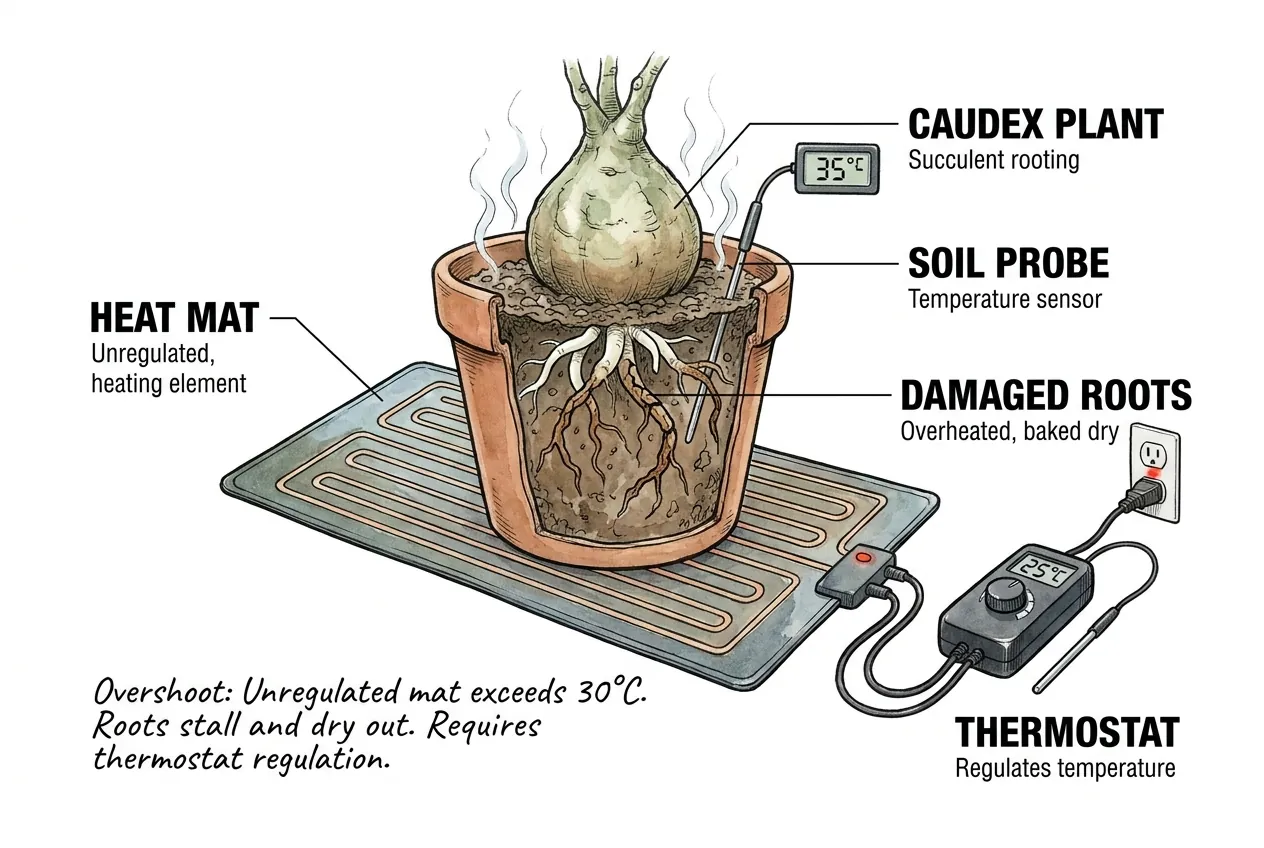
A bare mat in a warm room with no thermostat climbs past 30 C. Roots stall and the substrate can bake dry. The fix is regulation, not a different mat.
Cold-wet rot
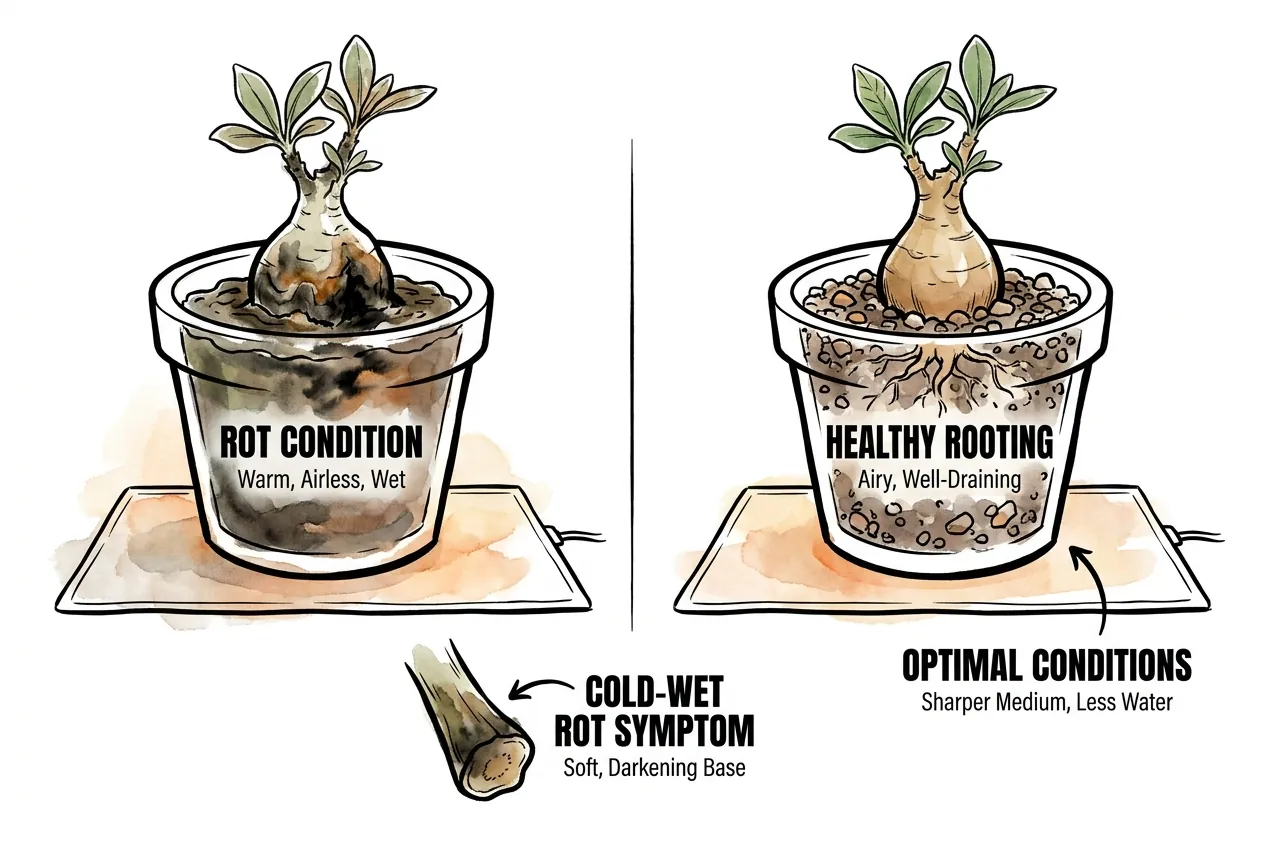
Fine or soggy substrate plus bottom heat equals warm, airless, and wet. That is the rot condition, and it appears as a soft, darkening stem base. The fix is a sharper, airier medium and less frequent water.
Silent probe error
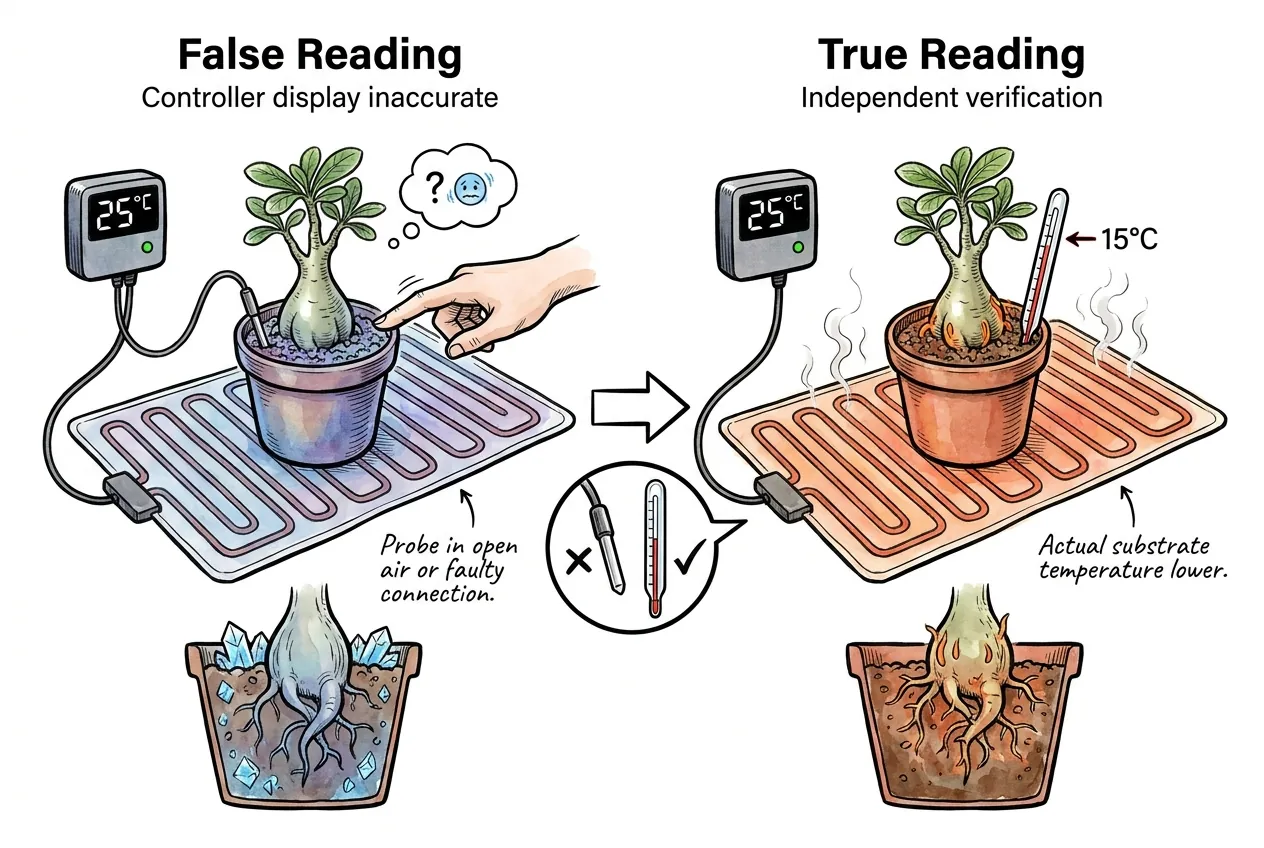
A probe on the mat surface or in open air feeds the controller the wrong number.
The substrate then runs too cold or too hot while the display looks fine. The fix is the verification step with an independent thermometer.
Dry-out
Pure pumice on a mat loses water fast, and an unwatered import desiccates. The fix is to water on a few-day cadence or move to the gritty mix.
When to replace hardware
Replace a mat that shows hot spots, a cracked coating, or that no longer reaches its ambient-plus-delta lift.
Replace a thermostat whose reading drifts away from an independent thermometer you trust. These are judgment calls on observed behavior, not fixed service intervals.
Match the symptom to its cause before buying anything new, because three of the four failures are setup errors, not broken gear.
Who should skip part or all of this kit
Not every grower needs the full setup, and forcing it wastes money.
Skip the whole kit
Skip bottom heat entirely if your rooting room already holds the substrate at 70 to 77 F through the day and night. A spot-check with the thermometer settles this in a day.
Skip the higher-tier combo
Skip the higher-tier combo if you root a single small pot. A standalone mat plus the low-cost standalone thermostat covers the same job for less and wastes less heat.
Skip pure pumice
Skip pure pumice if your schedule only allows weekly watering. The gritty mix holds a little more water and forgives a longer gap.
This hub pairs with the broader caudex overwintering setup guide and the companion on caudex soil temperature and autumn watering.
Common questions from winter-import growers
What temperature do caudex cuttings root at
Aim for a substrate near 77 F, which is 25 C. That matches the peer-reviewed rooting optimum and stays safely under the roughly 30 C point where rooting is inhibited. The target is the substrate at root depth, not the air.
Do I really need a thermostat, or is the mat enough
You need the thermostat for an import. A bare mat only offsets the room by a fixed amount, so in a warm room it can push the root zone past the inhibition line. The thermostat is the regulation that holds your target.
Can a sunny windowsill replace a heat mat
No. A windowsill warms the leaves at midday but the substrate tracks the cold glass and the cold night.
The root zone never holds the optimum, which is the one temperature that controls rooting.
Why did my import rot instead of rooting
Almost always warm plus wet plus fine substrate, or an unregulated mat that baked then stayed soggy.
Fix the medium to a sharp, airy mix and add a thermostat with the probe at root depth.
Key Takeaways
- Root-zone temperature, not air temperature, controls rooting. Heat the substrate to about 77 F.
- A bare mat only offsets the room. A thermostat with a root-depth probe is the real control.
- Keep the root zone under about 86 F. Past that point rooting is inhibited.
- Verify with an independent soil thermometer, then move a bad probe instead of raising the setpoint.
- Use a sharp 3 to 6 mm gritty or pumice mix so warmth roots the import instead of rotting it.
Affiliate Disclosure
This article contains Amazon affiliate links. As an Amazon Associate I earn from qualifying purchases. If you use these links, the site may earn a commission at no extra cost to you. Product availability, price, and specifications can change. Check the current listing before buying.