
How Long Does Stephania Erecta Take to Sprout? 170-Day Case
How long does Stephania erecta take to sprout? Three weeks to six months is normal. Monthly dead-or-dormant checks plus a clear cut-loss rule.
Derek Kim · 2026-10-20 · 13 min read
Key Takeaways
- Fresh Stephania erecta bulbs sprout in 3 weeks to 6 months. One documented bulb took 170 days.
- Audit monthly by weight, two-point press, smell, and drainage holes. Never unpot a waiting bulb.
- Substrate warmth of 25 to 28 C at bulb depth is the only evidence-backed accelerator.
- Rot thrives at sprouting temperatures. Keep the bulb surface dry and water a perimeter ring only.
- Discard on condition at any date. The calendar alone matters only past 9 to 12 months.
You potted a Stephania erecta bulb months ago. The shop said a few weeks. The bulb just sits there, smooth and silent, and every forum thread you open says either be patient or it is dead.
Here is the honest answer to how long Stephania erecta takes to sprout. Three weeks is the lucky end. Two to three months is common, one documented bulb took 170 days, and reports run out to a full year.
So the useful question is not the date. It is whether the bulb is still alive. A monthly check of weight, firmness, smell, and basal roots answers that without digging anything up.
How Long Does a Fresh Stephania Erecta Bulb Take to Sprout?
Care guides promise sprouting within two weeks to three months. One mainstream reference also reports bulbs that sat dormant for 12 months before waking.
A documented grower case ran 170 days from rootless bulb to first sprout. That is about five and a half months of nothing, followed by a normal, vigorous vine.
| Expectation source | Window |
|---|---|
| Typical care guides | 2 weeks to 3 months |
| Documented grower timeline on video | 170 days |
| Reported long outliers | Up to 12 months |
A firm, weight-stable bulb that has been silent for four or five months is still inside the documented normal range. Impatience kills more of these bulbs than biology does.
Plan the wait in checkpoints instead of one deadline. At day 30, silence means nothing.
At day 90 you have reached the top of the retail window, and the audit below becomes your real tool.
At day 170 a healthy bulb can still be exactly on schedule.
Why a Healthy Bulb Ignores a Perfect Setup
The bulb sold as Stephania erecta is botanically Stephania pierrei, a deciduous vine from Cambodia, Laos, Thailand, and Vietnam.
Its caudex is a swollen stem that carries the plant’s entire reserve budget. Two mechanisms let that organ ignore your perfect warmth and humidity for months.
Endodormancy Means the Bud Is Not Listening Yet
Tuber physiology splits not-growing into two different states. An ecodormant bud is merely waiting for better conditions and responds as soon as they arrive. An endodormant bud does not grow even under growth-promoting conditions.
Potato, the best-studied tuber, maps the control loop. The hormone ABA holds the bud locked, and cytokinins rise only immediately before sprouting. Even cultivated potato dormancy spans 1 to 15 weeks depending on genotype.
Nothing you do from the outside flips an endodormant bud on command. Warmth shortens the runway once dormancy fades, but the internal hormone shift sets the date.
Your Bulb’s Calendar Did Not Reset at Checkout
Imported bulbs are collected in Southeast Asia, cleaned, dried, and shipped bare. Most arrive with no roots at all.
A dried, rootless tuber must rebuild roots before any shoot shows, and that progress is invisible below the mix.
On top of that, the bulb’s internal season was set by a monsoon climate half a world away from your windowsill.
Comparable tropical tubers show how long that internal clock can run. Yam dormancy spans 50 to 210 days depending on species and genotype. Months of silence sit inside normal biology for this kind of organ.
The Monthly Dead-or-Dormant Audit
You cannot see dormancy release, but you can measure its opposite. A dying bulb loses mass, softens, or smells. This audit takes a few minutes a month and never disturbs the bulb.
| Check | Pass | Fail | Action on a fail |
|---|---|---|---|
| Weight on a kitchen scale | Within about 10 percent of potting weight | Faster loss between checks | Basal inspection the same week |
| Thumb press at shoulder and base | Hard to corky all over | A dent that stays, or softer than a firm potato | Basal inspection the same week |
| Smell at the mix line | Earthy or nothing | Sour or foul | Discard the bulb |
| Drainage holes | White root tips, or clean mix | Dark ooze or collapsed tissue | Unpot once and inspect |
Weigh the Pot Before You Judge the Silence
Every bulb I pot gets weighed the same day, pot and mix included, and that number goes on masking tape on the rim.
Once a month, before any watering, the pot goes back on a 1 g kitchen scale and the new reading joins the log.
Stored tubers lose water slowly through their skin by transpiration. That slow loss is normal, and the log makes its pace visible without touching anything.
My escalation line sits at roughly 10 percent below the potting weight. A drop past that line between monthly checks, paired with a failed press, means trouble rather than dormancy.
That cutoff is my working rule for low false alarms, not a published standard.
If you do not own a 1 g scale or substrate probe yet, the dormant caudex watering measurement kit covers the gear and the gates it feeds.
Press Two Points, With a Potato as Your Reference
A firm supermarket russet is my pass reference. In the same session as the weigh-in, the bulb gets a thumb-pad press at two points.
Those points are the shoulder and the area near the basal plate, pressed just hard enough to barely dent the potato.
Uniform hard-to-corky resistance passes. A spot that dents and stays dented fails, and so does any patch that feels looser than the potato.
Soft, water-soaked patches are the earliest surface sign of bacterial soft rot in storage tubers. Early detection matters because rot does not self-arrest in a warm pot.
Check the Drainage Holes, Never the Rootball
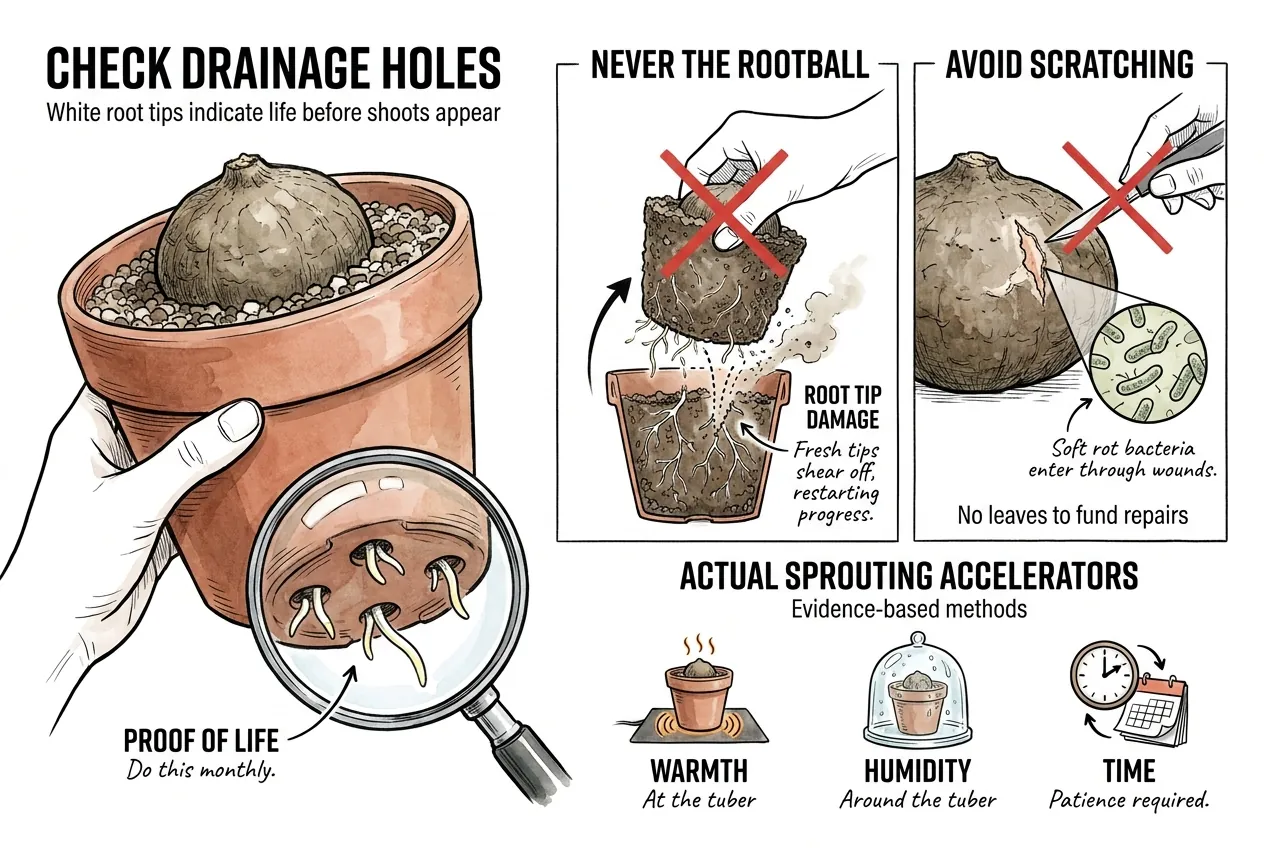
Tip the pot and look underneath each month. White root tips at a drainage hole are proof of life weeks or months before any shoot appears.
Resist the urge to unpot. Fresh root tips shear off when the mix shifts, and every break restarts the invisible progress you are waiting on.
Skip the scratch test too. Soft rot bacteria enter storage tubers chiefly through wounds, and a scratched bulb has no leaves to fund repairs.
What Actually Speeds Up Sprouting
Only three levers have evidence behind them. Warmth at the tuber, humidity around it, and time. Everything else on the folklore list either does nothing or adds risk.
Warm the Substrate, Not the Room
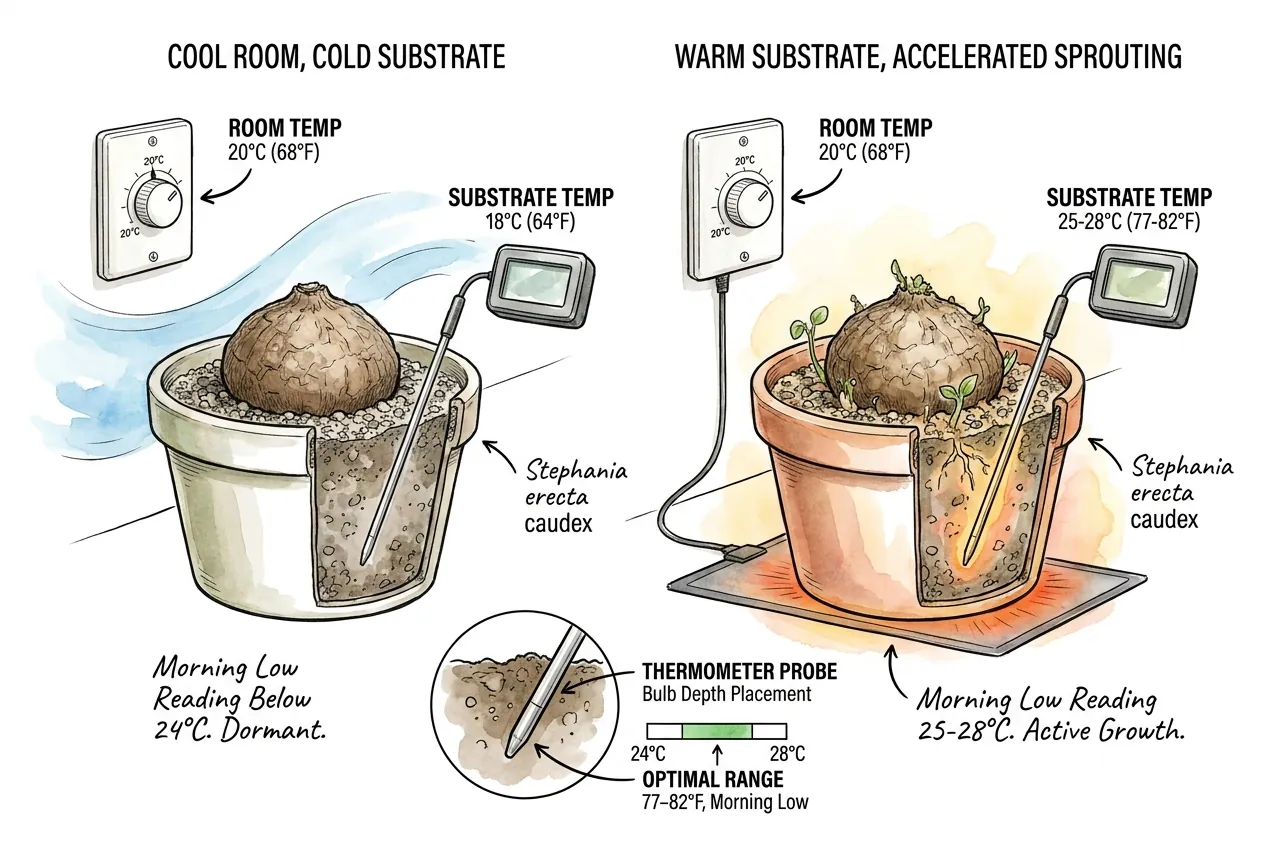
In yam, the closest well-studied analog, ventilated storage at 24 to 28 C with 70 to 90 percent humidity accelerated sprouting by weeks.
The number that matters is the temperature at the tuber, not the one on your wall thermostat.
A probe thermometer lives at bulb depth in my waiting pots. The reading that counts is the morning low, and after any setup change I wait for three mornings of readings before judging the new setup.
My working window at the probe is 25 to 28 C, which is 77 to 82 F, the upper half of the research range. A rootless bulb only benefits from faster metabolism there. When mornings read below 24 C, thermostat-controlled bottom heat goes under the pot with the controller probe at the same depth.
Room air overstates bulb-depth temperature, especially overnight near a window. For the gear decision, the heat mat for caudex rooting guide covers mats, controllers, and probe placement.
Humidity and the One-Time Soak
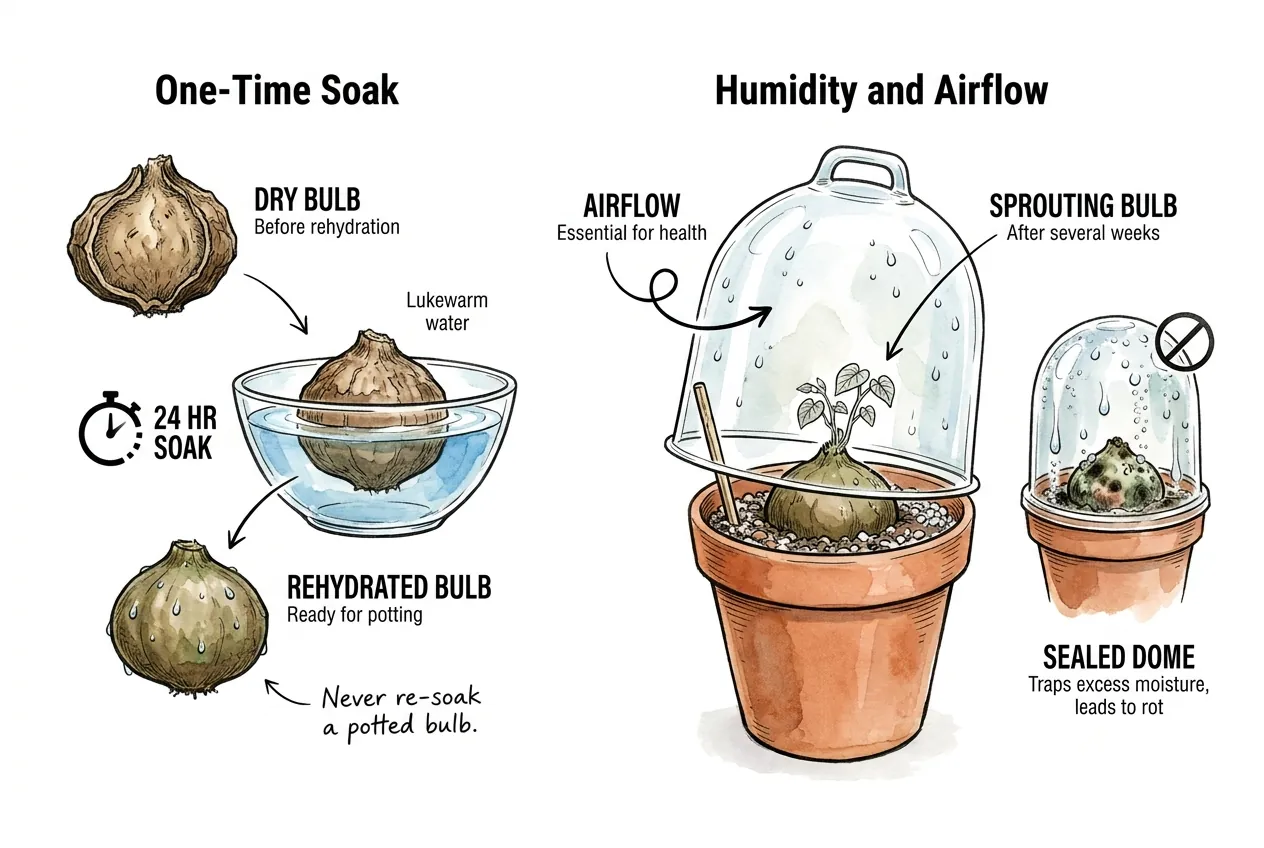
A humidity dome or loose clear bag slows the bulb’s water loss while it has no roots to replace it. Leave one side open for airflow. A sealed bag builds the standing water film that feeds rot instead of the bud.
If the bulb arrived hard and dry, a single 24 hour soak in lukewarm water before potting rehydrates it.
Care references converge on this one-time soak, with some soaking only the bottom half.
Never re-soak a potted, waiting bulb. The failure-mode list below covers what repeated wetting does to tuber skin.
Skip the Hormone Dip
Gibberellic acid genuinely breaks tuber dormancy in agriculture. A 2025 potato study reached 98 percent sprouting in about 20 days with a calibrated dip.
The same study measured the cost. Treated tubers lost nearly double the weight of controls during sprouting, 77.66 percent against 40.12 percent, because a forced wake-up burns reserves through respiration.
No published dip exists for Stephania. On a one-of-one bulb with a fixed reserve budget, an uncalibrated forced sprout risks spending exactly what the sprout needs. Warmth, humidity, and patience are the entire evidence-backed menu.
What Rots a Waiting Bulb
Most bulb deaths are grower-assisted. Nearly every entry on this list maps to one documented condition set, free water plus low oxygen on warm tissue.
Bacterial soft rot grows fastest at 70 to 80 F, almost exactly the sprouting window. Warmth is only safe while the bulb surface stays dry.
| Habit | Why it kills | Do instead |
|---|---|---|
| Watering onto the bulb | Water pools in the crown and holds an airless film on bud tissue | Water a perimeter ring only |
| Re-soaking a potted bulb | Soaking swells lenticels, which admit soft rot bacteria | One soak at potting, never again |
| Burying the bulb fully | A buried shoulder stays wet for days after each watering | Set the bulb one fifth to one third deep |
| Sealed bag or airtight dome | Condensation with no airflow creates the low-oxygen state rot needs | Vent one side always |
| Scratch tests and hard squeezes | Wounds are the main bacterial entry route | Thumb-pad press only |
| Unpotting to check roots | Shears new root tips and restarts the wait | Audit from the outside |
Planting depth deserves its own line. Care references converge between one fifth and one third of the bulb in the mix, basal plate down. The shallow end is safer in moisture-holding mixes.
The Holding Setup for a Six-Month Wait
The waiting pot has one job, which is drying fast. A rootless bulb drinks almost nothing, so every drop you add must leave by evaporation.
Use a pot barely wider than the bulb, in terracotta if you have it, filled with a majority-mineral gritty mix.
Park it in bright shade over the warmth source, never in direct midday sun.
Water a small perimeter ring every few weeks so the mix cycles between barely moist and dry. Keep water off the bulb itself at every watering.
The pot-weight log doubles as the moisture gauge. A pot sitting at its dry baseline weight is dry, and no finger test is needed.
When to Cut Your Losses
No published standard defines the give-up date for this species, so the honest framework is condition-first with a time backstop. Condition ends the wait at any date, and the calendar alone never does.
| Bulb condition | Under 6 months | 6 to 9 months | Past 9 months |
|---|---|---|---|
| Firm, weight holding | Wait | Wait, verify substrate warmth | Final basal inspection, your call |
| Firm but steadily lightening, no roots ever seen | Wait, recheck setup | Basal inspection | Discard without guilt |
| Soft spot or sour smell | Discard | Discard | Discard |
| Feather-light or hollow feel | Discard | Discard | Discard |
The patience ceiling is high. The documented 170 day case sat silent past month five, and reports of healthy wake-ups run to a full year.
My own backstop sits at nine to twelve months for a firm bulb. By then the probe has ruled out cold, so continued weight drift means reserves are draining faster than dormancy is releasing.
I treat that backstop as my judgment call, not a rule from the literature.
Cut a written-off bulb in half before binning it. A white, firm interior means it was alive, and the lesson is warmth or more patience next time.
Brown, stringy, hollow, or liquefied tissue confirms rot or terminal desiccation, and the lesson lives in the rot table above.
Do the cut after the decision, never to make it. It calibrates your next purchase, not this bulb’s fate.
One more habit protects your wallet. Photograph the bulb on arrival day and log its weight from day one. Seller guarantee windows close within weeks, long before the sprout distribution does.
After the Sprout
Emergence flips the rules. Watering moves from a trickle toward real wet-dry cycles as leaves expand, light becomes the priority, and the vine wants support immediately.
| Care element | Before emergence | After emergence |
|---|---|---|
| Water | Perimeter trickle every few weeks | Moderate soak when the mix dries |
| Light | Bright shade | Bright light, ramped over one to two weeks |
| Humidity dome | On, vented | Off within days |
| Support | None | Small hoop or trellis at first vine growth |
One warning carries the whole first season. A leaf flush is paid from tuber reserves and can happen with few working roots, so leaves prove spending, not establishment.
Keep the monthly weigh-ins going through season one. A bulb that ends the season at or above its potting weight enters year two with a real budget.
One that leafed hard while steadily lightening is the classic stall case covered in the year-2 Stephania erecta diagnosis.
Expect natural leaf drop in autumn. The species is deciduous, and a yellowing vine in October is the calendar working, not a care failure.
Key Takeaways
- Fresh Stephania erecta bulbs sprout anywhere from 3 weeks to 6 months, and a documented case took 170 days.
- Audit monthly by weight, two-point press, smell, and drainage holes. Never unpot a waiting bulb to check it.
- Substrate warmth of 25 to 28 C at bulb depth is the only evidence-backed accelerator, with vented humidity second.
- Rot runs fastest at sprouting temperatures, so keep the bulb surface dry and water a perimeter ring only.
- Discard on condition at any date, on the calendar only past nine to twelve months for a firm bulb.