
Compacted Soil Caudex Roots and When to Step Up Pot Size
Compacted soil caudex roots starve from pore collapse long before rot shows. Learn how to test drainage, decompact safely, and size your next pot.
Maya Ellison · 2026-11-22 · 29 min read
Key Takeaways
- Keep 20 to 30 percent air-filled porosity after drainage so root-zone oxygen stays above 12 percent.
- Run a timed drench-and-weigh check when a firm caudex stalls or pot water channels down the rim gap.
- Trim mushy or hollow roots with alcohol-wiped blades and let wounds dry 3 to 7 days in warm shade.
- Reuse or downsize pots with 1 inch of root clearance and step up only when roots pack 75 percent.
- Screen mineral grit through a 2 to 3 millimeter sieve and wait 5 to 7 warm days before watering.
A firm, leafy caudex can sit atop a dead root system for weeks before a single wrinkle appears on its skin.
Compacted soil collapses the air channels that fine feeder roots need to breathe. That collapse starves roots of oxygen and traps growth-halting gases long before rot turns the stem soft.
Spotting pore collapse early lets you strip away degraded media safely. Sizing the next pot to viable roots rather than caudex width keeps a stalled plant from sliding into fatal crown rot.
Why Compacted Soil Suffocates Caudex Feeder Roots
Compacted soil kills fine feeder roots by severing gas exchange pathways and forcing root cells into an energy crisis.
Even a pot that does not look flooded on top can starve its lower root zone of oxygen within hours of watering.
Macropore Collapse and Dead-End Air Pockets
Container mixes depend on large macropores between coarse particles to drain freely after watering and pull fresh oxygen back into the pot.
Fine micropores inside or between tiny particles hold water tightly against gravity through capillary forces.
When a potting mix compacts through settling, hand-tamping, or particle breakdown, macropores collapse into micropores and air-filled porosity drops.
Container-substrate research sets an ideal baseline of 50 to 80 percent total porosity. After drainage, mixes need 20 to 30 percent air-filled porosity to keep root-zone oxygen above 12 percent.
Below 12 percent root-zone oxygen, plants cannot produce new roots. Between 5 and 10 percent oxygen, existing roots stop growing, and below 3 percent oxygen, roots die.
Percolation modeling of container media shows that disconnected dead-end air pores account for roughly 10 percent of total porosity.
Gas diffusivity can fall to zero even when about 10 percent air space remains trapped inside isolated bubbles.
Oxygen diffuses roughly 10,000 times slower through water than through air. Once water films bridge narrowed pore throats in a compacted core, fresh oxygen cannot reach deep feeder roots fast enough to replace respiration losses.
Tip
Target a mineral-dominant mix that holds 20 to 30 percent interconnected air-filled porosity after drainage so gas diffusivity never stalls in the lower pot.
Hypoxia-Driven ATP Failure and Aquaporin Closure
Fine feeder roots burn oxygen continuously through mitochondrial respiration to generate ATP for cell division and mineral transport.
Roots also account for up to 50 percent of a plant’s overall hydraulic resistance, making their cellular water channels critical for hydration.
When compaction cuts off oxygen, root cells fall back on anaerobic fermentation. That fallback yields only 2 ATP per glucose molecule instead of roughly 30 to 36 ATP.
Without abundant ATP, plasma-membrane proton pumps lose energy, membrane potential collapses, and active uptake of nitrate, potassium, and phosphate stalls.
Fermentation also accumulates ethanol, acetaldehyde, and lactic acid inside root cells, triggering cytoplasmic acidification. That drop in cellular pH closes plasma-membrane aquaporin water channels and can slash root hydraulic conductivity by more than 30 percent.
This cellular shutdown creates a dangerous paradox for caudex growers. A plant sitting in damp, compacted soil stops absorbing water and begins to wrinkle, tempting the grower to water even more.
Trapped Ethylene and Carbon Dioxide Buildup
Soil compaction harms feeder roots even before standing water appears because crushed pores trap the gases roots naturally release.
Roots sense compacted media largely through restricted diffusion of the volatile hormone ethylene.
In loose, well-aerated substrates, root-synthesized ethylene vents harmlessly through continuous macropores. When compaction severs those channels, tissue ethylene concentrations can spike up to 20-fold within the first hour. That spike arrests root elongation and causes stubby radial swelling.
Respired carbon dioxide also builds up in the blocked pore space, acidifying thin water films around root tips.
Repeated cycles of oxygen starvation and sudden re-aeration trigger oxidative stress bursts. Those bursts can cause observable root-tip cell death within 1 hour of recovery after a 4-hour hypoxia event.
| Root-Zone Factor | Loose Coarse Substrate | Compacted Fine Substrate |
|---|---|---|
| Interconnected air space | 20 to 30 percent after drainage | Below 10 to 15 percent with dead-end pores |
| Respiration and ATP yield | Aerobic phosphorylation at 30 to 36 ATP per glucose | Anaerobic fermentation at 2 ATP per glucose |
| Water and ion transport | Active proton pumps and open aquaporins | Acidosis-gated aquaporins with over 30 percent conductivity drop |
| Gas venting around tips | Free diffusion of ethylene and carbon dioxide | Up to 20-fold ethylene spike within 1 hour and tip arrest |
Why a Firm Caudex Hides Feeder-Root Suffocation
Caudex plants separate below-ground work between short-lived, oxygen-hungry feeder roots and a thick, perennial storage organ.
Because that swollen stem buffers water loss, above-ground appearance lags weeks or months behind feeder-root death.
Desert-adapted succulents deploy thin-walled ephemeral feeder roots, often called rain roots, from lateral buds within hours of soil wetting.
Those fine roots have a high surface-area-to-volume ratio and unsuberized tips for rapid uptake. That delicate structure leaves them vulnerable whenever pore oxygen drops.
By contrast, the caudex, swollen taproot, or tuber minimizes surface area and seals its exterior beneath protective periderm.
Anatomical sections of Dioscorea tubers show a 5 to 6 layer outer cortex. Inside sits a wide central ground tissue packed with thin-walled, starch-filled parenchyma cells.
Those water-storing parenchyma cells act as a hydraulic capacitor that discharges internal moisture into the vascular stream during supply deficits.
When compacted soil kills fine feeder roots, the plant deposits hydrophobic suberin barriers. It also sheds damaged lateral roots to stop stored water from leaking back into the pot.
Warning
Never judge feeder-root health by caudex firmness alone, because hydraulic capacitance and suberin barriers keep stems plump long after fine roots suffocate.
Why Watering a Shriveled Caudex in Compacted Soil Accelerates Rot
Once internal water reserves finally drop enough to crease the caudex skin, growers often assume the plant is thirsty and drench the pot.
Without living feeder roots to transpire that moisture, water sits in collapsed micropores. That stagnant moisture keeps the substrate at or above 70 percent of available water capacity.
University extension pathology guidelines identify soil moisture at or above 70 percent of available water capacity as prime territory for Pythium root rot.
Warm-season species such as Pythium aphanidermatum turn aggressively pathogenic once soil temperatures climb above 77 degrees Fahrenheit (25 degrees Celsius).
Hypoxic, dying root cells leak sugars, amino acids, and potassium ions into surrounding water films. Flagellated Pythium and Phytophthora zoospores swim through those continuous films by chemotaxis, following the chemical trail straight to compromised root junctions.
Unlike woody forest trees reinforced with dense heartwood, a caudex consists of soft, starch-rich parenchyma with few structural barriers.
Once water molds breach the damaged root crown, decay can liquefy the storage core rapidly.
How to Tell If Caudex Potting Mix Is Compacted Before Rot Sets In
Waiting for a mushy caudex base leaves too little healthy tissue to save. You can catch pore collapse weeks earlier by tracking how water enters the pot and how fast pot weight drops. Warm-weather shoot behavior also flags root distress early.
Hydrophobic Crusting and Pot-Wall Channeling
Organic-heavy mixes often fool growers into thinking drainage is fast. Commercial drying makes peat moss hydrophobic, and once peat moisture drops below 20 percent, it resists rewetting and shrinks away from the container wall.
Purdue Extension substrate data show that when peat dries from 60 percent to 20 percent water content, its hydraulic conductivity drops 100-fold.
Water then pools on top instead of soaking into the root ball. It can also race down the 1 to 3 millimeter rim gap straight into the saucer.
Before unpotting a suspect plant during active growth, I run a timed drench-and-weigh check to separate true core wetting from wall channeling.
I weigh the dry pot on a digital kitchen scale first. Then I slowly pour room-temperature water equal to 20 to 25 percent of the pot volume evenly across the center surface.
Next, I time how many seconds pass before water first exits the bottom drain hole and watch for surface ponding. I re-weigh the pot 10 minutes after drainage stops. If water exits within 5 seconds while pot mass rises by less than 10 percent of pot volume, the core is bypassing water.
For example, gaining under 100 grams in a 1-liter pot signals channeling. Water ponding on top longer than 30 seconds without sinking also flags a compacted or hydrophobic core that needs an unpotting inspection.
I treat the 20 to 25 percent drench volume, 5-second exit cutoff, 10 percent mass-gain floor, and 30-second ponding limit as conservative operational rules.
They are not published standards, yet they cleanly separate bypass channeling from matrix wetting without laboratory instruments.
Skip this wet test if the caudex feels soft, smells foul at the drain holes, or is dormant, and inspect dry instead.
Lower-Core Saturation and Ethylene-Driven Shoot Stress
Compaction can also hit the lower half of the pot instead of drying into a hydrophobic brick.
In that case, the top 2 centimeters look dry while the bottom third stays cool, heavy, and airless.
University of California IPM diagnostics list surface ponding, soggy lower media, and a rotten-egg hydrogen sulfide odor as clear signs of aeration deficit.
Above ground, root hypoxia triggers hormonal signals long before stem rot appears. Hypoxic roots synthesize the ethylene precursor ACC and export it upward through xylem sap to leaves.
That signal reduces stomatal conductance and triggers premature lower-leaf yellowing and drop.
Chronic aeration deficit also stalls shoot tips and shrinks new leaves during warm active weather above 70 degrees Fahrenheit (21 degrees Celsius).
If a caudex fails to plump 48 to 72 hours after a thorough watering while temperatures are warm, the feeder-root network is failing.
| Diagnostic Signal | Healthy High-AFP Mix | Hydrophobic Channeled Core | Collapsed Waterlogged Core |
|---|---|---|---|
| Surface infiltration | Uniform wetting within seconds | Ponds over 30 seconds or slips down rim gap | Slow puddling and soggy crust |
| Drain-hole timing | Steady percolation after core wets | Exits in under 5 seconds down pot wall | Sluggish or delayed drip |
| Pot weight after drainage | Predictable gain followed by steady dry-back | Gains under 10 percent of pot volume | Stays heavy in lower third past 7 to 10 days |
| Shoot and caudex cue | Firm caudex and active shoot tips | Creased caudex fails to plump after watering | Stalled shoots and yellowing lower leaves |
Caution
Inspect the root zone before watering again whenever a pot drains in under 5 seconds without gaining weight or stays bottom-heavy past 7 days.
How Substrate Breakdown and Fines Drive Pore Collapse
Even a mix that drains well on day one loses air space over 12 to 24 months.
Organic fibers decay, fine sand migrates downward, and soft clay aggregates weather into silt. Understanding each component’s failure timeline tells you when to reset before roots suffocate.
Organic Decomposition and Fine Sand Migration
Microorganisms break down organic potting ingredients using roughly 1 pound of nitrogen for every 25 pounds of carbon, pitting particle surfaces and generating sub-millimeter fines.
In a 42-day controlled biodegradation trial at 35 degrees Celsius, white peat lost 1.06 percent of its organic matter.
Coconut coir lost 2.67 percent, eroding surface structure and lowering air-filled porosity while raising water retention.
Adding fine sand does not rescue an organic mix. Particle-size studies show that fine fractions below 0.3 millimeters and intermediate fractions from 0.85 to 2 millimeters govern pore tortuosity.
Dense sand grains wash down into structural voids and slash saturated hydraulic conductivity.
Soft Akadama Weathering vs. Permanent Volcanic Aggregates
Inorganic aggregates also vary sharply in lifespan depending on parent clay mineralogy and kiln firing temperature.
Low-fired volcanic clays such as standard akadama retain internal clay-platelet boundaries. Repeated wet-dry cycles slake those platelets into pore-clogging silt over roughly 1.5 to 3 years.
By contrast, natural volcanic pumice, vesicular basaltic scoria, and high-temperature kiln-vitrified expanded shale lack slaking clay platelets.
USDA-ARS trials comparing Douglas fir bark blends confirm that adding volcanic pumice lowers water-holding capacity relative to peat blends while maintaining a rigid mineral skeleton.
Hard-Water Carbonate Scaling and Surface Sealing
Irrigation water chemistry accelerates compaction at the top of the pot. Purdue Extension notes that irrigation alkalinity of 120 ppm calcium carbonate equivalents or higher drives substrate pH creep.
Hard water exceeding 200 ppm bicarbonate, 60 ppm calcium, and 25 ppm magnesium precipitates white carbonate crusts as surface water evaporates.
Rutgers Cooperative Extension adds that water electrical conductivity above 1.0 dS/m creates a high salinity hazard in small containers with low buffering capacity.
Pairing hard tap water with fine decorative top-dressing seals surface pores. Coarse porous surface layers allow faster water penetration while moderating evaporation.
| Substrate Component | Structural Lifespan | Primary Breakdown Mode | Effect on Air-Filled Porosity |
|---|---|---|---|
| Sphagnum peat moss | 6 to 18 months | Microbial decay and hydrophobic wall shrinkage | Drops as fines accumulate and cores repel water |
| Coconut coir | 12 to 24 months | Surface erosion generating fine water-holding pores | Moderate decline and higher water retention |
| Aged coarse pine bark | 18 to 24 months | Slow lignin-limited decay into spongy fines | Preserves macropores longer than peat before slumping |
| Fine sand | Immediate collapse | Downward migration into coarse pore throats | Slashes hydraulic conductivity and air space quickly |
| Low-fired akadama | 1.5 to 3 years | Wet-dry slaking into clay-like silt | Moderate-high early, then clogs lower pores |
| Pumice, scoria, or expanded shale | 10 years or longer | Virtually inert rigid mineral skeleton | Preserves permanent macropores across repots |
Tip
Anchor long-term caudex mixes with 60 to 80 percent rigid volcanic or high-fired aggregates and flush with low-alkalinity water when tap alkalinity exceeds 120 ppm.
How to Decompact Roots and Inspect for Viable Tissue
Once diagnostics confirm pore collapse, removing the old media without stripping healthy root cortex determines how quickly the plant recovers.
Wear chemical-resistant gloves and eye protection when working with Euphorbia or Adenium. Euphorbia milky latex can cause severe ocular keratouveitis, and Adenium sap is a strong irritant.
Dry Chopstick Teasing vs. Controlled Water-Jetting
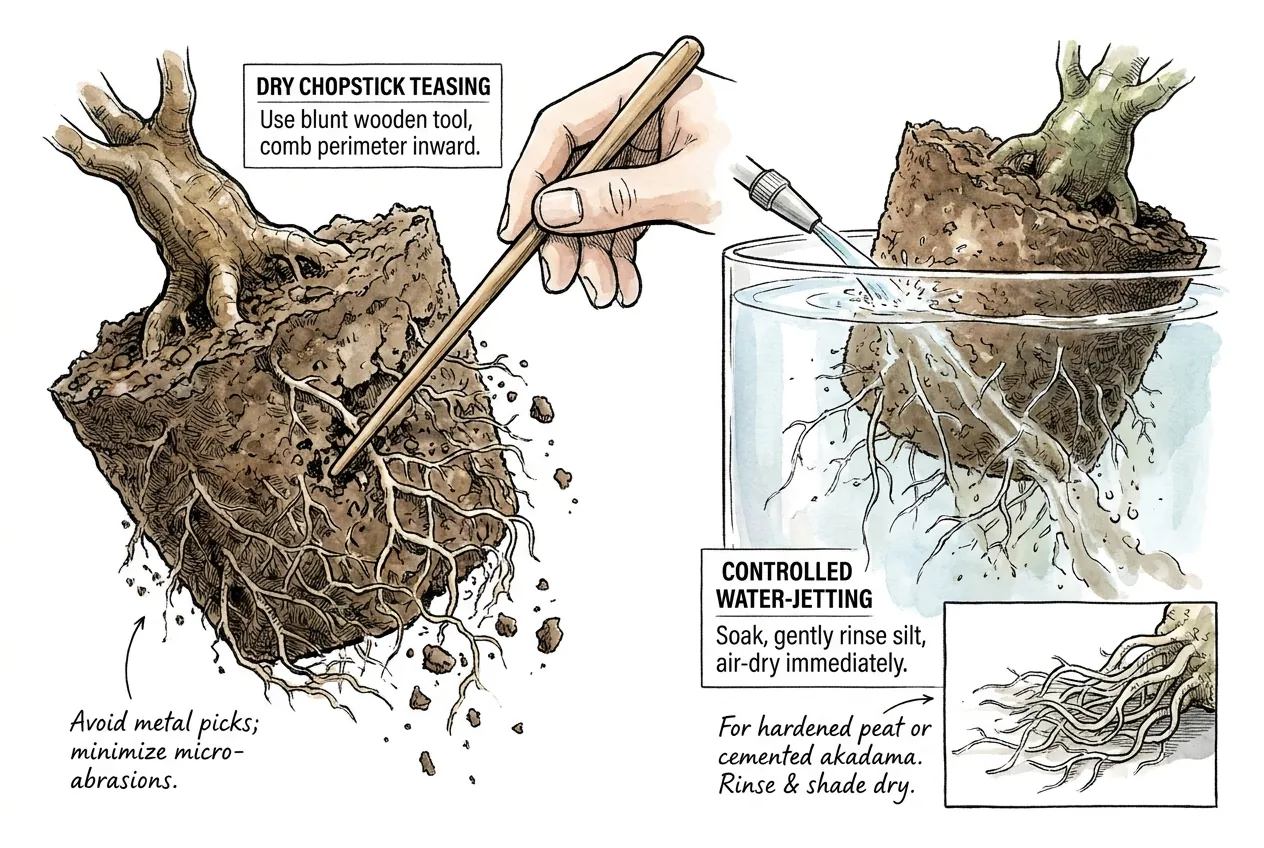
Start dry whenever possible so fresh micro-abrasions are not exposed to water films. Following standard bonsai repotting practice, use a blunt wooden chopstick or bamboo skewer to comb outward from the root-ball perimeter inward. Avoid metal picks that gouge soft caudex skin.
Thick woody roots only transport energy and anchor the plant, whereas fine feeder roots perform water, nutrient, and oxygen uptake.
Dried peat can harden into a brick, and degraded akadama can cement into clay silt that threatens to snap live white roots.
If that happens, soak the lower root ball in tepid water for 10 to 15 minutes.
Gently rinse the silt away, and air-dry the roots immediately in shade.
Visual and Tactile Triage of Feeder Roots
After clearing away old media, inspect every section of the root system by color and fingertip feel.
Healthy, functional feeder roots are white, cream, or light tan and feel firm and elastic when bent. Their outer cortex stays tightly attached under a gentle pinch-and-slide test.
Roots killed by dry hypoxia feel papery, hollow, or brittle and snap cleanly without moist interior tissue.
Roots killed by wet hypoxia or Pythium turn dark brown, gray, or black and feel mushy.
Their outer cortex slides off between your fingers to expose a thin central strand known as the rat-tail symptom.
| Root Condition | Color and Texture | Pinch-and-Slide Test | Action to Take |
|---|---|---|---|
| Viable feeder root | White, cream, or light tan, firm and elastic | Outer cortex stays tightly bound to stele | Leave completely intact |
| Dry-suffocated root | Tan or gray, papery, hollow, and brittle | Snaps dry with no living white interior | Trim back to firm white tissue |
| Hypoxic or rotted root | Dark brown or black, soft and water-soaked | Outer cortex sloughs off leaving a bare strand | Trim all affected tissue back to clean flesh |
Two-Step Tool Sanitation and Wound Suberization
UF/IFAS Extension emphasizes that cleaning and disinfecting cutting tools are two distinct steps because soil and sap neutralize chemical sanitizers.
Wipe organic debris off your blade first with a damp cloth. Then wipe or dip the blade in 70 to 100 percent isopropyl or ethanol alcohol, which acts immediately without corroding steel.
A 10 percent chlorine bleach solution also disinfects blades, though it requires a 30-minute soak and loses half its potency within 2 hours. Rinse steel thoroughly afterward to prevent corrosion. Trim away all mushy, hollow, and cortical-sloughing roots back to clean white tissue, leaving firm feeder roots intact.
Fresh cuts leak sugars and amino acids until the plant seals them with hydrophobic suberin and a protective wound periderm.
North Dakota State University Extension data on storage tubers show complete suberization finishes in 3 to 6 days at 68 degrees Fahrenheit (20 degrees Celsius).
Two protective periderm layers form in 5 to 7 days at that warm temperature. Cooling to 50 degrees Fahrenheit (10 degrees Celsius) delays complete suberization to 7 to 14 days.
Sugarbeet storage-root trials confirm the same temperature barrier. Wounded roots seal completely within 14 days at 12 degrees Celsius, yet they fail to heal over 28 days at 6 degrees Celsius.
Rest freshly trimmed caudex roots in warm, shaded, ventilated air at 68 degrees Fahrenheit (20 degrees Celsius) or higher for 3 to 7 days.
Important
Clean blades between cuts, trim only dead or sloughing roots, and let wounds suberize in warm dry air for 3 to 7 days before watering.
When Should You Step Up Pot Size for a Caudex Plant
After removing compacted media and dead roots, most growers reach automatically for a wider pot. In caudex culture, stepping up pot size too early is one of the fastest ways to trigger a second round of root hypoxia.
Perched Water Table Physics in Shallow vs. Deep Pots
Every container holds a saturated perched water table at its base after free drainage stops because capillary tension balances the pull of gravity.
The vertical height of that airless zone depends on the pore size of your mix, not the height of the pot.
In a comparison of 4-inch-diameter pots, a 3.75-inch-tall standard pot holds the same thickness of saturated bottom mix as a 5.0-inch-tall pot.
That leaves a much larger share of the shallow root zone waterlogged. Taller pots drain more completely in the upper 0.5 inch while keeping the lower zone moist, so lifting pots beats checking surface dryness alone.
Why Stepping Up Two Inches Doubles Wet Substrate Volume
Container volume scales with the square of the radius. A modest jump in pot diameter multiplies uncolonized wet media faster than slow-growing roots can expand.
Stepping up from a 4-inch to a 6-inch pot of equal depth increases substrate volume by 2.25 times, or 125 percent.
Slow-growing caudiciforms such as Pachypodium gracilius, Stephania, and Dioscorea carry a small leaf canopy relative to their stored water volume.
Because their daily transpiration pull is low, water films linger in uncolonized outer rings. That stagnant moisture in the bottom perched water zone starves sparse roots of oxygen.
University of Arizona Cooperative Extension explicitly warns against overpotting Adenium into oversized containers and recommends moving up only to a slightly larger pot.
University of Arkansas Extension similarly advises keeping caudiciform pots relatively small for the plant and notes that winter-wet conditions during dormancy are often fatal.
Measuring Viable Root Clearance After Decompaction
Instead of guessing by caudex diameter, I size the container strictly to the cleaned, living root ball after all dead tissue is trimmed.
Put on protective gloves and safety glasses first whenever pruning Euphorbia or Adenium. Euphorbia latex can cause acute corneal inflammation requiring 10 to 15 days of medical treatment to resolve.
Once the root ball is trimmed to firm tissue, I center it inside the dry candidate pot at its intended planting depth.
With a ruler, I measure the horizontal gap between the outermost firm feeder roots and the inner pot wall at two perpendicular points.
If that radial clearance is 1 inch (2.5 centimeters) or more, I downsize to a container leaving 0.5 to 1 inch (1.25 to 2.5 centimeters) of room.
When radial clearance sits between 0.5 and 1 inch (1.25 to 2.5 centimeters), I reuse the disinfected original pot with fresh screened mix.
I step up 1 to 2 inches (2.5 to 5 centimeters) only when firm roots press against over 75 percent of the inner pot wall.
Roots visibly pushing the caudex upward are the other trigger. Extension guides warn against overpotting without setting a universal millimeter cutoff, so I apply the 1-inch clearance and 75-percent wall-contact rules as conservative operational thresholds.
| Post-Decompaction Root State | Radial Clearance to Pot Wall | Pot-Sizing Decision |
|---|---|---|
| Dead roots trimmed back by 30 to 50 percent | 1 inch (2.5 cm) or more | Reuse disinfected pot or downsize to 0.5 to 1 inch clearance |
| Moderate healthy roots with open outer grit | 0.5 to 1 inch (1.25 to 2.5 cm) | Reuse same pot size with fresh screened mix |
| Firm roots touching over 75 percent of wall | Under 0.5 inch (1.25 cm) | Step up 1 to 2 inches (2.5 to 5 cm) in diameter |
Summary
Downsize if viable roots leave 1 inch or more of clearance, reuse the pot at 0.5 to 1 inch, and step up only when roots touch over 75 percent of the wall.
Seasonal Timing and Post-Repot Rehydration
Even a perfectly sized pot and screened mineral mix will rot a decompacted caudex if you repot during deep dormancy or water too early.
Both wound sealing and new feeder-root growth are strictly gated by season and root-zone heat.
Aligning Repotting With Active Growth and Root-Zone Heat
Caudiciforms follow two opposing seasonal calendars. Summer growers such as Adenium, most Madagascan Pachypodium, and Operculicarya enter dormancy when night temperatures drop below 50 degrees Fahrenheit (10 degrees Celsius).
Repot them in late spring or early summer, never in fall or winter.
Winter-growing geophytes such as Dioscorea elephantipes drop their vines for a dry summer rest. They resume root and vine activity as temperatures cool in late summer to early autumn. Repotting at the onset of each group’s active growing window ensures auxin signaling and carbohydrate flow are ready to build new feeder roots.
Soil temperature governs both meristem division and biochemical wound sealing. Controlled studies on Opuntia ficus-indica show root elongation spans 12 to 43 degrees Celsius (53.6 to 109.4 degrees Fahrenheit).
The optimum sits at 27 to 30 degrees Celsius (80.6 to 86 degrees Fahrenheit). Cool soil shrinks the root cell division zone by 20 percent.
Molecular wound-healing trials further show that temperatures around 22 degrees Celsius (71.6 degrees Fahrenheit) drive continuous lignin and suberin gene expression over 14 days. By contrast, 4 degrees Celsius suppresses those pathways. Keep recovering summer growers above 70 degrees Fahrenheit (21 degrees Celsius) by day and 60 degrees Fahrenheit (15.5 degrees Celsius) at night.
| Caudiciform Growth Rhythm | Representative Genera | Active Growth Window | Optimal Decompaction Timing |
|---|---|---|---|
| Summer growers | Adenium, Pachypodium, Operculicarya | Late spring through early fall above 60 F nights | Late spring or early summer as buds swell |
| Winter growers | Dioscorea elephantipes, winter Stephania | Autumn through spring cool-season vining | Late summer to early autumn as new vine emerges |
Dry-Settling Grit and the Skewer Rehydration Gate
Never water a freshly bare-rooted or root-pruned caudex immediately to settle the mix. Penn State Plant Pathology notes that bi-flagellated Pythium zoospores swim through free water films toward host cells, encyst, and penetrate tissue. Phytophthora zoospores rely on the same aquatic chemotaxis.
To prevent secondary rot, I settle dry or barely damp mineral-heavy mix around the roots by tapping the pot sides rather than flushing with water.
I hold the plant in bright indirect light for 5 to 7 days without watering. Day temperatures stay above 70 degrees Fahrenheit (21 degrees Celsius) and nights above 60 degrees Fahrenheit (15.5 degrees Celsius).
If more than 25 percent of the feeder-root mass was trimmed, I extend that dry callousing window to 7 to 10 days.
Once that waiting window ends, I push a clean wooden skewer down into the outer bottom third for 10 minutes.
Staying away from the main taproot avoids puncturing healing tissue, and I also check caudex-shoulder firmness against its pre-repot baseline.
I apply the first light watering only after the 5 to 7 day window passes and the skewer emerges completely dry.
I withhold water longer if the plant stays leafless or nights drop below 60 degrees Fahrenheit (15.5 degrees Celsius). Softer caudex tissue than baseline triggers a dry inspection instead.
This combined 5 to 7 day warm interval and dry-skewer gate is an operational author rule built from wound-suberization and oomycete motility research.
It ensures no residual water film bridges unsealed root abrasions. If an emergency winter rescue forces a bare-root reset in cold weather, pot into bone-dry grit and wait for spring warmth.
Remember
Pot decompacted caudiciforms into dry mineral grit, tap the pot sides to settle particles, and wait 5 to 7 warm days before watering.
Preventing Future Compaction Through Screening and Container Choice
Once a caudex recovers, keeping macropores open for years comes down to particle screening before mixing and matching container breathability to your growing climate.
Screening Out Fines Below 2 to 3 Millimeters
Bagged pumice, scoria, and bark often carry substantial dust and fine grit, especially toward the bottom of the sack.
Analyzing 28 soilless substrates, Naasz and Bussières found that particles under 0.3 millimeters and 0.85 to 2 millimeters directly control air-filled porosity. Those fine particles raise pore tortuosity and slow hydraulic conductivity.
Rutgers Cooperative Extension sets 10 to 20 percent air capacity by volume as the container baseline and warns that oxygen stress develops below 10 percent.
Dry-sieving mineral aggregates through a 1/8-inch (2 to 3 millimeter) hardware-cloth screen removes dust before blending. Otherwise, those fines wash downward and seal the lower pot.
After removing collapsed peat or degraded akadama, compare particle durability and water-holding tradeoffs in our Caudex Substrate Comparison hub before mixing your next batch.
Matching Pot Material and Drainage Geometry to Your Climate
Container walls govern how fast excess moisture leaves the perimeter of the root ball. Nebraska Extension notes that unglazed terracotta wicks moisture radially through porous walls, admits air to outer roots, and buffers temperature swings.
Thin plastic holds water longer, and black plastic can drive container media past 120 degrees Fahrenheit in direct sun.
USDA-ARS nursery trials comparing solid plastic pots against breathable fabric root bags found that fabric containers dried faster and produced more fibrous, non-circling root systems.
Regardless of material, keep bottom drainage holes wide, unobstructed, and elevated off standing saucers.
Do not rely on a shallow layer of large pebbles at the bottom of a pot to fix a fine, compacted mix.
PLOS ONE container-drainage research confirms that a perched water table of fixed height still forms above coarse layers.
A thick 60-millimeter coarse transition layer only reduced water retention in loamless organic media.
When choosing a replacement container after bare-root decompaction or a step-up, review wall permeability and drainage geometry in our Best Pot for Caudex Plants guide.
Note
Screen out particles under 2 to 3 millimeters before mixing and pair mineral-dominant grit with porous terracotta or breathable containers that match your watering habits.
Next Steps for Saving a Compacted Caudex
If a caudex is already softening at the base or smelling sour at the drain holes, unpot it dry today.
Trim back to clean white tissue with an alcohol-wiped blade before rot reaches the core. If the caudex is still firm but fails the drench-and-weigh or skewer check, wait for temperatures above 70 degrees Fahrenheit (21 degrees Celsius).
Once the roots are clean and trimmed, measure radial clearance to decide whether to reuse the pot, downsize, or step up 1 to 2 inches.
Rebuild the root zone with screened mineral-dominant grit in a breathable container. Hold water for 5 to 7 warm days until the lower third tests dry so feeder roots never suffocate again.