
Fockea Edulis Flowers but No Seeds? It Takes Two Plants
Fockea edulis flowers no seed pods? That is dioecy. One plant can never set seed alone. Sex your plant, hand-pollinate with pollinia, harvest before the split.
Rachel Torres · 2026-08-28 · 13 min read
Key Takeaways
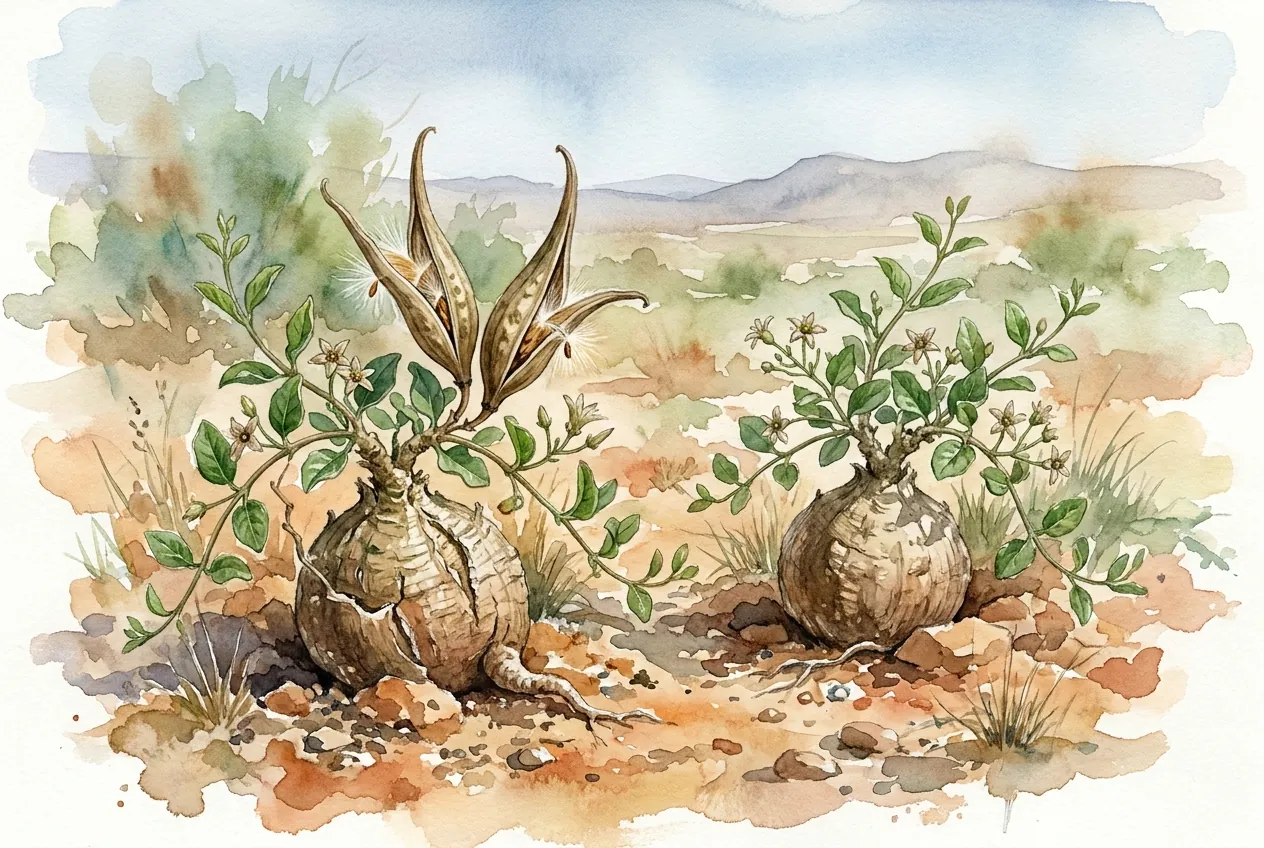
- One Fockea edulis can never set seed. The species is dioecious, so seed takes a male and a female plant.
- Any pod ever proves a female. Flower color, size, or a home dissection does not provide a verified sex key.
- Pollen ships as solid pollinia. Insert one into the stigmatic slit with a fine hook, or let flies do it.
- Bag pods with mesh at the first seam change. Harvest when the seam opens under light pressure.
- Sow fresh seed warm with no hormones. Expect sprouts in weeks and a real caudex in years.
Your Fockea edulis is not broken. It flowers every late summer, the little green stars smell sweet, and then every single one drops without a trace of a pod.
Growers audit their light, their fertilizer, and their watering for years over this.
The answer is one sentence. Fockea edulis is dioecious, so every plant is permanently male or permanently female, and one plant alone can never make a seed.
The fix is not better care. It is a second plant of the opposite sex, blooming at the same time, plus a pollen transfer that actually works on this odd flower.
Why a Lone Fockea Edulis Never Sets Seed
Dioecy means the species splits its sexes between separate individuals, the way hollies and kiwis do. A male Fockea has no ovaries anywhere on it. A female has no pollen source of her own.
This is a normal minority strategy in plants, not a defect. Botanists count about 15,600 dioecious species across flowering plants, roughly 5 to 6 percent of the total. No cultural change will ever produce seed on a solo Fockea edulis, because the plant is missing an entire sex, not a nutrient.
The upside of dioecy is built-in outcrossing. Every seed you eventually harvest will have two parents and real genetic diversity, which matters for a species grown mostly from seed.
Flowers That Drop Clean Are Normal, Blasted Buds Are Not
Before you accept the dioecy diagnosis, confirm the failure pattern. A dioecy-limited plant opens complete, scented flowers that live several days and then fall whole, with zero swelling at the base. That is a healthy plant doing everything it can.
Buds that brown and shrivel before ever opening tell a different story. That is heat stress, root trouble, or a watering swing, and it deserves the usual cultural audit.
The species flowers in late summer on established plants, with small green flowers under two centimeters wide.
Which Sex Is Your Plant
You cannot shop for a partner until you know what you already own. Fockea sexing is genuinely hard, and most of the confident color rules circulating online trace back to no verifiable source. Here is the honest evidence hierarchy.
The Only Certain Test Is a Pod
If your plant has ever carried a pod, it is female, permanently. Fockea follicles are unmistakable once you know the search image. They are comparatively large paired pods that growers call horns, shaped like small bananas, grey-green ripening toward brown.
Only pollinated female plants produce them. A plant that has flowered for years around other Fockeas without ever podding is probably male, but that is inference rather than proof. Treat pod history as the only definitive sex marker a home grower can rely on.
| Evidence | What it proves | Confidence |
|---|---|---|
| Any pod, ever | The plant is female | Definitive |
| Flower appearance or home dissection | Nothing reliable enough for a purchase | Unverified |
| Flower color or size impressions | Nothing verifiable | Folklore |
A Loupe Record Documents the Flower, Not Its Sex
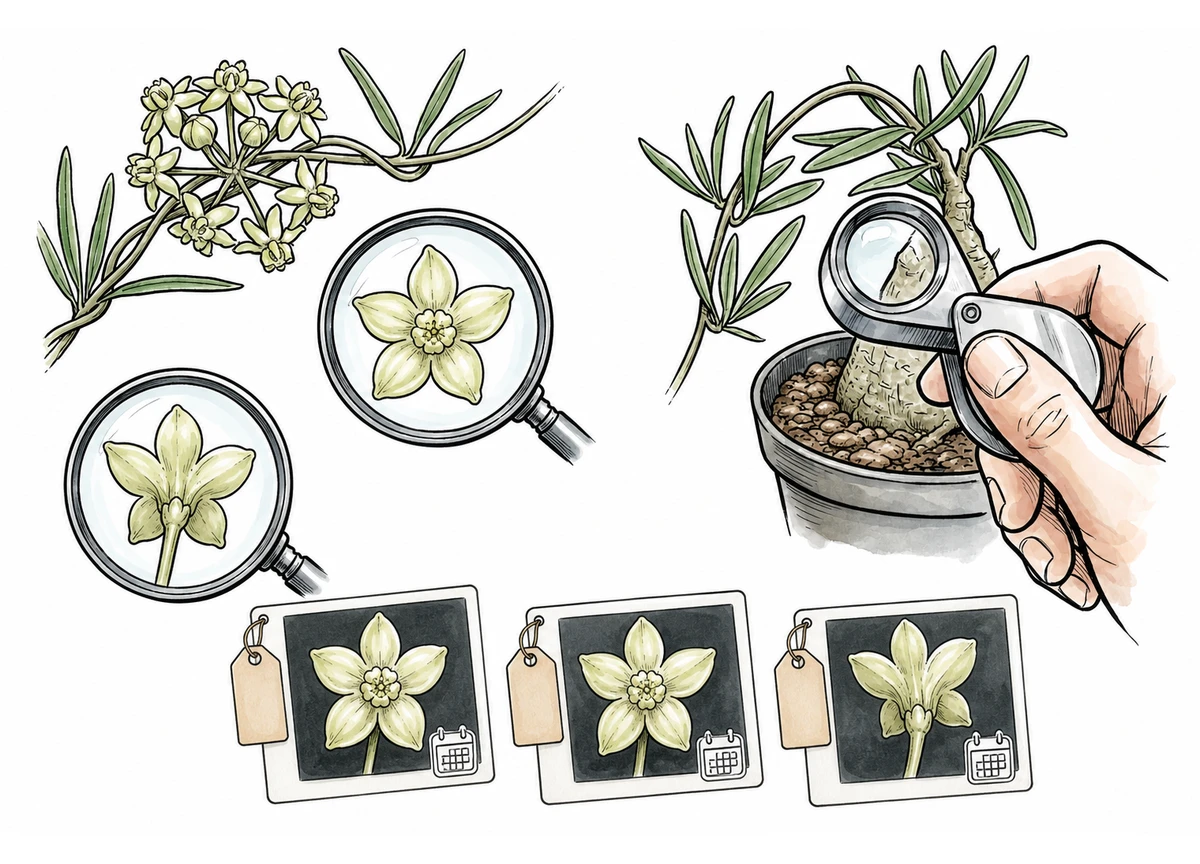
When a fresh flower opens, I photograph its face and base under the same 10x magnification, with the plant identifier and date in frame. I repeat the record for three flowers on separate days without cutting them. The series documents flower condition and timing but does not assign sex.
My label remains unsexed unless the plant has a verified pod history or a traceable propagation record from the seller. A seller claim stays attached to its source instead of becoming an observed fact. This prevents an unsupported flower impression from deciding which partner I buy.
Flower color, size, and a home dissection are not verified sexing keys for this species. A pod remains the only direct home evidence that the plant is female.
How Asclepiad Pollination Works and Why a Paintbrush Fails
Fockea belongs to Apocynaceae subfamily Asclepiadoideae, the milkweed lineage, and milkweeds gave up loose pollen long ago.
The pollen ships as five pairs of solid waxy sacs per flower, called pollinia, each pair joined by a tiny clip. Nothing about this system responds to dusting.
In habitat, small flies do the work. A fly’s leg slips into a guide-rail slit on the flower’s central column, snags the clip, and tears the whole pollinarium free.
At the next flower, the dangling pollinium wedges into another slit and stays there, like a key left in a lock.
That is why the paintbrush trick from Adenium or Pachypodium fails here completely. The receptive stigmatic surfaces hide inside chambers behind the guide rails, physically unreachable by any brush. Pollinating a Fockea means mechanically inserting a pollinium into the stigmatic slit, and nothing less counts.
Family-wide data back up how specialized this is. Most studied Apocynaceae species, 73 percent, depend on a single broad pollinator group, and the milkweed subfamily reconstructs as ancestrally fly-pollinated. Fockea edulis itself is reported as fruit-fly pollinated.
Getting Two Plants to Bloom Together
Owning two plants is necessary but not sufficient. You need a male and a female with open flowers in the same week, and that has two failure points. Wrong sexes, and mismatched bloom windows.
On sexes, the math is unforgiving. Seed batches run close to an even split, so two random unsexed plants match sexes about half the time.
Buy a proven podded female if you can find one, or buy three or four seedlings and let the odds work for you as they mature.
On timing, the species blooms in late summer on established plants, and flowering is uncommon on young, freshly imported, or recently repotted stock.
Individual flowers last only days, so a male that finishes the week before the female opens produces nothing.
If your plants sit on different wake-up schedules, the Fockea dormancy trigger guide explains what actually starts a Fockea’s season.
Once the first bud opens, I count each plant’s open flowers every other day through September. I place the probe halfway between caudex and pot wall at half the medium depth, aligning its cable with a pot-rim mark. Five-minute readings from hours two through eight after lights-on form the seven-day daytime median.
I exclude the first lighted hour because heater and fixture startup can dominate a short record. If overlap stays under seven days for two seasons, I start only the later plant’s warming seven days before its recorded first extending bud. I use its prior active-week median as the setpoint and keep light, pot, feeding, and watering trigger unchanged.
At warming start, I photograph one marked bud or shoot against a millimeter ruler and repeat the photograph on day 14. New water-soaked tissue stops the trial immediately, while less than 1 mm extension returns the thermostat to its normal schedule that day. If growth reaches 1 mm but overlap remains short, I advance warming another seven days the following spring so each season tests one shift.
The Hand-Pollination Workflow
With both sexes blooming, you become the fly. The asclepiad community has refined this into a repeatable bench technique, and it needs three things.
Magnification, a fine-tipped tool to extract, and a fine hook to insert.
Tools and Setup
The standard reference works between 10 and 70x magnification, with most manipulation done near 20x. A 10x loupe on a stand or a cheap USB microscope reaches the useful range at home.
Watchmakers forceps handle extraction, and an insect pin bent into a micro-hook handles insertion.
Brace your hands. Experienced workers steady their wrists on blocks or bean bags, because every useful movement at this scale is a finger movement.
Work in the morning on freshly opened flowers under bright, indirect light.
Extract, Park, Insert
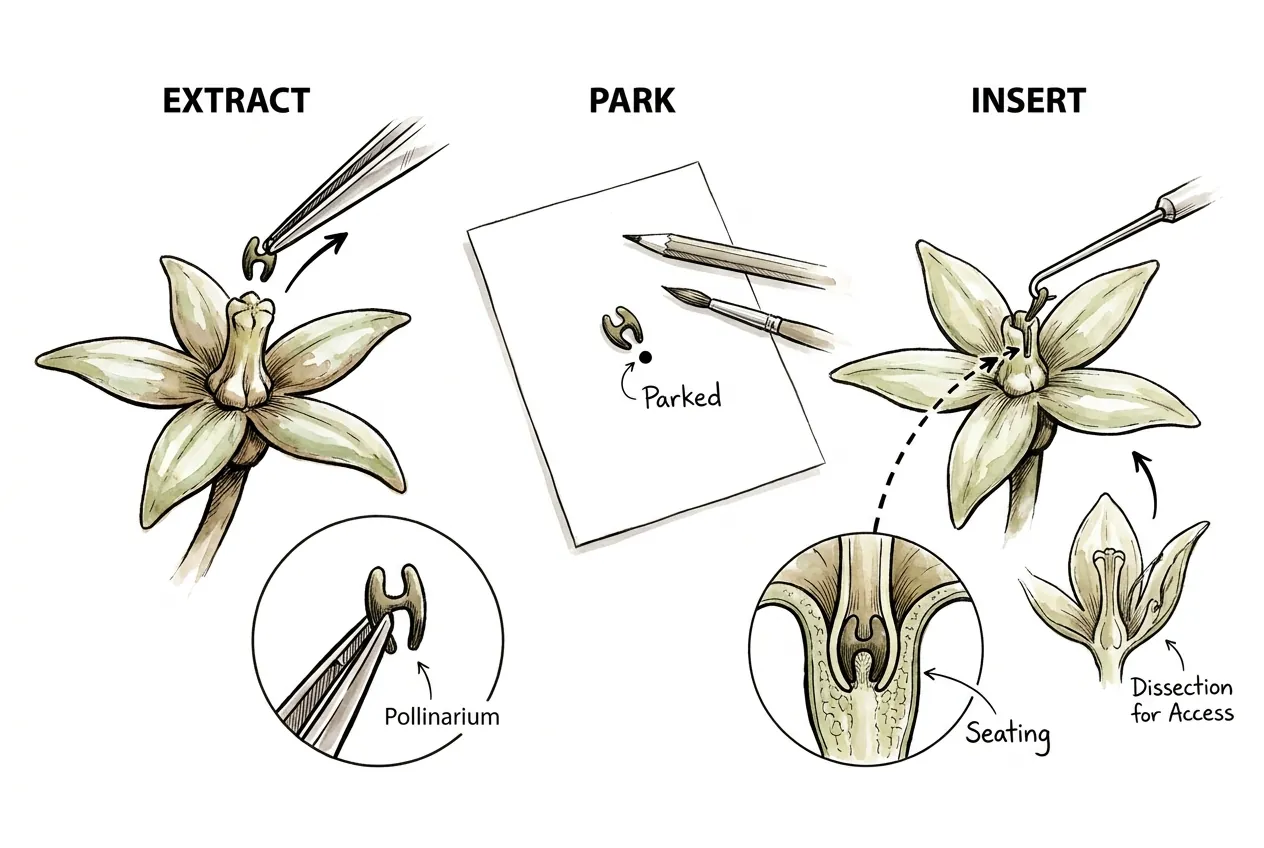
Work in this order.
- On the male flower, slide the forceps tip under the dark clip at the top of the column and lift the whole pollinarium free.
- Park it on a sheet of white paper and mark its position, so you never lose track of which flower it came from.
- On the female flower, find a guide-rail slit on the central column.
- With the hook, draw one pollinium into the slit like a key into a lock, and seat it as deeply as it will go.
Depth matters more than elegance. Shallow insertions are the most common silent failure, so pull the pollinium fully home. If the petals block your angle, dissecting part of them away to expose the column is accepted practice and does not hurt the fruit.
Reading Success Within Days
This method grades itself fast. A successfully inserted pollinium absorbs fluid and swells within 8 to 10 hours, turning from dark and glassy to pale, dull, and cloudy.
If fertilization follows, the petals separate within 2 to 4 days and the sepals close over the beginning follicles.
Expect a low hit rate anyway and let volume work. Milkweed-family breeding studies show fruit set is inherently low and varies strongly between individual plants, even for practiced hands.
Pollinate several flowers per session, tag each attempt with dated thread, and keep attempting across the whole overlap window.
Or Let the Flies Do It
If both plants can summer outdoors, delegation is legitimate. Group the pots so flowers sit within centimeters of each other for the whole overlap window, and let the small flies that find the scent shuttle pollinaria for you.
You give up the per-flower verification, but you gain hundreds of free attempts. In a warm US summer this is the lowest-effort route to a pod, and it is exactly how the species reproduces at home in southern Africa.
Hand work and fly work also stack, so there is no reason to choose only one.
From Pod Set to Seed Harvest
A successful cross announces itself within weeks as one or two horns swell where a flower used to be. Now the risk flips. Asclepiad follicles split along a seam at maturity, and the silk-tufted seeds can blow away in a single windy afternoon.
The Seam Is the Trigger, Not the Calendar
Pods on the same plant ripen independently, so I give each pod an identifier and take its baseline photograph on the day I find it. I repeat the fixed-angle photograph weekly, then daily after the seam pales or the surface loses its baseline color. The first raised seam or color break sends that individual pod into mesh.
Harvest has its own test borrowed from milkweed seed programs. A ripe pod opens at the seam under light finger pressure, and ripe seed inside is brown.
Pale cream seed is immature, so a sealed seam and pale seed both mean wait.
| Signal | Ripe pod | Not yet |
|---|---|---|
| Seam under light pressure | Opens | Stays sealed |
| Seed coat color | Brown | White or cream |
| Action | Harvest now | Keep the mesh bag on |
Bag early rather than precisely. A bagged green pod costs nothing, while an unbagged ripe pod can cost the whole crop.
Mesh, Never Plastic
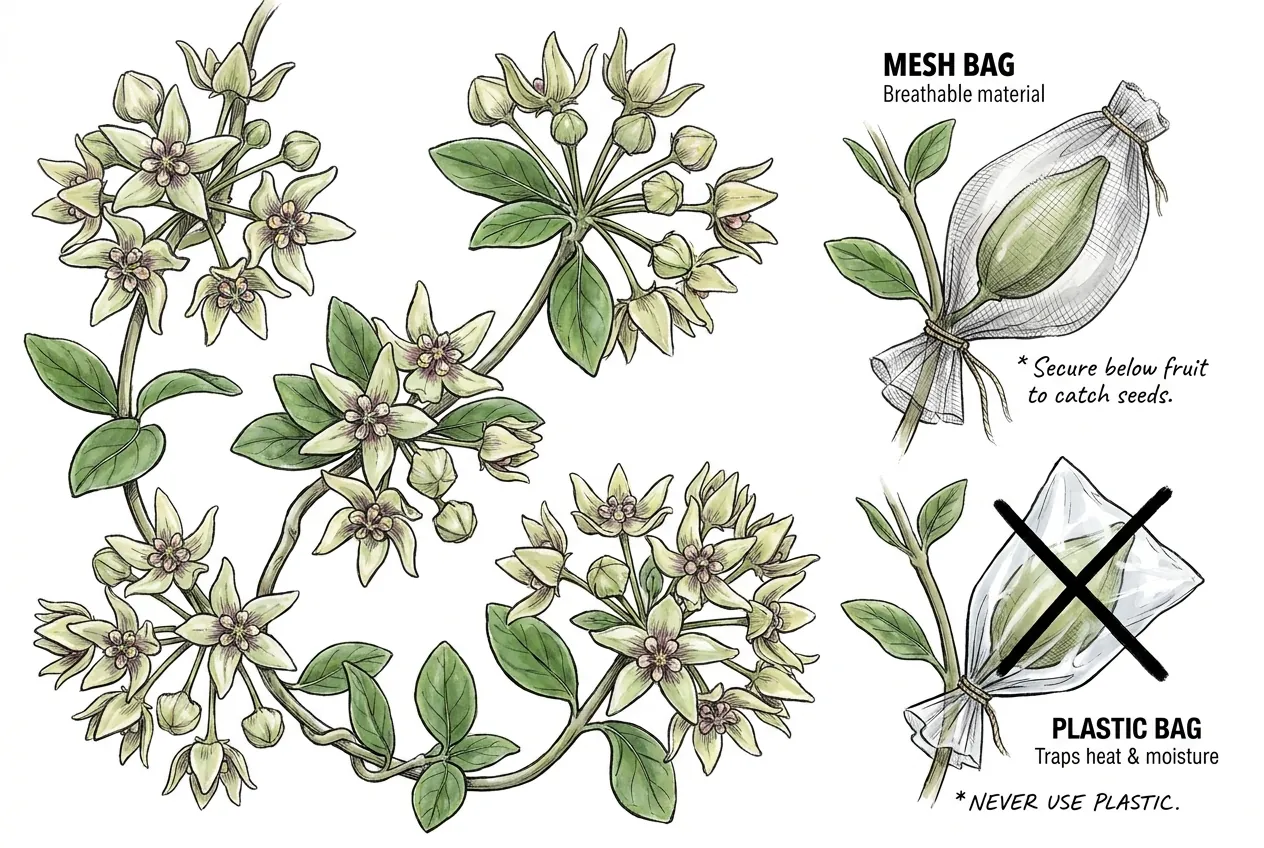
Conservation seed collectors already solved the surprise-split problem. Tie a fine mesh bag around the pod, secured on the stem below it, so a split loses nothing. Stockings, hole-free socks, and organza gift bags all work.
Never use a plastic bag. Plastic traps heat and moisture against the ripening pod and kills the seed you are trying to save.
The same seam-and-bag logic runs through the guide to bagging Adenium seed pods if you want the technique in a different genus.
Clean, Dry, and Store the Spare
Strip the silk at harvest while the seed is contained, working over paper indoors. A paper bag with a few coins, shaken hard, separates seed from floss quickly.
Sow part of the batch fresh and store the rest as insurance. Storage wants completely dry seed in a cool, dark, stable place. Damp seed in a sealed container molds, which repeats the plastic-bag lesson in a jar.
Sowing the Seed You Made
Fresh Fockea seed is the easy part of this whole story. References agree on warm-season sowing in a light, sharply draining mix, kept moderately moist until germination.
No source documents a dormancy-breaking requirement, so skip hormone soaks by default and run a water-only control first if you are curious.
The GA3 test-batch guide covers when a hormone is actually justified.
When you hit the what-do-I-buy moment for heat, dome, and medium, the species-by-species caudex seed germination setup walkthrough handles exactly that decision. Fockea slots into its warm, fresh-sown, non-dormant category.
Set honest expectations on the far side of germination. A documented club grow-off sowed seed in June 2020 and handed back presentable young caudex plants in December 2022, about two and a half growing years later.
Mature plants eventually carry a caudex of 30 to 60 cm, and they want protection once temperatures head toward 10 °C. Seed sprouts in days to weeks, but the caudex you actually want is a multi-year project.
Dead Ends Worth Skipping
Three tempting shortcuts absorb seasons of effort and give nothing back. Cross them off now.
Cuttings are the big one. They are hard to root, and even a rooted one grows as a thin vine, because the caudex is a seedling storage organ built from the sprouting axis.
You cannot cut your way to a second breeding plant worth owning, and you cannot cut your way to a caudex at all.
Self-pollination on one plant is a true zero. There is nothing to self, since the missing sex is developmental, and no credible report of sex-switching exists for Fockea.
Moving pollinaria between flowers on the same plant wastes the bloom, and moving them between two same-sex plants wastes the season, which is why the sexing work comes first.
If a second plant is genuinely off the table, two honest options remain. Commercial Fockea edulis seed is inexpensive and unrestricted, and a small batch of seedlings will almost certainly contain both sexes.
Or find one other grower with a blooming plant and swap fresh flowers during the overlap week, since a pollinarium survives a short trip parked on paper.
The Two-Plant Bottom Line
Keep a plant unsexed unless it has verified pod history or a traceable propagation record.
Close the gap with a proven opposite-sex partner when available, or raise several seedlings and wait for direct evidence.
Next August, run the bench technique or park both pots outside and let the flies commute.
Bag every horn at the first seam change, sow fresh, and accept the multi-year caudex timeline.
The flowers were never the problem, and now they get to be the point.