
Caudex Seedlings First Winter Dormancy: Skip or Rest?
Should caudex seedlings skip their first winter dormancy? Use a 2 cm caliper rule, a 60°F night floor, and 14-hour lights to make the call.
Maya Ellison · 2026-08-30 · 14 min read
Key Takeaways
- Winter rest is optional quiescence for most summer growers, and seedlings can least afford to pay for it.
- Measure at the soil line. Under 2 cm, grow through winter. At 2 cm plus a full season, rest is survivable.
- A grow-through needs 14 lit hours, a verified 60°F overnight floor, and top-inch watering.
- Route by species first. Dioscorea, Tylecodon, and Othonna grow in winter and must be watered.
- Re-measure monthly. No confirmed 1 mm gain and no new leaf for 8 weeks means stop forcing and idle until spring.
Most first-year caudex seedlings should skip their first winter dormancy. The exceptions are decided by a ruler, not a calendar. A summer-growing caudex seedling under 2 cm across at the soil line stays warm, lit, and growing through winter.
Small plants cannot afford a dry rest, and the reasons are measurable. Late August and September are exactly when this decision gets made. Night temperatures start sliding, and whatever you set up now becomes the seedling’s whole winter.
Why the First Winter Is a Different Question for Seedlings
Adult caudex plants shrug off a dry winter because rest is cheap for them. For a seedling the same rest is an expensive gamble. The difference is physiology, not sentiment.
Winter rest is optional quiescence for most caudex species
For most summer-growing caudiciforms, winter rest is not a biological requirement. Physiologists call true dormancy an entrained state that ignores good conditions until it is cued back out.
Quiescence simply lifts when the constraint lifts, and most caudex shutdowns behave like quiescence.
The triggers are external and controllable. Shortening days terminate growth in many perennials, and falling night temperature modifies or replaces that signal.
For Adenium, growers document shutdown when nights regularly fall below about 50°F.
The Tucson Cactus and Succulent Society notes that seedlings of most taxa keep growing through their first winter, sometimes a second, before obligate dormancy appears.
Keep the room warm, the light long, and the soil lightly watered, and a young summer grower never receives the shutdown memo.
You are not fighting the plant, only declining to send the signal.
A small caudex cannot bankroll a dry rest
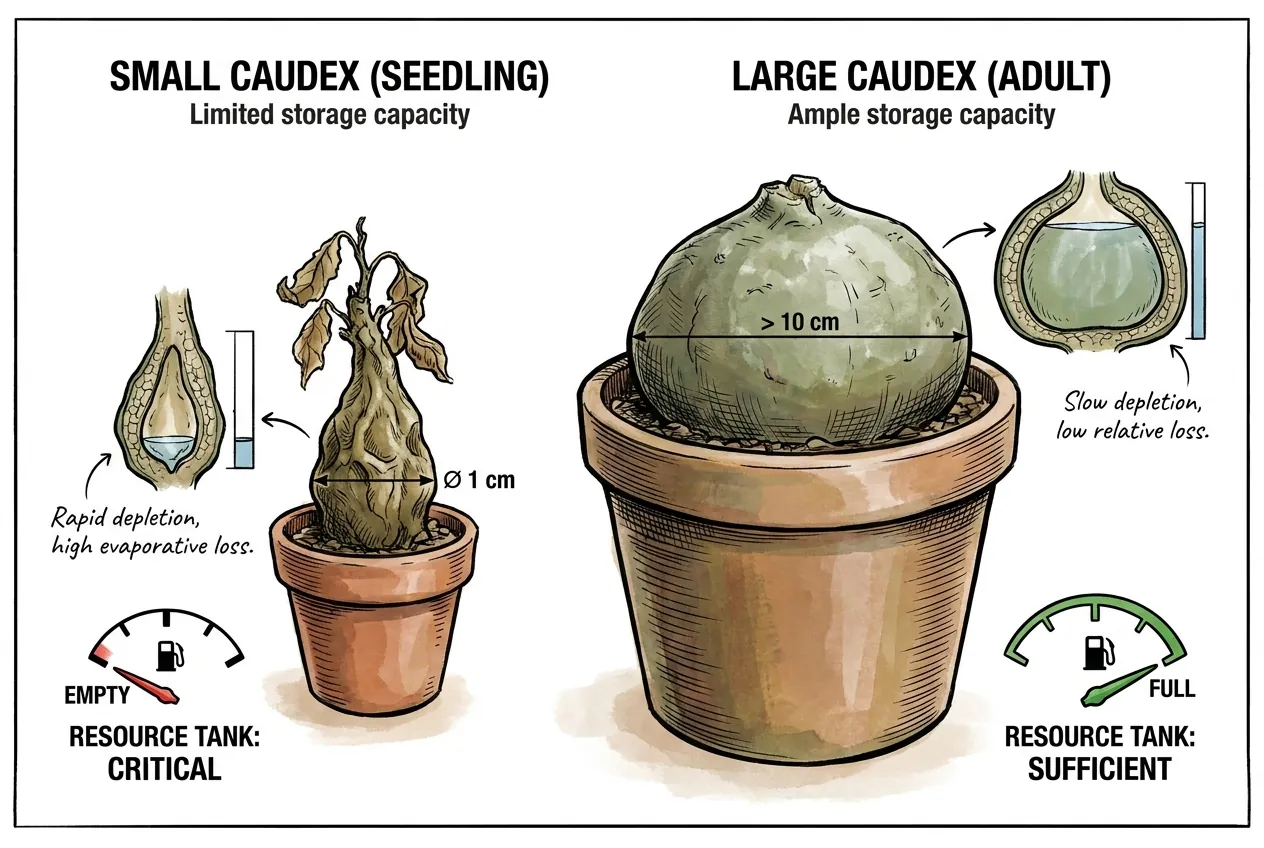
A resting plant pays its bills from storage. It burns nonstructural carbohydrates to respire and draws on stored water to stay hydrated while the roots sit dry.
In a controlled study of tree seedlings, combined shade and drought burned through 22 to 60 percent of stored carbohydrates in just seven weeks.
The water side is worse, because it scales against the small plant. Storage volume grows with the cube of caudex diameter while evaporative surface grows only with the square.
Mauseth’s classic analysis of succulent shoots concludes that high water storage with low relative loss comes primarily from being large, and narrow stems stay restricted to moister conditions.
A 1 cm caudex entering a winter-long dry rest runs adult physiology on a fraction of the adult tank. Even conservative dormancy care sheets quietly concede the point.
They tell you to keep resting adeniums bone dry, then carve out a monthly-watering exception for small pots.
The Size-Based Call in One Measurement
The whole decision compresses into one number you can read off a caliper in ten seconds. Everything else is either justification or execution.
The 2 cm caliper rule at the soil line
Every autumn I measure each seedling along a marked soil-line axis with digital calipers and write the diameter on its pot tag. Below 2 cm, I route a summer grower to the winter grow-through. Reaching 2 cm after one full season only removes my size veto because the species and its current growth state still decide whether rest is appropriate.
The 2 cm figure is my conservative operating rule because no published source provides a first-dormancy diameter cutoff. Storage rises roughly with the cube of diameter while surface area rises with the square. A 2 cm body therefore has about eight times the volume of a 1 cm body against about four times the surface.
The one-season condition matters as much as the number. Specialist Adenium schedules only relax night-temperature floors after the first year, which tells you tolerance is earned by stored mass and root establishment together.
How fast different species reach the gate
Species reach 2 cm on wildly different schedules, which is exactly why measuring beats birthday-counting. A well-fed Adenium can clear the gate in its first season. In a published media trial, Adenium obesum seedlings averaged a 2.32 cm caudex in the best substrate within the trial period.
Slow species need years. The South African National Biodiversity Institute puts a Dioscorea elephantipes caudex at roughly 10 mm after year one and 120 mm only after five years. A Pachypodium or Operculicarya seedling typically lands somewhere between those extremes.
The first winter also overlaps the fastest relative growth a summer grower will ever show. American Adenium’s seedling timeline reports the caudex can double or triple in size between months six and twelve.
For a spring sowing, that surge lands squarely in November through March, and a forced rest forfeits it.
Route by Species Before You Route by Size
The caliper rule only applies to summer growers. Some caudex species refuse the skip, and a whole second group is winter-growing, which flips the entire question upside down.
The routing table for common caudex seedlings
Check your species against its actual seasonal program before applying any size rule. Adenium obesum and Adenium swazicum lack obligate dormancy entirely, while Adenium somalense and its hybrids demand bone-dry winters regardless of your thermostat.
A plant that yellows and drops leaves despite warmth and long light has voted for rest, and you supply a dry idle instead of arguing.
| Species group | Seasonal program | First-winter call for a small seedling |
|---|---|---|
| Adenium obesum, A. swazicum | Summer grower, no obligate rest | Skip. Grow through warm and lit |
| Adenium arabicum, A. somalense | Summer grower, strong rest tendency | Follow the plant. Dry idle once leaves drop |
| Pachypodium (Madagascar summer species) | Summer grower | Skip year one. Rest after visible caudex and a full cycle |
| Operculicarya, Fockea | Summer grower, often semi-evergreen indoors | Gentle skip works well |
| Cyphostemma | Summer grower, strong internal leaf-drop clock | Do not force. Idle when it defoliates |
| Dioscorea elephantipes | Winter grower | No skip question. Winter is its season, water it |
| Tylecodon, Othonna | Winter growers | Same inversion. Winter is the growing season |
The winter growers are the trap that catches beginners. A Dioscorea elephantipes seedling dried off in December is being drought-stressed in the middle of its natural growing season, the equivalent of drying an Adenium in June.
SANBI notes the adult rests in summer, and watering it during that rest can cut its lifespan in half, so the calendar inversion runs both directions.
What Skipping Actually Requires
Declining dormancy is a commitment to three conditions held all winter. Light that resembles a growing season, warmth that never dips into shutdown territory, and water matched to a plant that is actually growing.
Give fourteen hours of light with real intensity
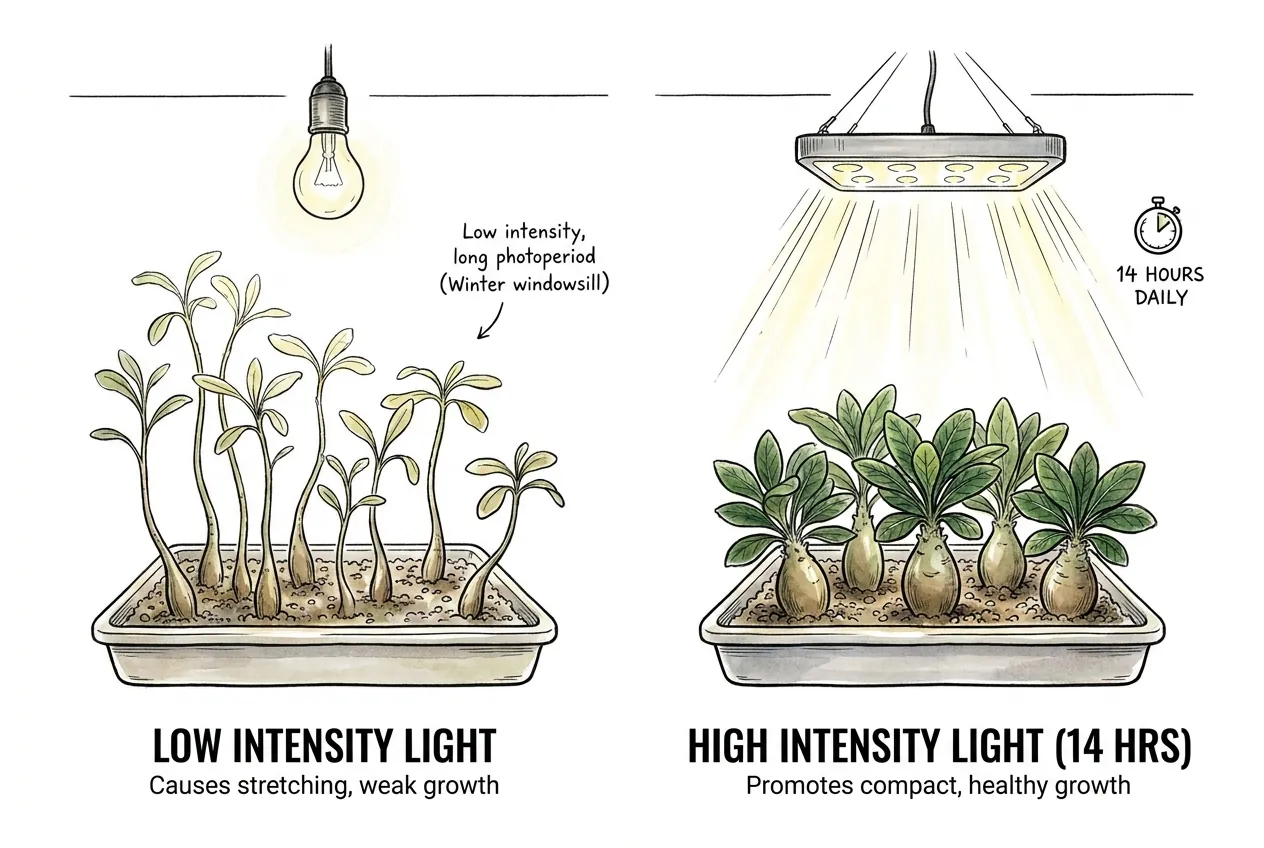
A 14-hour timer is a practical starting point within Iowa State Extension’s 12-to-14-hour range for supplemental light. In Michigan State trials run at a daily light integral of 23 mol, Echeveria grew 8.7 inches wide under 16-hour days versus 6.8 inches under 9-hour days.
Intensity is where windowsill winters fail. Indoor light in winter is very low, and a long photoperiod at feeble intensity produces stretch, not growth.
If your fixture cannot make seedlings visibly compact, fix the light before committing to a grow-through.
The full selection math lives in our guide to grow lights for caudex plants.
Verify the overnight minimum at shelf level
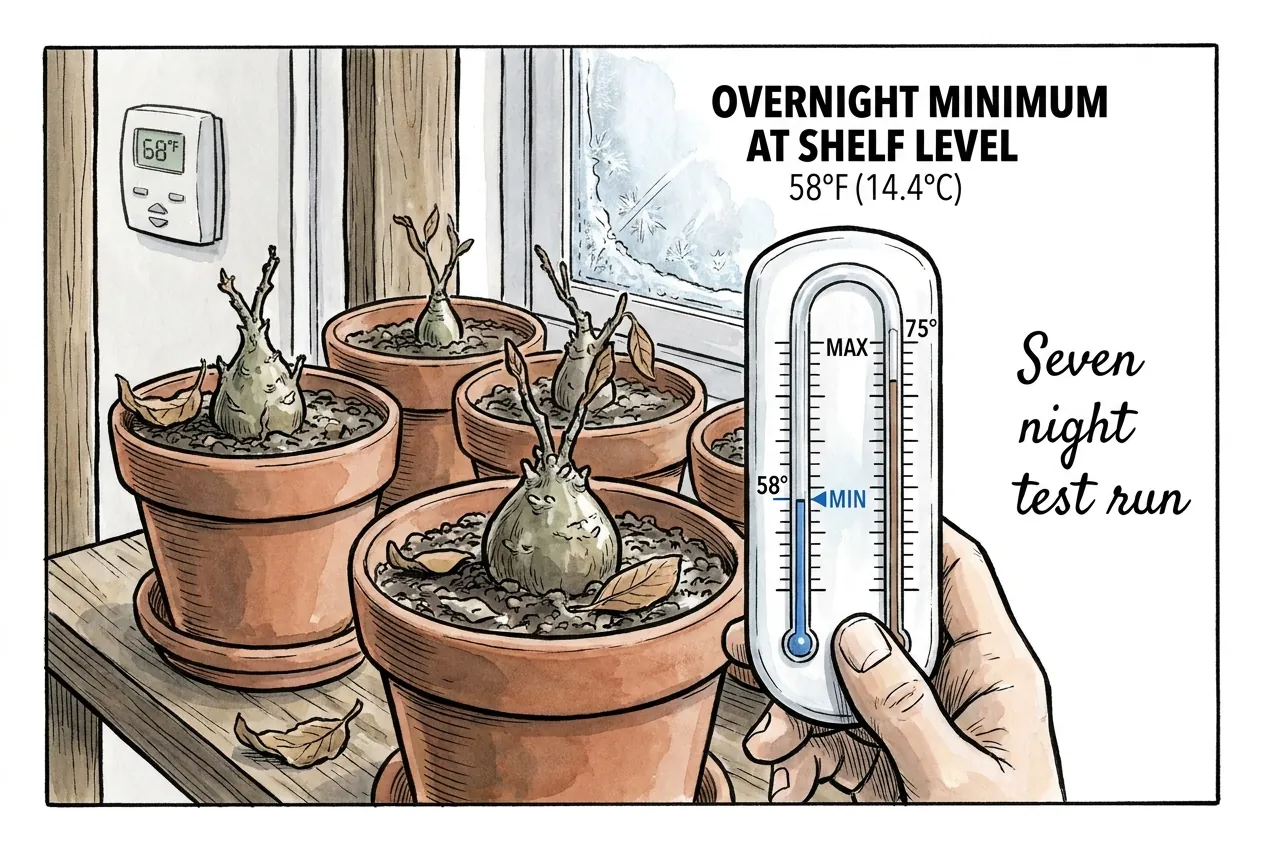
The number that ends grow-throughs is the overnight minimum at the shelf, not the thermostat reading.
A rack near a window can run well below the room while you sleep.
Specialist seedling guidance wants nights no cooler than 65°F in the first six months, with brief dips to 60°F tolerable after that.
Mature non-obligate adeniums get watered through winter at 50°F nights only when days hit 80°F.
Before I commit my seedlings each autumn, a min-max thermometer sits at pot height on the winter shelf for seven straight nights with lights and heat on their planned schedule. Each morning I read the minimum and reset it. If any night logs below 60°F, the spot gets fixed or that tray takes the rest path instead.
The 60°F floor is my rule, set at the edge specialist schedules treat as brief-exposure territory.
It leaves margin above the temperatures where cold, wet media start killing roots. For safe ways to hold a shelf above the floor, see the caudex winter warmth setup guide.
Water by the top inch, not the calendar
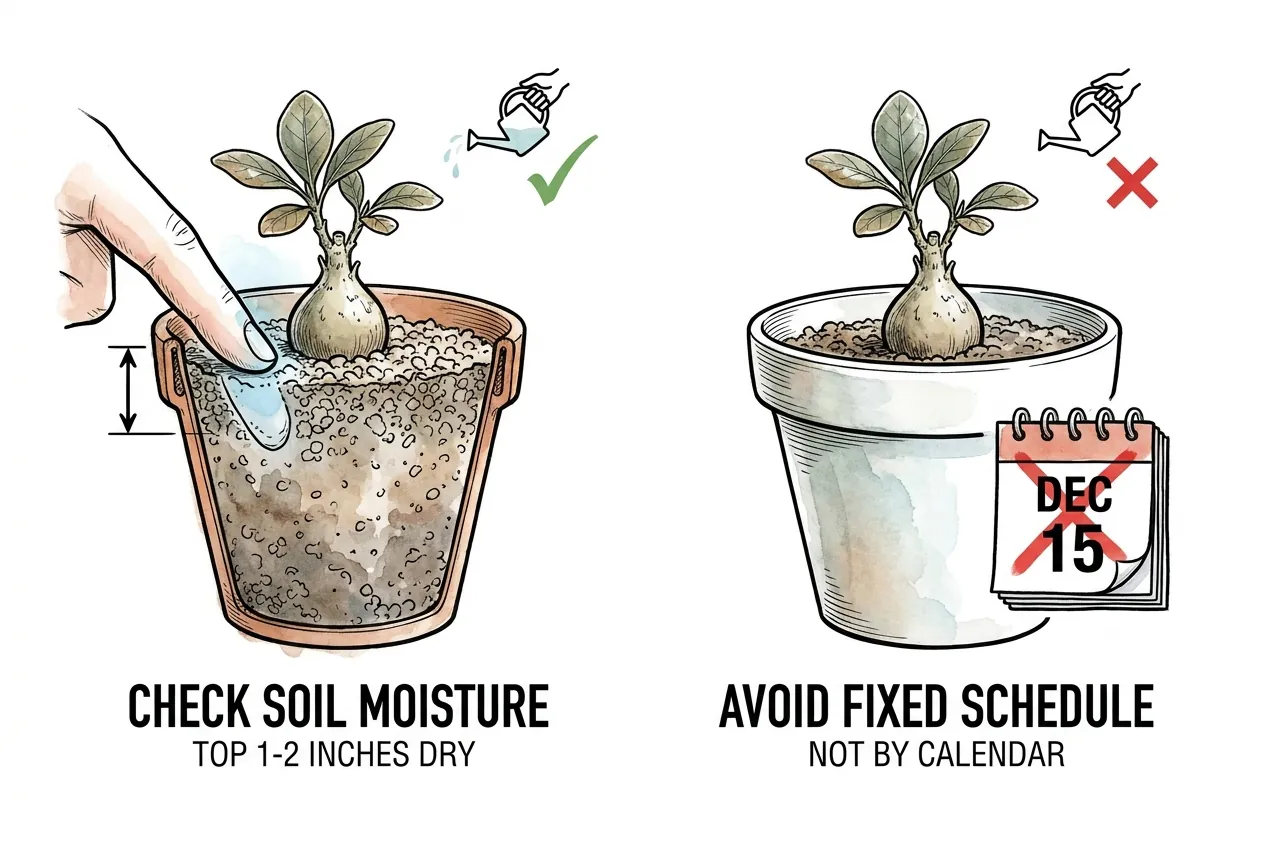
An actively growing seedling in a heated winter room dries far slower than it did in July, so summer cadence will drown it. Water when the top inch of medium has dried. Colorado State Extension makes the same interval do pest control, since letting the top 1 to 2 inches dry between waterings is the primary control for fungus gnats.
If warmth or light fails mid-winter, do not keep watering like it is August. Drop to the sparse idle specialist growers use for cool-held plants, a light drink every two to three weeks above 60°F. That holds reserves without stacking cold and wet.
The Honest Risk Ledger of a Grow-Through
Skipping dormancy trades one risk set for another. The forced-rest risk is physics, while the grow-through risks are management.
Warm and dark is the worst combination
Heat without light is how growers manufacture ugly plants. Dim indoor light is enriched in far-red, and phytochrome signaling reads that ratio as shade and orders internodes to stretch.
In controlled work on dicots, a single week of far-red enrichment measurably elongated stems across five species.
A warm seedling under weak light burns energy building tall soft tissue with no caudex payoff.
Michigan State’s succulent lighting work warns specifically that low-intensity fixtures containing far-red drive excessive stem elongation.
If you cannot supply intensity, a cooler and slower winter beats a warm dark one.
Wet trays breed gnats, damping-off, and cold rot
Continuously moist warm media is an incubator. Damping-off pathogens including Pythium, Thielaviopsis, and Acremonium favor damp media, overcrowding, and overwatering, and announce themselves as a water-soaked lesion at the soil line followed by collapse.
Fungus gnat females seek the same wet peaty surface to lay eggs.
The third failure mode is thermal. Adeniums rot readily when their media is wet in the 40s°F, so one cold snap on a freshly watered tray can end the project overnight. This is why the thermometer audit precedes the watering can.
The countermeasures are already in the setup. Let the surface cycle dry, space the pots, and keep the shelf above the verified floor.
If the Rest Path Wins, Run It Like a Small-Pot Rest
Sometimes the answer is rest anyway. The species demands it, the shelf audit fails, or the plant defoliates on its own schedule.
A small plant can survive rest, but only the small-pot version of it.
Running the rest without killing a small plant
Cool, dry, and dim is the program, with one seedling-specific amendment. Dormant plants in small pots still get watered about monthly, while large specimens can go all winter with nothing.
Give that monthly drink in the morning of a warmer day and keep it small.
Between drinks, read the caudex instead of the calendar. Dormancy guides advise watering a resting Adenium only when the caudex starts to feel slightly soft or shows faint shriveling.
A firm caudex is a plant still paying its bills from storage, and firmness is the whole scoreboard during rest.
One hard boundary remains. A plant held at or below 50°F must stay bone dry, because wet media in that cold range rots roots. If softness appears and you are unsure whether you are reading rot or normal dormancy shrink, work through the soft caudex firmness map before you water or cut.
Prove the Grow-Through Is Working, Then Exit Gracefully
A grow-through is a claim that the plant is gaining. Claims get audited. The same calipers that made the autumn call also verify the winter is paying for itself, and they tell you when to stop.
The pot-tag re-measure that catches a stall
At the autumn baseline, I record the marked-axis diameter and whole-pot mass immediately before watering. Each month I remeasure only when the pot returns within 2% of its latest prewatering mass. A removed leaf, shifted stake, or changed label receives a tare note before the next comparison.
I count diameter growth only when readings seven days apart are both at least 1 mm above the autumn baseline. One millimeter equals 5% of the 2 cm gate, making placement drift less likely to masquerade as growth. A newly expanded leaf remains a separate signal.
No confirmed 1 mm gain and no new fully expanded leaf for eight weeks ends my grow-through attempt. This stop rule applies only after nights stayed above 60°F and the plant received 14 lit hours. It prevents an idling seedling from being watered like an actively growing one.
Staging the first real dormancy in a later year
Once a plant clears 2 cm and a full season, give it its first real rest by sending the natural cues in their natural order.
Stop fertilizing in early autumn, stop extending the photoperiod, and let nights settle into the low 60s°F.
Then stretch watering intervals until the leaves yellow and drop on their own.
This sequence works because shortening days and cooling nights are the same signals that trigger growth cessation in perennials generally.
The plant closes down its own foliage and water losses before the dry period arrives. You are conducting, not amputating.
Through the rest, apply the small-pot rules from the previous section, then resume watering when spring growth shows, typically around early April.
Our autumn watering break point guide covers the soil-temperature side of that taper for the whole collection.
One Caliper Reading, One Thermometer Week
The decision in front of you this autumn is one measurement and one thermometer week. Take the caliper reading, audit the shelf, and let those two numbers, not the calendar, choose your seedling’s first winter.