
Sago Palm Fertilizer: Fix Frizzle Top or Yellow Fronds
Sago palm fertilizer by symptom: manganese sulfate for frizzle top, potassium plus magnesium for yellow old fronds, and a soil pH test before you buy.
Maya Ellison · 2026-11-05 · 22 min read
Key Takeaways
- Frizzled new fronds point to manganese. Yellowing on the oldest fronds points to potassium or magnesium.
- A sago is a cycad, but UF/IFAS says it shares palm nutrient needs, so palm fertilizer with manganese fits.
- Look for 8-2-12-4Mg with slow-release potassium and magnesium plus sulfate manganese, spread evenly.
- Test soil pH before more manganese. Lockout becomes likely above 7.0, and a capsule kit can blur that line.
- Damaged fronds never re-green. For frizzle top, tag the youngest damaged frond and judge only the next flush.
The right sago palm fertilizer depends on which fronds look wrong. Small, twisted, yellow-to-brown new fronds point to manganese, while yellowing that starts on the oldest fronds points to potassium or magnesium.
A slow-release palm fertilizer covers all three over the long run, and a soil pH test shows whether the soil is locking manganese away.
The short answer by symptom
Start with where the damage sits on the plant, then buy for that cause. The table covers landscape sagos in the US South and potted sagos anywhere.
| What you see | Where it shows | Likely cause | Product class to buy | Check first |
|---|---|---|---|---|
| Small, twisted fronds with yellow or brown streaks | Newest flush | Manganese shortage or lockout | Palm fertilizer with manganese, plus manganese sulfate in the ground | Soil pH, drainage, recent transplanting |
| Yellow bands along the edges, green center, no dead tissue | Oldest fronds | Magnesium shortage | Palm fertilizer, plus magnesium sulfate if severe | Age of the potting mix in pots |
| Translucent yellow-orange spots and dead leaflet tips | Oldest fronds | Potassium shortage | Slow-release palm fertilizer, plus a potassium-magnesium mineral in pots | Lawn fertilizer inside the root zone |
| White crust on frond undersides with yellow blotches | Any frond | Cycad aulacaspis scale | No fertilizer | Scale check |
| Even browning on exposed upper fronds after frost | Upper fronds | Cold injury | Nothing | Whether the next flush is normal |
Buy for the fronds that show the damage, because manganese problems appear on new growth and potassium or magnesium problems appear on old growth.
Why new fronds and old fronds fail for different reasons
Two physical facts drive every purchase. One nutrient stays where it lands, and two others move toward new growth when supplies run short.
A cycad that feeds like a palm
Sago palm, Cycas revoluta, is a cone-bearing cycad, while palms are flowering plants, so it is not a palm in the botanical sense.
UF/IFAS states that sago palms share similar nutrient requirements with true palms. That is why palm fertilizer containing manganese is a popular choice for sagos.
A 2020 review found leaf element data for only 46 of 358 described cycad species, and magnesium was the least studied macronutrient.
Palm thresholds guide the decision, but where the symptom sits is more reliable than a borrowed leaf number.
UF/IFAS also warns that every part of a sago contains neurotoxins that can paralyze or kill animals and people who eat it. Keep pets away from the plant, and pick up fallen seeds.
Manganese stays put, so frizzle top hits the newest flush
Manganese moves very little inside a plant and does not shift from older leaves into young ones.
A frond that unfolds during a shortage stays deformed for life. Only the next flush, the next set of fronds to open together from the crown, can show whether a fix worked.
Soil chemistry decides how much manganese the roots can reach. Soluble manganese turns into unavailable oxides quickly in sandy alkaline soil, and UF/IFAS lists high soil pH as a direct cause of palm frizzletop.
Where manganese is already marginal, cold soil can also cause a temporary shortage by slowing root activity.
Frizzle top can be a lockout or root problem, so a pH test and a drainage check belong before the second bag of manganese.
Potassium and magnesium move, so old fronds yellow first
Potassium and magnesium are mobile, so a plant running short pulls them out of its oldest fronds to feed new ones.
That is why both shortages start on the oldest ring of fronds. UF/IFAS adds about one-third as much magnesium when it treats potassium shortage, because a high potassium-to-magnesium ratio can cause magnesium shortage.
Read the frond before you buy
Work from the newest flush outward, then check the undersides and the soil.
Frizzle top on the newest flush
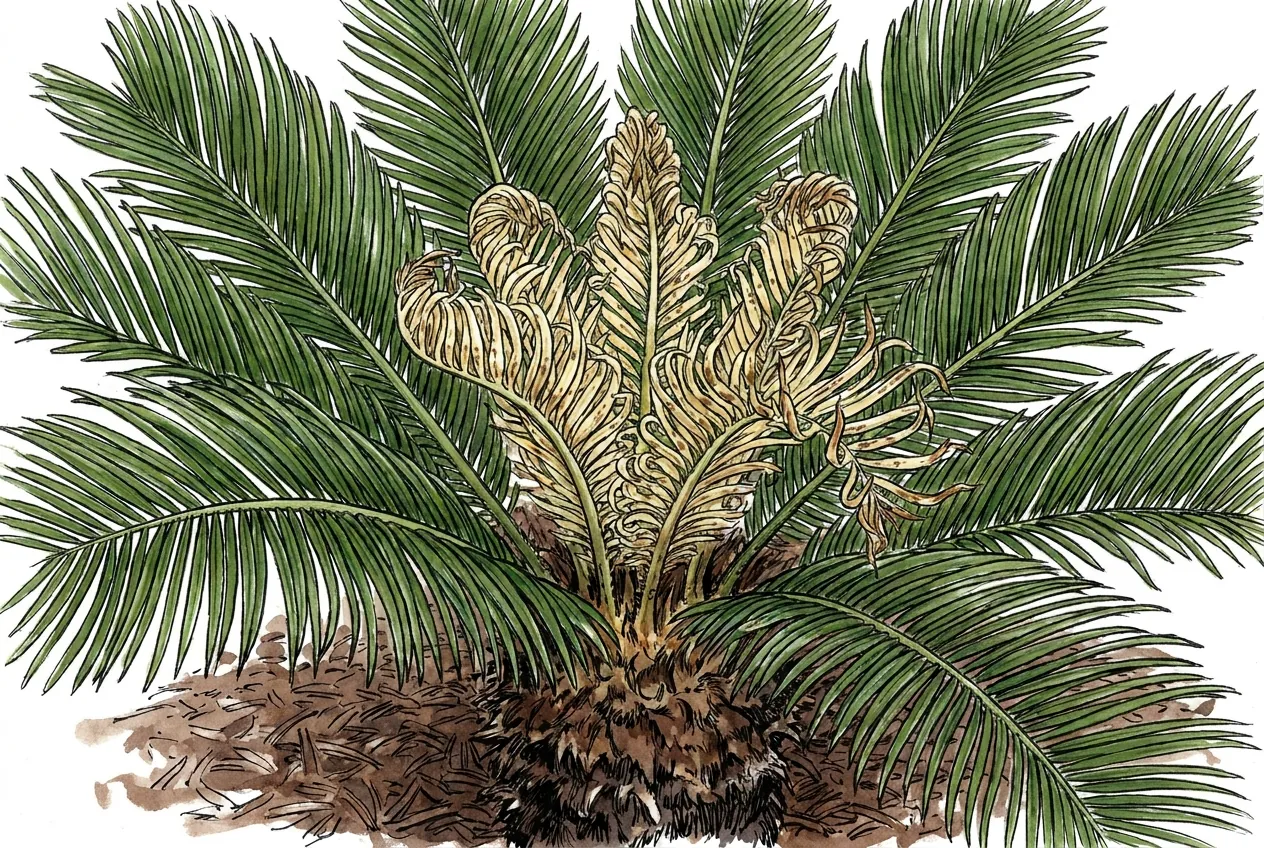
UF/IFAS describes early manganese shortage on sago as yellow or brown spots and streaks that resemble a disease.
New fronds come out small and distorted, then turn from yellow to brown. Severe cases can discolor the whole top half of the plant.
Full-size green fronds below a frizzled flush fit this pattern, because the damage only shows in growth made after supply failed.
Epsom salt will not help here, since it is magnesium sulfate rather than manganese sulfate.
Yellow bands or spots on the oldest fronds
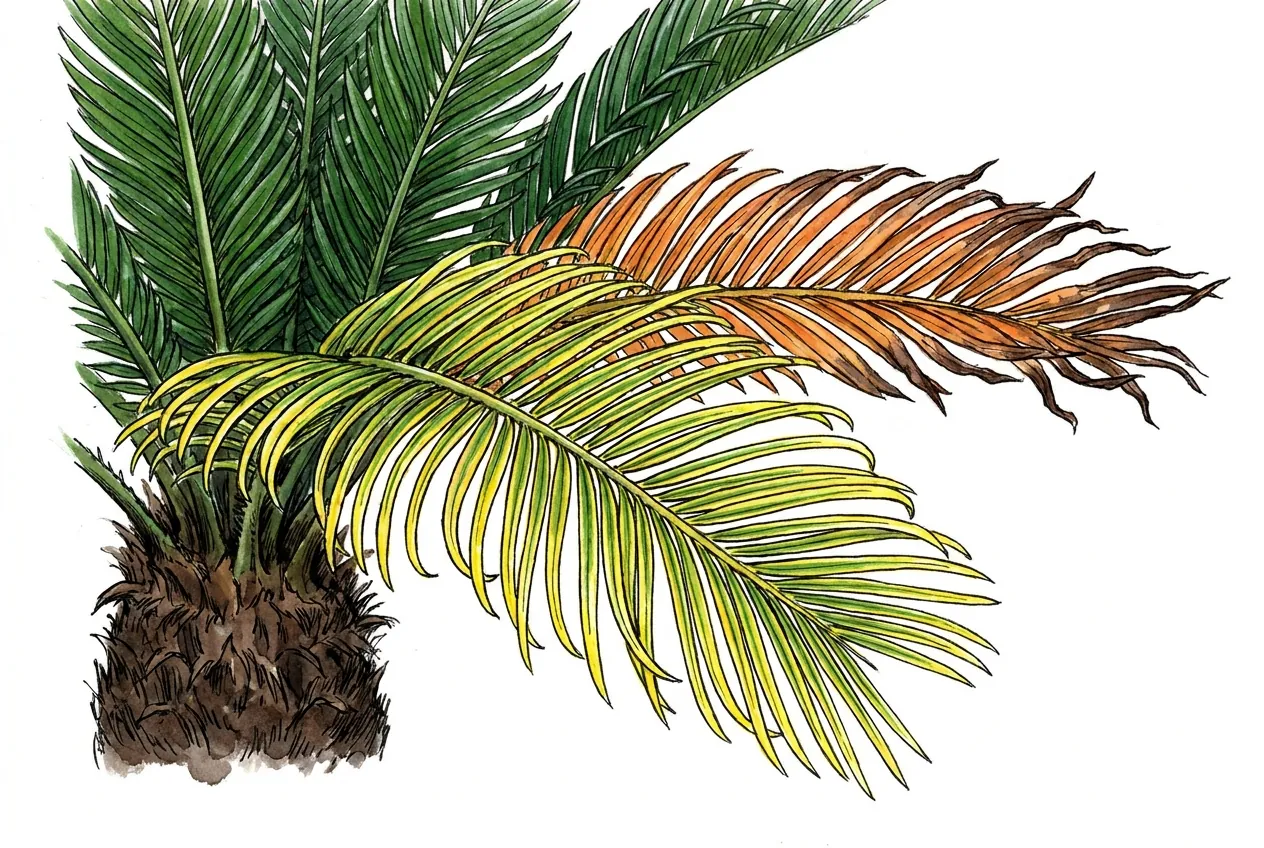
Magnesium shortage shows as broad yellow bands along the edges of the oldest fronds, with a green center and no dead tissue.
A UF/IFAS county office diagnoses that look on sago as magnesium shortage.
Potassium shortage looks different. It starts as translucent yellow-orange spots on the old fronds, which usually turn orange to bronze with dead leaflet tips, worse toward each frond’s tip. Both patterns can show up on one plant.
Look-alikes that no fertilizer fixes
White, waxy specks on frond undersides and leaf stalks, with yellow blotches above them, point to cycad aulacaspis scale.
Sago is highly susceptible, and the scale can also live on the roots. Run the one-bump check for scale vs corking before you buy any fertilizer.
Cold injury browns sections of the upper fronds evenly after a frost, and the next flush usually comes out clean.
Root trouble is the third look-alike, since root rot, poor drainage, over- or under-watering and recent transplanting can all produce manganese symptoms.
If the pot or bed stays wet through cool weather, read about cold wet soil and caudex root rot before adding nutrients.
Selection criteria for each product class
UF/IFAS research defines a working palm fertilizer, and the label’s analysis and derived-from list are where to check a bag.
| Product class | Spec to look for | Why it matters | Where to check |
|---|---|---|---|
| Palm fertilizer | 8-2-12-4Mg or 8-0-12-4Mg with about 2% manganese | Matches the potassium and magnesium demand of palms | Analysis on the bag front |
| Palm fertilizer | All nitrogen, potassium and magnesium in slow or controlled release | Soluble parts leach first and skew the ratios | Derived-from list |
| Palm fertilizer | Manganese as a sulfate, not an oxide | Oxides barely dissolve in neutral to alkaline soil | Derived-from list |
| Manganese corrective | Manganese sulfate, with the manganese percentage stated | The manganese form UF/IFAS recommends | Guaranteed analysis |
| Potassium-magnesium corrective | Both potash and magnesium listed, sulfate form, low chloride | Potassium alone pushes magnesium down | Guaranteed analysis |
| pH test | Reads clearly on both sides of neutral | Manganese lockout rises as soil turns alkaline | Range and resolution |
Labels can mislead, because a coated source can still be reported as water soluble. Look for sulfur-coated potassium sulfate and kieserite, a slow-dissolving magnesium sulfate, in the derived-from list. Avoid any palm product built on sewage sludge, which can induce severe manganese shortage.
A bag with the right numbers but soluble potassium can leave a palm more potassium-deficient than it was before feeding.
The base program with a slow-release palm fertilizer
The base fertilizer prevents deficiencies and corrects mild to moderate ones. For south Florida landscapes, UF/IFAS suggests up to 1.5 lb of an 8-2-12-4Mg per 100 square feet of canopy every three months. Central and north Florida plants may need less.
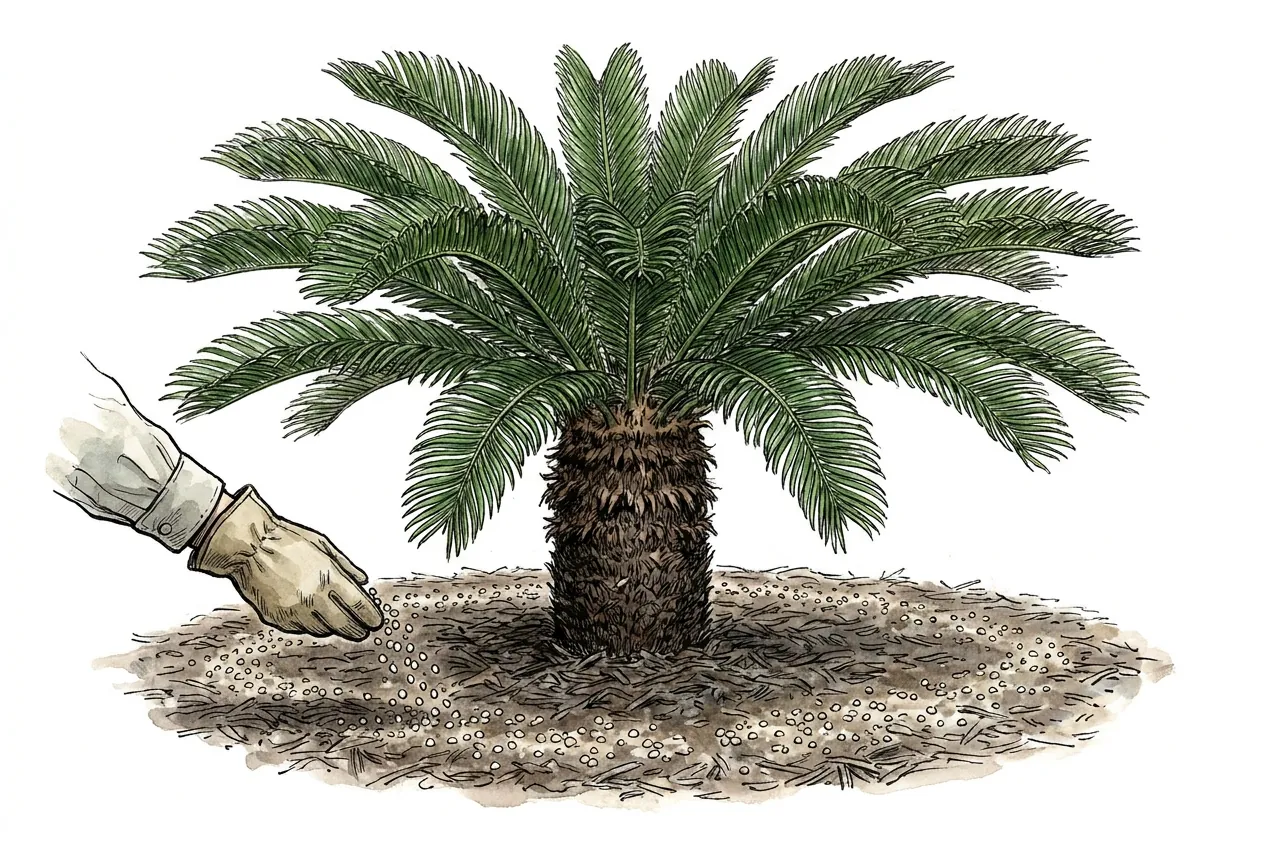
Spread it evenly under the whole canopy. Nutrients move mostly downward, so holes, spikes and bands at the trunk reach only a small share of the roots.
High-nitrogen lawn fertilizer has killed palms through induced potassium shortage from 30 feet away.
Online, Miracle-Gro Shake ’N Feed Palm Food is the widely stocked bag with the same 8-2-12 numbers.
Scotts lists it with magnesium, iron and manganese, for palms and cycads in the ground or in containers.
It feeds for up to 3 months at about 1 tablespoon per square foot of canopy.
Work it into the top 1 to 3 inches and water it in.
The public product page gives no magnesium percentage, manganese source or coating details, so the slow-release and sulfate rules above cannot be checked.
The bag also contains added compost of unstated type, and UF/IFAS advises keeping composted sludge and manure products away from palms in its manganese guidance.
It is the easier fit for outdoor potted sagos, since Scotts lists container use. A Florida owner on sand who can find a local bag listing sulfur-coated potassium sulfate and kieserite should buy that bag instead.
Manganese sulfate for frizzle top
Manganese sulfate is the manganese source UF/IFAS recommends for palms. UF/IFAS soil rates start at 8 oz for a small palm or one on acid sand, broadcast under the canopy.
Hi-Yield Manganese Sulfate carries 31% manganese and 17% sulfur in water-soluble granules labelled for palm frizzle top.
A landscape sago takes the label’s palm rate, not its per-area bed rate, so a small sago starts at ½ lb. That matches the 8 oz UF/IFAS starting rate.
Severe frizzle top can get the label’s repeat every 2 to 3 months, since recovery may not show until after the second dose.
A visible response can take 3 to 6 months, so a mild case waits for the flush check below.
The label gives no container rate, so never put the per-palm amount in a pot. Fix drainage and pH first, then rely on a palm fertilizer that lists manganese and container use.
Hi-Yield granules stain concrete, and too much manganese induces iron shortage with pale new fronds. The label calls for protective gloves, clothing and eye protection, warns against breathing it in, and says to keep it out of reach of children.
On alkaline soil, UF/IFAS adds a manganese sulfate foliar spray as a short-term supplement to soil feeding.
Hi-Yield lists soil rates only, so spray only a product whose label gives a foliar rate.
Judge the fix on the next flush
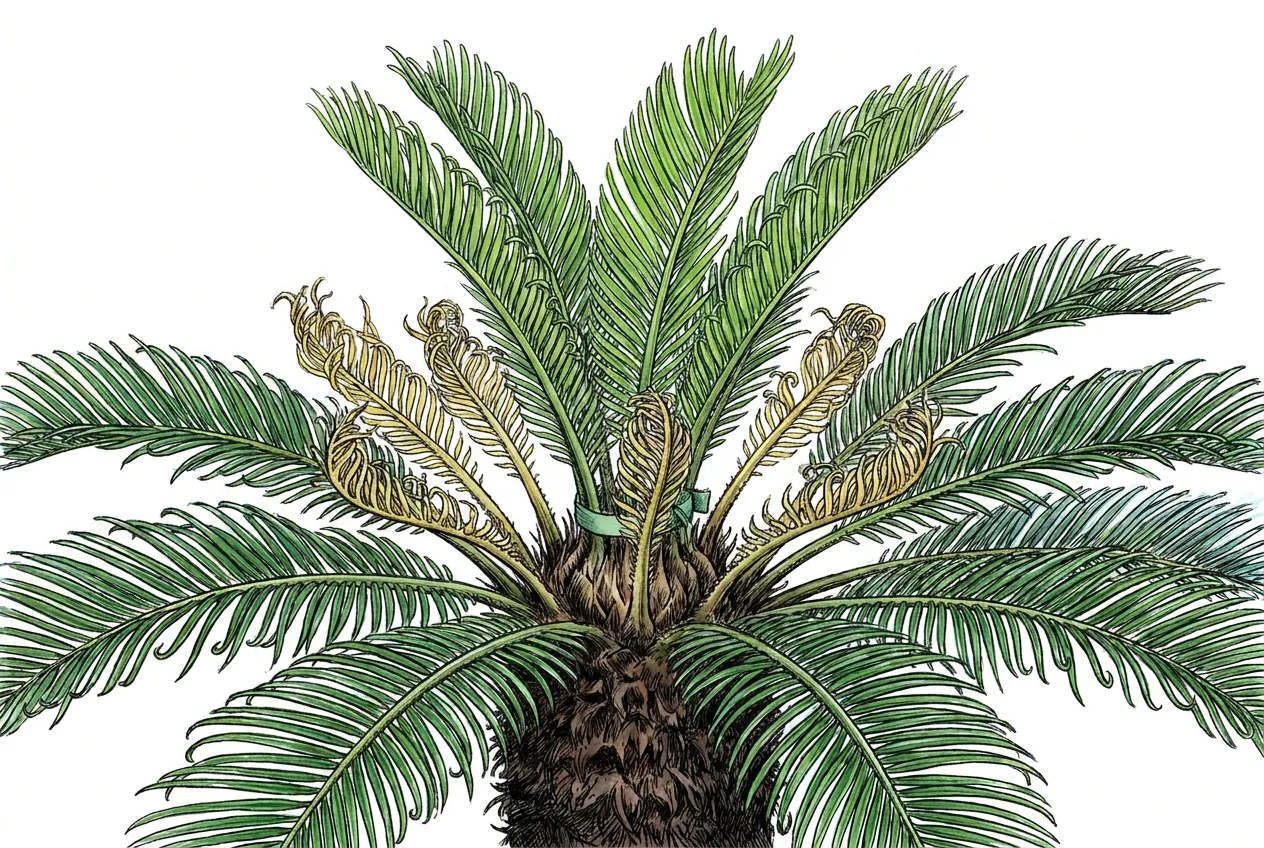
On treatment day, I tie a soft plant tie around the base of the youngest damaged frond and photograph the crown from a marked spot. Everything at or below that tie grew before treatment. My endpoint is the first flush that starts emerging after that day, not one already showing.
I look at the crown monthly, but the decision waits until that flush has fully opened and hardened.
Meanwhile, a mild case gets no second dose, and a severe case stays on the label’s 2 to 3 month repeat.
Once the flush hardens, I compare it with the photo and with the full-size fronds below the damage.
If the new fronds reach the same length with flat, unstreaked leaflets, manganese sulfate stops but the base fertilizer continues.
If they still come out small and streaked, I check soil pH and the roots first.
Extra manganese at that point risks iron shortage without fixing the cause.
Potassium plus magnesium for old-frond yellowing
Potassium spotting needs magnesium alongside it, because potassium alone can push the plant into magnesium shortage. For mild to moderate landscape cases of either shortage, UF/IFAS relies on the base fertilizer every three months.
Damaged fronds never re-green, so recovery can take one to two years or longer while new fronds replace them.
Magnesium banding alone needs no extra potassium, and UF/IFAS warns that high potassium can worsen it.
Severe banding gets magnesium sulfate at its label rate on top of the base fertilizer, preferably slow-dissolving kieserite.
Epsom salt supplies magnesium without any potassium, so it cannot touch potassium spotting.
Keep the yellow fronds on while you wait. UF/IFAS found that regularly removing potassium-deficient fronds speeds the decline.
On leaching sand, the cure is controlled-release potassium, because extra water-soluble potassium washes out as fast as it goes on.
For potassium spotting in pots, Down To Earth Langbeinite 0-0-22 supplies both nutrients in one sulfate mineral.
It lists 22% soluble potash, 10.8% magnesium and 22% sulfur, with chlorine capped at 3%. The container rate is 1 to 2 teaspoons per gallon of potting mix, worked into the surface monthly during the growing season.
It carries more magnesium relative to potassium than the 8-2-12-4Mg ratio UF/IFAS recommends, which guards against potassium-induced magnesium shortage.
Its safety data sheet lists eye and skin irritation and calls for a particle mask and nitrile gloves.
Test soil pH before blaming the fertilizer
UF/IFAS says manganese is commonly deficient in alkaline soils, while pH between 5.5 and 7.0 needs no adjustment.
Soils built on limestone, marl, shell or leftover concrete run alkaline and cannot be made permanently acidic.
There, UF/IFAS uses fertilizers containing water-soluble manganese routinely, with foliar spray only as a supplement.
On that ground, choose a base bag whose derived-from list names manganese sulfate, so routine manganese continues after the extra doses stop.
For a landscape sago, the default is a lab test. Send a mixed sample from several spots under the canopy to the UF/IFAS Extension Soil Testing Laboratory, or to your state’s Extension soil lab.
A capsule kit can blur the 7.0 decision line. In a UC Cooperative Extension comparison, one widely sold kit read pH 6.5 on every soil.
It could not register a soil at 7.8, because its scale stopped at 7.5.
The one $100-plus tool worth considering is a Bluelab Soil pH Pen for repeat testing.
It reads pH directly in soil or potting mix, with a 0.0 to 14.0 range, 0.1 resolution and ±0.1 accuracy at 25°C.
It needs moist soil and two-point calibration, and a worn probe means a new pen.
Re-test potted sagos on the feeding schedule
For potted sagos, I re-test the mix every time the base fertilizer goes on, using a soil pH pen calibrated at pH 7.0 and 4.0.
The day after a normal watering, I read the mix at two opposite points halfway between trunk and pot wall. Then I average the two readings.
Purdue Extension says all nutrients are readily available in soilless mix at pH 5.4 to 6.2.
Within that band, pH is not the cause, so roots, drainage and dose come next.
Above 6.2, I change the water source or repot into fresh mix, since more manganese-containing fertilizer cannot fix the pH.
Below 5.4, manganese is already readily available, so I add none and check the roots.
Small containers shift pH quickly under alkaline tap water. The every-feeding cadence is my own rule for catching that drift before a new flush forms.
If your water leaves white crust on pots, the guide to hard water and salt buildup shows how to test it.
Potted and indoor sagos follow different rules
UF/IFAS guidance for container palms names nitrogen as the most limiting nutrient and calls potassium shortage uncommon.
Magnesium runs short once the dolomite in the mix is used up, usually after about six months.
Pale new fronds in an old, soggy mix usually point to poor aeration rather than missing iron.
UF/IFAS advises knocking off the degraded mix and repotting, and it warns against oversized pots that stay too wet.
The guide to the best pot for caudex plants compares drying rates if you need a new container.
UF/IFAS advises the high end of the label rate for nursery container production. A home potted sago, especially indoors, is safer at or below the label rate during active growth.
For other caudex genera on the same bench, the caudex plants fertilizer guide covers their feeding differences.
In a pot, fix drainage and old mix before buying any corrective, because many container deficiencies start in the root zone.
Setup order from diagnosis to first feeding
Run these steps in order so each purchase answers a question the previous step raised.
- Photograph the crown and note whether damage sits on the newest flush, the oldest fronds or both.
- Check frond undersides for white scale and recall any recent frost.
- Check drainage and roots, especially in pots and after transplanting.
- Test soil pH with a lab sample, or with a calibrated pen for potted plants.
- For a landscape sago, measure canopy area and calculate the base fertilizer dose.
- Apply the base fertilizer in spring, adding a corrective only if the symptom matches, and manganese sulfate only in the ground.
- For frizzle top, tag the youngest damaged frond and judge the next flush.
Dose by canopy area, not by guesswork
I measure the canopy spread tip to tip across the widest pair of opposite fronds, then again at right angles.
The average of those two numbers, in feet, is the working spread. Canopy area in square feet is 0.785 times that spread squared, the area of a circle.
A sago 4 feet across covers about 12.6 square feet. At the UF/IFAS south Florida suggested rate of 1.5 lb per 100 square feet, that works out to about 3 oz of base fertilizer.
That dose gets weighed on a kitchen scale kept only for fertilizer.
The method covers only the base fertilizer on landscape sagos, not manganese sulfate or pots. Miracle-Gro gives its rate in tablespoons per square foot, so weigh that volume on the same scale.
When the UF/IFAS and label amounts disagree, my rule is to use the smaller and never exceed the label.
Concentrated fertilizer burns roots, so the lower number carries less risk. Spread each dose from the trunk out to the frond tips, never piled at the base, and water it in.
I re-measure the spread each spring, because a growing sago changes its dose.
Who should not buy each product class
- A local fertilizer blackout bans nitrogen and phosphorus, so pause every product with either, including the base palm fertilizer. UF/IFAS says these blackouts often run June through September, so check your county ordinance. Skip fertilizer spikes in any season.
- Manganese sulfate is the wrong buy when only the oldest fronds are yellow, or for a potted sago, since its label gives no container rate. It is also wasted when scale, frost or root rot explains the damage. Stop buying it once a new flush comes out clean, even if older fronds stay frizzled.
- In the ground, skip the potassium-magnesium mineral, because the base palm fertilizer handles mild to moderate potassium spotting there.
- A soil pH pen is not worth it for one or two landscape sagos, or if you will not calibrate it monthly. One lab test answers the question there.
Maintenance, failure modes and pen lifespan
Many failures come from too much manganese or the wrong product near the roots.
Failure modes that waste a season
- Lawn fertilizer inside the root zone, which can induce potassium shortage.
- Applying manganese above the label rate, or more often than every 2 to 3 months, which risks iron shortage.
- Using sludge or manure products near the plant, which bind manganese.
- Letting a pH pen probe dry out, which ruins it.
Pen care and replacement
Bluelab’s care sheet says pH probes age quickly through normal use and die if they dry out.
It calls for 3 to 5 drops of storage solution in the cap every week, plus cleaning and calibration every 30 days.
A bottle of Bluelab KCl Storage Solution covers that weekly top-up.
That bottle only keeps the probe hydrated, and calibration still needs pH 7.0 and 4.0 buffers.
If a cleaned, freshly calibrated pen still will not settle on a steady reading, it may have reached the end of its life.
Storage and safe handling
Store fertilizer bags dry, sealed and out of reach of children and pets. Wear gloves, long sleeves and eye protection when spreading any of these products. Sweep manganese granules off paving before watering, so they do not stain it.
Buyer questions about sago palm fertilizer
Should you cut off the damaged fronds?
Not while they carry green. Early removal cuts green leaf area and erases the symptoms that show what went wrong. UF/IFAS’s rule of thumb is to remove only fully brown fronds.
Can you fertilize a sago in winter?
UF/IFAS consumer guidance calls for palm fertilizer three times a year from spring through fall and says winter feeding is unnecessary because growth slows.
For indoor plants, see when to stop fertilizing caudex plants.
Where to start, and when to stop
Outside the growing season, the useful purchases are a pH test and, for frizzled new growth in the ground, manganese sulfate ready for spring.
Start the base palm fertilizer when spring growth begins, then keep it on a fixed schedule that pauses for any local blackout.
Old-frond yellowing recovers slowly, so keep the base program going and judge it by whether the next-oldest fronds stay free of new yellowing.
For frizzle top, the first clean flush is the signal to stop buying manganese sulfate.
Affiliate Disclosure
This article contains Amazon affiliate links. As an Amazon Associate I earn from qualifying purchases. If you use these links, the site may earn a commission at no extra cost to you. Product availability, price, and specifications can change. Check the current listing before buying.