
Pachypodium Water Therapy: Does It Save Dehydrated Caudex?
Does pachypodium water therapy save shriveled caudexes? Learn why jars trigger rot and how a 14-day root-mass test separates real recovery from swelling.
Derek Kim · 2026-11-16 · 19 min read
Key Takeaways
- Standing water cuts oxygen diffusion by roughly 10,000-fold and invites Pythium and soft-rot decay.
- Drought-sealed Pachypodium roots sit behind waxy suberin layers and need warmth to grow new tips.
- Check four collar points for firmness and keep nights at 22 C minimum before introducing moisture.
- Measure blotted mass over 14 days because 48-hour swelling only reflects passive osmotic uptake.
- Warm, barely damp coarse pumice with over 20% air porosity outperforms water jars for recovery.
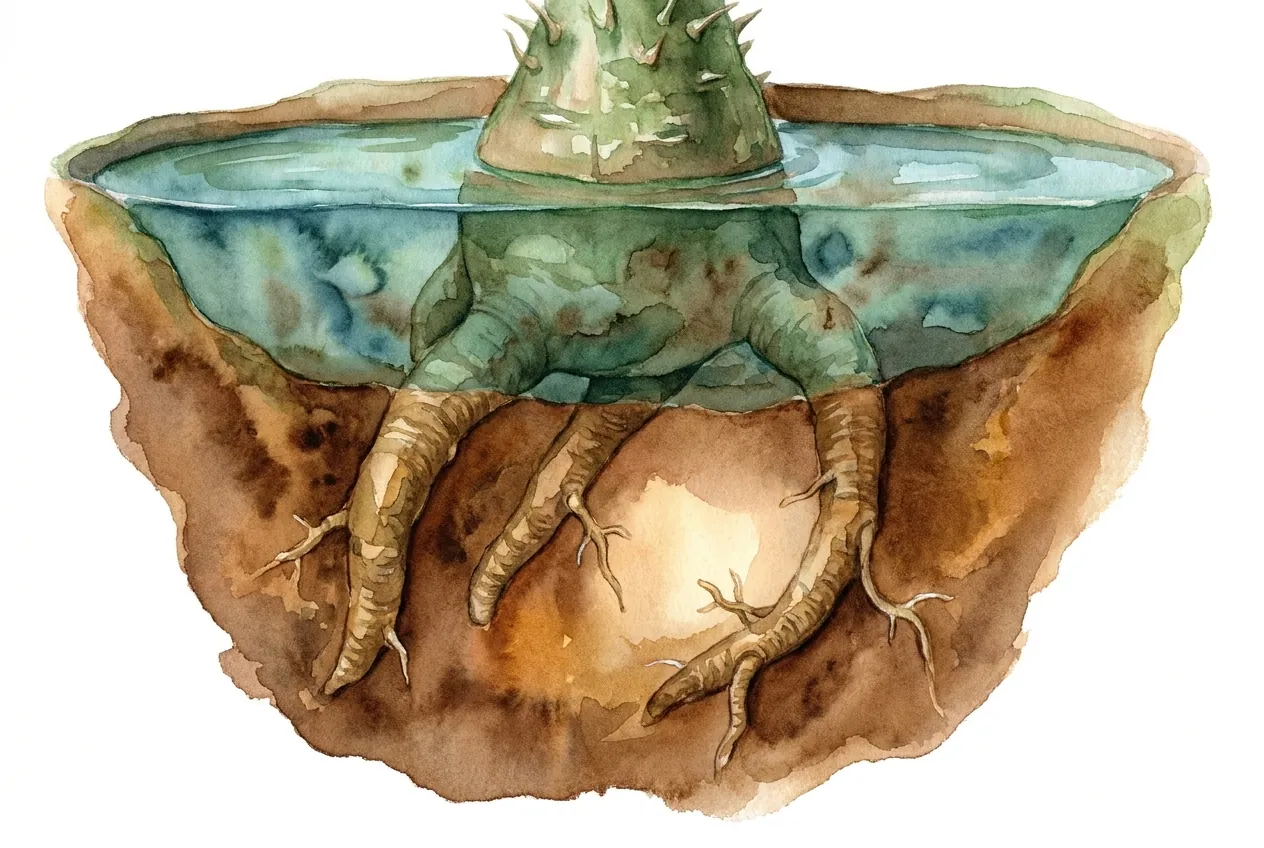
Water therapy rarely saves a dehydrated Pachypodium on its own. Submerging the roots in a jar of water usually accelerates rot instead.
Standing water cuts oxygen diffusion by roughly 10,000-fold compared to air. Meanwhile, dormant or bare-root caudex roots sit sealed behind thick, waxy suberin barriers that cannot drink on demand.
A short, warm 14-day air-gap hover test can show whether viable root buds remain. You must measure blotted mass rather than trusting early swelling. Even then, warm and barely damp coarse pumice outperforms standing water for actual recovery.
Why a Shriveled Caudex Cannot Drink Immediately in Water
A wrinkled Pachypodium looks desperate for a long soak. Yet its internal water-storage tissues and drought-sealed roots follow very different rules. Putting sealed roots into cold or stagnant water ignores how caudex storage cells and root barriers actually work.
Elastic Parenchyma Stores Water Without Immediate Collapse
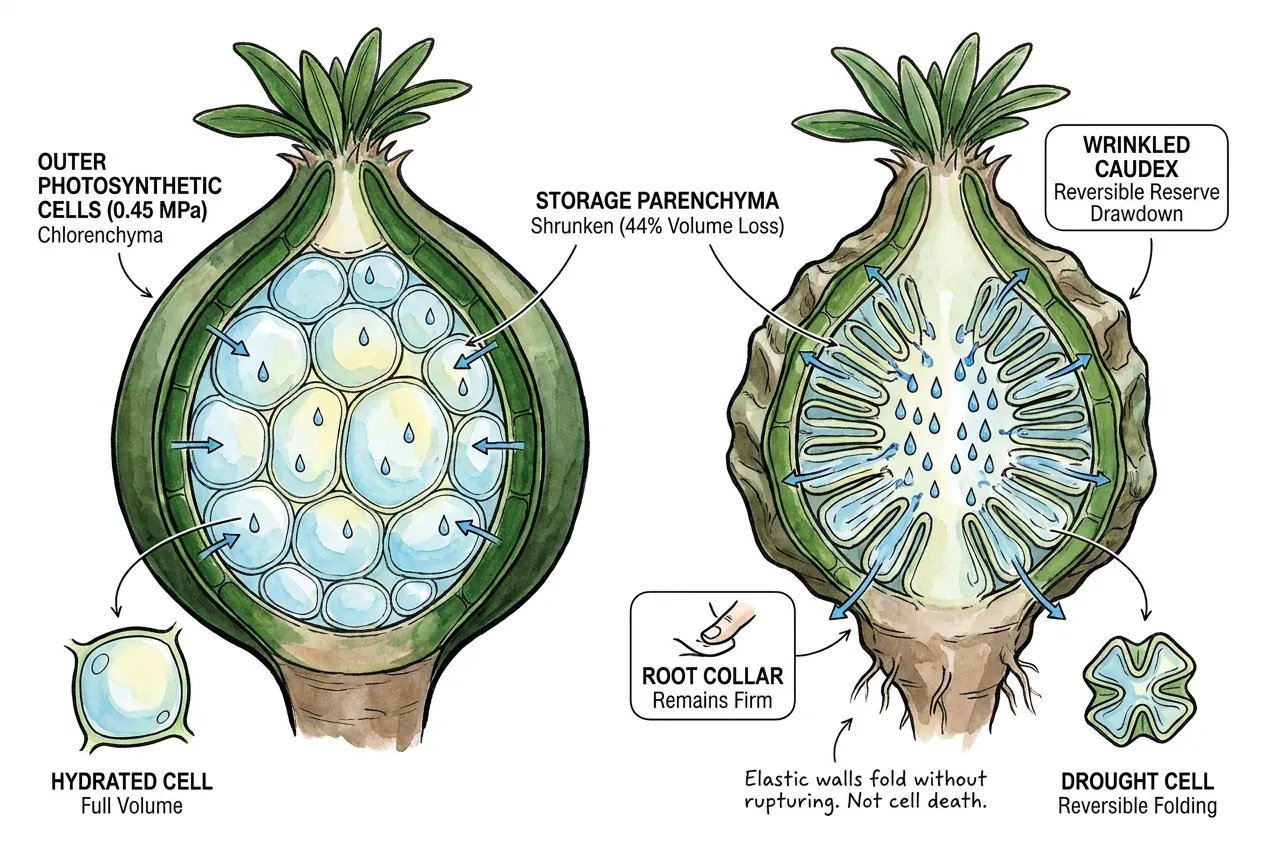
Pachypodium caudexes hold water inside thin-walled storage cells called parenchyma. In tested succulent stems, storage parenchyma operates at much lower baseline pressure (0.10 MPa) than outer green photosynthetic cells (0.45 MPa).
In controlled drought trials on succulent stems, plants lost 33% of total water content over 6 weeks.
Roughly 95% of that water came from storage parenchyma, which shrank 44% in volume while outer cells shrank only 6%.
Cell-wall biomechanics research shows these specialized storage walls fold in a regular, reversible pattern during drought rather than rupturing. A wrinkled or slightly yielding upper caudex is usually a reversible reserve drawdown rather than cell death, provided the root collar remains firm.
Drought and Shipping Seal Old Roots Behind Suberin
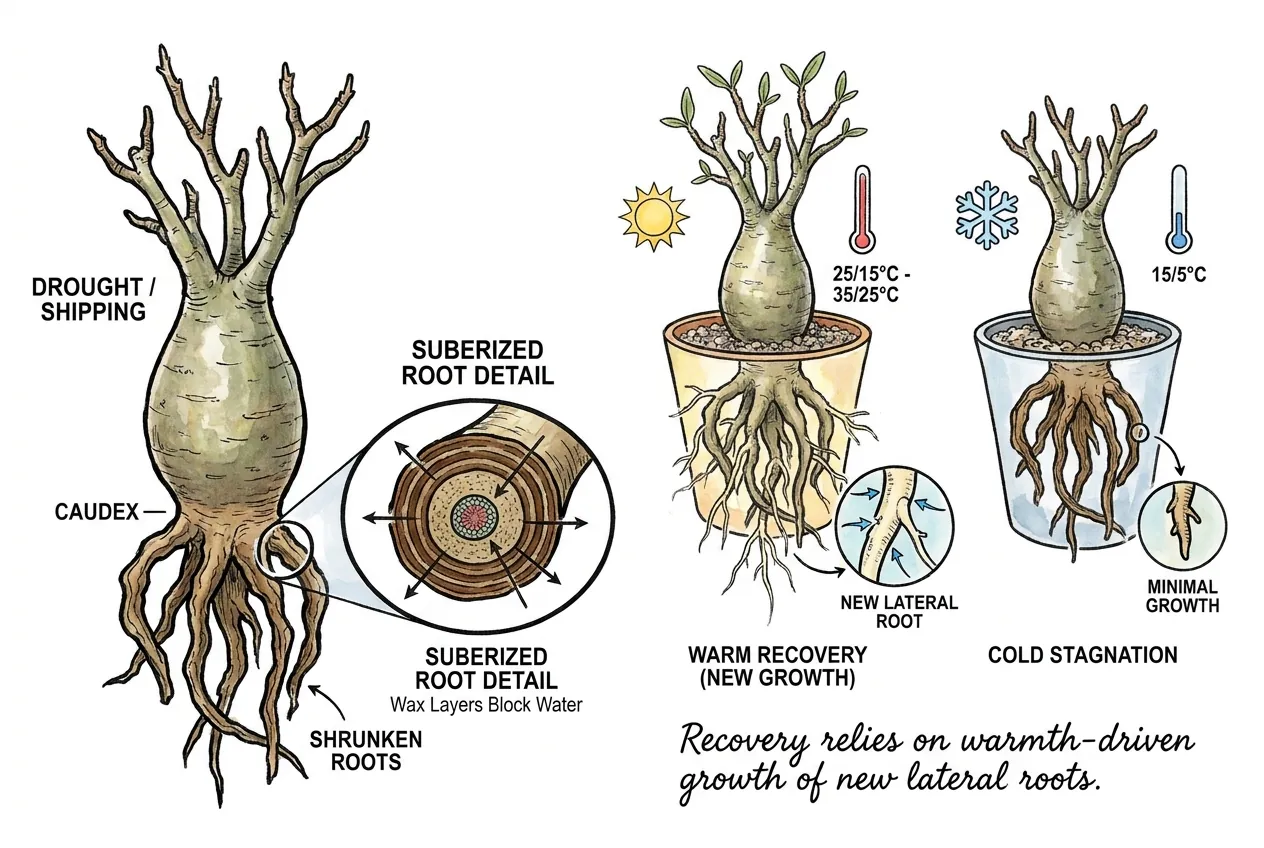
When substrate dries out or a plant ships bare-root, existing roots shut down water movement. This stops stored caudex moisture from leaking backward into dry soil or air. In Agave deserti, 7 and 14 days of drying caused 24% and 34% root shrinkage, opening air gaps that cut hydraulic conductivity roughly fivefold.
Over 45 days of drying in Cylindropuntia acanthocarpa (formerly Opuntia acanthocarpa), root water conductance dropped by about 67%.
It recovered to 60% of baseline only after 8 days of rewetting as aquaporin water channels reactivated.
Prolonged drought also tripled wall suberization in older brown roots, expanding waxy layers from 1 or 2 cells to 6 or 7 layers.
Because heavily suberized roots cannot drink rapidly, recovery depends on warmth-driven growth of new lateral roots.
In desert succulents, root growth was substantial at 25/15 °C and 35/25 °C day/night cycles, but dropped more than 70-fold at 15/5 °C.
Normal Dormancy Shrinkage Versus Acute Dehydration
Pachypodium species follow strict wet and dry seasonal clocks. They shed leaves as day length shortens and temperatures cool. Field data on Madagascar pachycauls (Adansonia) show dry-season stem water drops up to 12% while basal sap flow stays near zero.
Similarly, Pachypodium namaquanum drops its terminal leaf whorl on a strict seasonal schedule. Malagasy species such as Pachypodium rutenbergianum rest dry in winter above a 55 °F (13 °C) minimum night floor. Leafless winter wrinkling in a cool room is normal seasonal reserve use and must be kept dry rather than soaked.
| Diagnostic Sign | Normal Dormancy Shrinkage | Acute Dehydration |
|---|---|---|
| Trigger | Cool short days and natural leaf drop | Extended bare-root shipping, high heat, or summer root loss |
| Caudex Feel | Mild uniform give with a firm root collar | Deep vertical fluting or leathery pinchable ribs |
| Typical Water Loss | Roughly 5% to 12% seasonal drawdown | Deeper progressive loss exceeding 20% to 30% |
| Safe Action | Keep dry in bright air until warm spring growth | Run pre-test triage and warm re-rooting in aerated grit |
What Standing Water Does to Xeric Pachypodium Roots
Dropping a bare-root Pachypodium into a jar of water solves none of its suberin barriers. Instead, it creates an immediate oxygen crisis. Even if new roots emerge, those water-adapted structures struggle when moved back into mineral grit.
The 10,000-Fold Oxygen Bottleneck and Cortical Sloughing
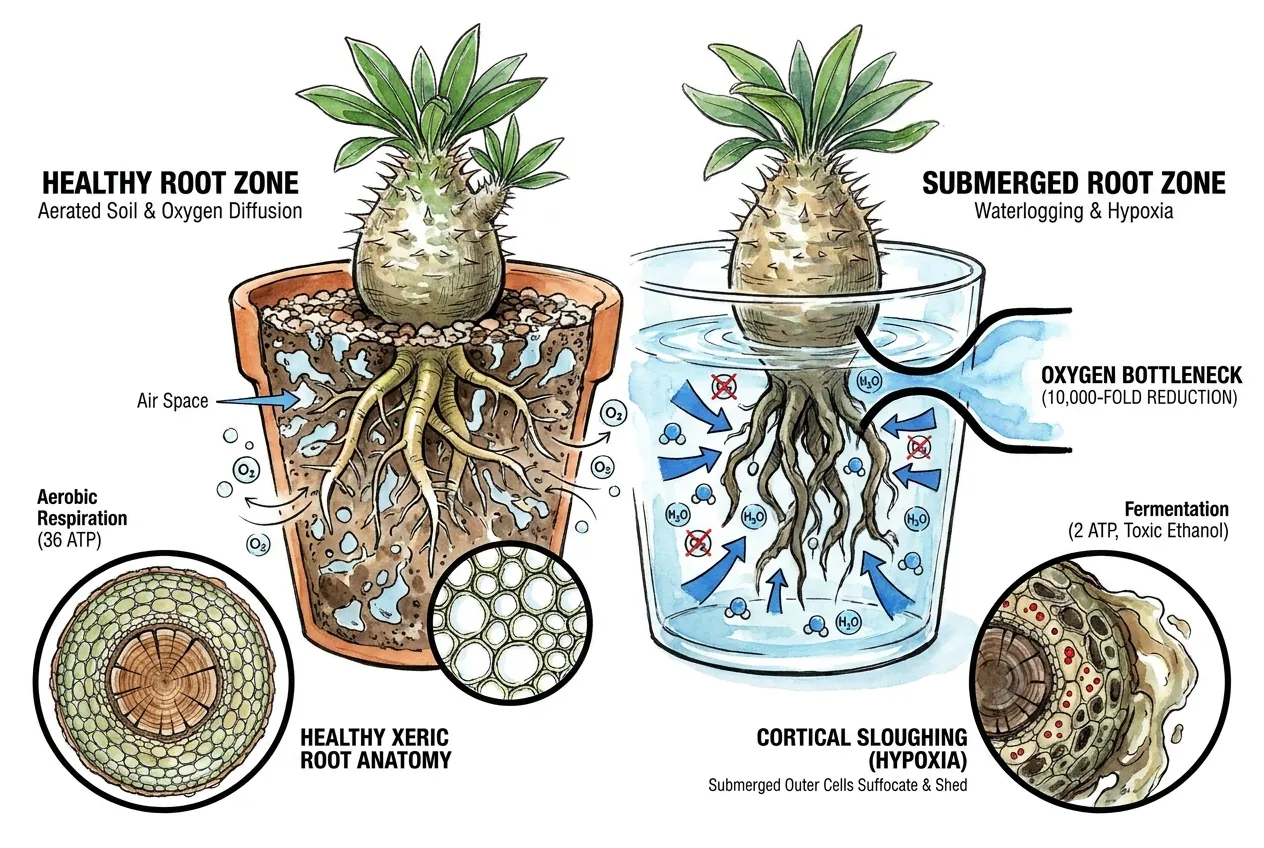
Water saturation reduces gas diffusion nearly 10,000-fold compared to air, inducing root-zone hypoxia within hours to days.
Without oxygen, root cells drop from aerobic respiration yielding roughly 36 ATP per glucose to fermentation yielding roughly 2 ATP. That energy crash causes cell acidosis and toxic ethanol buildup.
Container horticulture guidelines specify 10% to 20% air-filled porosity after drainage, warning that oxygen stress develops below 10% air space. Standing water provides 0% air-filled porosity.
Wetland plants survive flooding by forming longitudinal air channels (aerenchyma) paired with barriers that pipe shoot oxygen down to root tips. Xeric Pachypodium lack that wetland anatomy. Submerged outer root cells suffocate and slough off the woody inner core like a wet sleeve.
Why Water-Grown Roots Collapse in Dry Mineral Grit
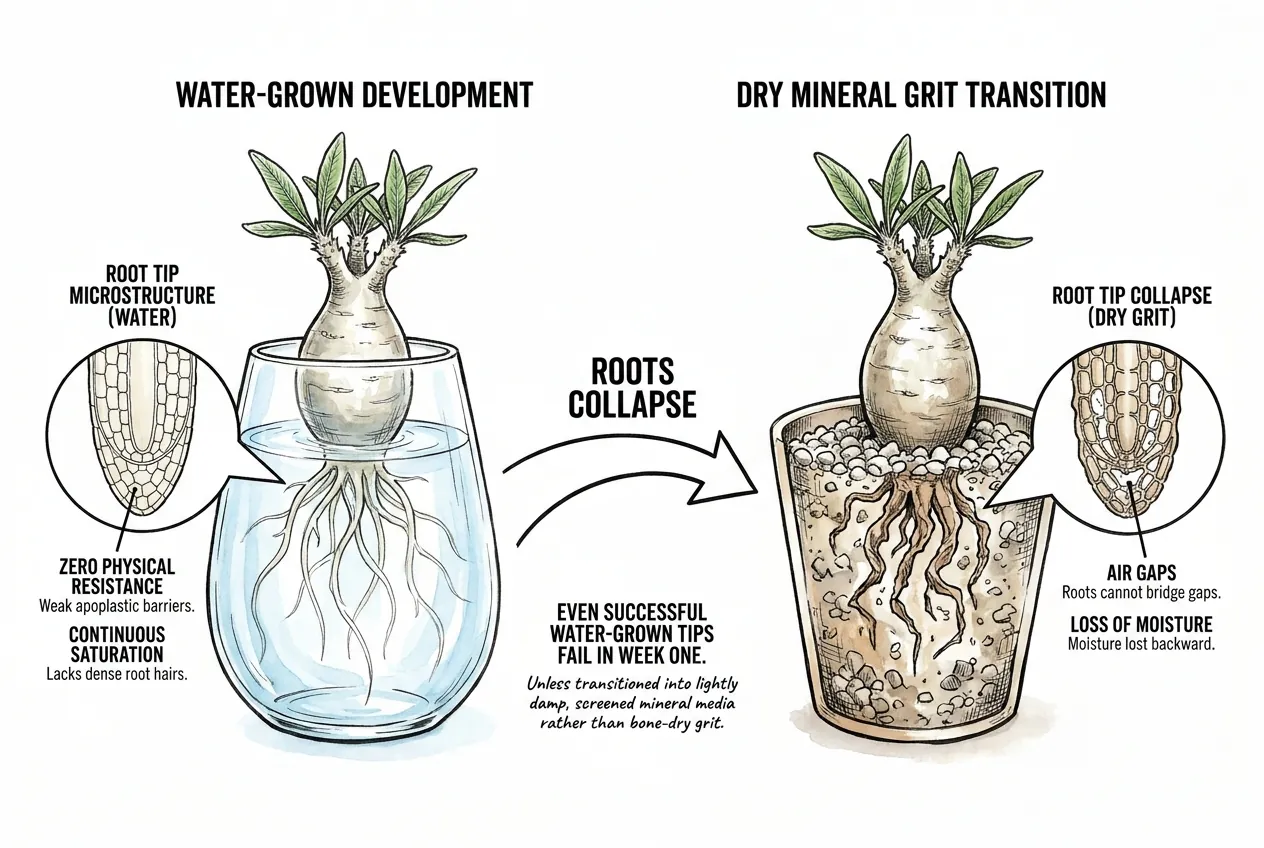
Roots grown in liquid develop under zero physical resistance and continuous saturation. Controlled comparisons show soil-grown roots build suberin barriers closer to the tip and accumulate roughly twofold more suberin than hydroponic roots.
Water-formed roots also lack dense root hairs. In granular soil tests, roots with root hairs generated up to fivefold greater anchorage force (2.5 N versus 0.5 N). They also stabilized in 16 hours instead of 33 hours for hairless roots.
When a grower moves fragile water roots straight into bone-dry pumice, the tips cannot bridge mineral air gaps and lose moisture backward. Even successful water-grown tips fail in week one unless you transition them into lightly damp, screened mineral media rather than bone-dry grit.
Pathogen Pressure in Warm, Stagnant Jars
Dissolved oxygen often drops below 4 mg/L in stagnant water. Stressed root membranes then lose selectivity and leak sugars and amino acids like glutamic and aspartic acid.
Motile Pythium and Phytophthora zoospores swim up those amino-acid trails to infect compromised root tips.
In hydroponic trials, Pythium inoculum at just 6.7 CFU/mL started infection and grew to 1,030 CFU/mL in four weeks.
Pythium dissotocum shifted from silent dormancy at 16 to 18 °C to severe decay within hours at 24 to 28 °C.
Phytophthora zoospores persist under 24 hours per batch, so ongoing infection relies on decaying tissue releasing fresh spores.
Warm stagnant water also wakes latent Pectobacterium (formerly Erwinia) soft-rot bacteria inside breathing pores (lenticels) and shipping micro-cracks.
Soft rot causes its worst decay between 70 and 80 °F (21 to 27 °C) under low oxygen and produces a foul odor.
Distinguishing Biofilm Blooms From Mineral Haze
Roots release organic carbon that feeds bacteria, turning stagnant water uniformly milky within 24 to 48 hours.
Those bacteria coat glass and root stubs in slimy biofilm. Harmless hard-water mineral scale leaves a dry chalky ring at the waterline with zero odor or slime.
Scrubbing organic slime away before disinfecting is mandatory because organic debris neutralizes chlorine. Household 5.25% bleach diluted 1 to 9 (~0.5% chlorine) kills Pythium and bacteria when used within two hours and rinsed well.
For metal blades, 70% alcohol for at least 30 seconds sanitizes without corrosion.
If you see dark basal lesions on an import, keep it dry and avoid adding jar chemicals.
Instead, use our caudex root rot fungicide chooser or bare-root Pachypodium arrival guide. Warmth between 21 and 28 °C drives both root initiation and peak soft-rot decay, so stagnant water must be dumped and scrubbed every 48 hours.
Pre-Test Triage Before Any Water Touches the Caudex
Hobbyist water therapy covers three distinct setups on opposite ends of oxygen availability and crown wetting.
Comparing them side by side explains why full immersion fails most often.
| Method Variant | Oxygen Availability | Root-Crown Wetting | Pathogen Risk | Practical Role |
|---|---|---|---|---|
| Full Root Immersion | Very low (0% air porosity) | High liquid contact | Highest (zoospores and soft rot) | Avoid for xeric Pachypodium |
| Air-Gap Hover (1 to 2 cm) | High (gas phase around roots) | Moderate if condensation forms | Moderate (needs 48 h water changes) | Short 14-day diagnostic test only |
| Warm Damp Coarse Pumice | High (over 20% air-filled pores) | Low (thin surface films only) | Lowest (no standing water) | Preferred recovery medium |
Before a drop of water touches a wrinkled caudex, I run a mandatory four-point triage check on the dry plant.
Under bright light, I inspect the dry base and root crown for snapped roots, uncallused cuts, or darkened tissue.
Any freshly bruised bare-root import stays dry for 5 to 7 days so wounds callus.
With a clean thumbpad, I press gently at four opposing compass points 1 to 2 cm above the root crown.
The upper caudex on the same plant serves as my firmness baseline. From 15 to 20 cm away, I waft air gently by hand to check for sour odor without inhaling over moldy tissue.
On the exact resting shelf, I leave a min/max thermometer probe for 24 hours before introducing moisture.
Missouri Botanical Garden lists 55 °F (13 °C) as the dry night floor, while pathology guides link cool wet media to collar rot.
Balancing those risks, I use 22 °C (72 °F) as a conservative author overnight floor rather than a published species standard.
If any collar point feels softer than the upper caudex, shows dark or oozing tissue, or smells sour, I keep the plant dry.
The same abort rule applies to cool leafless dormancy or overnight temperatures below 22 °C (72 °F). Proceed to hover or damp pumice only when all four collar points are firm, cuts are callused, and nights stay at 22 °C (72 °F) minimum.
The 14-Day Root-Mass and Turgor Evaluation Protocol
Suppose you have a firm, callused, warm-season Pachypodium that stalled in dry grit. A 14-day gravimetric check tests whether water vapor wakes root buds or merely causes temporary swelling.
Why 48-Hour Plumping Is a False Positive
In Agave deserti trials, roots resumed initial water uptake within 1 to 2 days of rewetting.
Yet plants droughted for 90 to 180 days failed to restore hydraulic conductivity within 7 days.
Instead, new lateral roots and renewed tip elongation emerged 7 to 11 days after rewetting.
Recent drought-recovery research also confirms that root hydraulic recovery outpaces leaf pore reopening in the canopy. Checking only caudex firmness or waiting for leaves within 48 hours mistakes passive osmotic swelling for functional feeder-root recovery.
Step-by-Step Blotted Weighing and Stop Rules
Clinging water skews bare-root weights by 2 to 5 g. On Day 0, I brush off loose debris and weigh the dry plant on a 1 g scale, noting any white root tips (2 mm+).
I then suspend the caudex 1 to 2 cm above water in open air at 24 to 28 °C (75 to 82 °F).
At Days 3, 7, and 14, I lift the plant and blot surface moisture gently with a dry paper towel for 30 seconds. This matches laboratory root-fresh-weight methods. Right after blotting, I weigh it on the same level 1 g scale, count 2 mm+ white tips, and press four collar points.
Every 24 hours, I hold white paper behind the jar to check clarity and sniff gently from 15 to 20 cm away.
Every 48 hours, I dump all water away from other plants, scrub the jar with soap, and refill with fresh water.
No published Pachypodium trial defines a universal mass-gain cutoff. I therefore require at least 3% to 5% blotted mass gain plus new 2 mm+ white tips by Day 14.
That conservative author margin sits safely above 1 to 2 g household scale noise.
Move to mineral grit only if blotted mass rises 3% to 5% with new white tips by Day 14, and abort if water clouds.
If the caudex stays firm at Day 14 without hitting both targets, end liquid exposure anyway and pot into warm, barely damp pumice.
Wash hands after handling suspect tissue and discard test water away from other pots. Visit our guides on measurement tools and 1 g scales or heat mats and root-zone thermostats for setup gear.
| Checkpoint Metric | Passive Osmotic Swelling | Genuine Feeder-Root Recovery | Hypoxic or Rot Failure |
|---|---|---|---|
| Timing | Days 1 to 3 | Days 7 to 14 | Any day (often 24 to 72 hours) |
| Blotted Mass vs Day 0 | Plus 1% to 3% then flat | Sustained plus 3% to 5% or higher | Flat or negative below Day 0 |
| New White Root Tips (2 mm+) | Zero | Present and elongating | Zero or brown slimy tips |
| Water Clarity (24 h check) | Clear | Clear with 48 h refresh | Cloudy, slimy film, or sour odor |
| Root-Collar Firmness | Firm | Firm | Softer than upper caudex |
Environmental Controls During Rehydration
Temperature, light, and vapor pressure deficit (VPD, the drying pull of indoor air) decide whether a recovering Pachypodium grows roots or dries out.
Extension benchmarks set propagation media at 72 to 77 °F (22 to 25 °C) with air 5 to 10 °F (3 to 6 °C) cooler.
Meanwhile, UC IPM warns that warm-season Pythium aphanidermatum turns pathogenic above 77 °F (25 °C) at 70% or higher water capacity.
Evaporative cooling keeps damp media several degrees colder than room air, so probes must sit 2 to 3 cm deep at rooting depth.
A conservative 24 to 26 °C (75 to 79 °F) root-zone target in airy media balances caudex metabolism against Pythium risk. It also avoids the transpiration spike seen in 30 °C trials.
High light heats leafless bark and widens VPD. Research across 11 species shows rising temperature drives water loss through the bark cuticle even when leaf pores stay shut.
Keep unrooted Pachypodium in bright, indirect light away from dry HVAC drafts.
| Environmental Variable | Too Low (Risk) | Working Target | Too High (Risk) |
|---|---|---|---|
| Root-Zone Temperature | Below 20 °C (68 °F) stalls mitosis and invites cold-wet rot | 24 to 26 °C (75 to 79 °F) measured at rooting depth | Above 28 to 30 °C triggers warm Pythium and transpiration loss |
| Light Intensity | Deep darkness delays recovery once buds break | Bright diffused or indirect light | Direct sun or strong LEDs heat bark and spike cuticular loss |
| Humidity and VPD | Heavy misting on bark wets lenticels and collar | Moderate indoor air with zero dry drafts | Hot dry air accelerates cuticular desiccation |
Keep thermometer probes at rooting depth and shield leafless caudexes from direct sun so cuticular water loss does not outpace root initiation.
Transitioning Rehydrated Roots Back to Mineral Media
Moving a plant with 2 to 10 mm white tips out of vapor requires preserving high air-filled porosity.
Granules must stay lightly damp enough to prevent tip desiccation, and fine dust under 2 mm destroys that balance.
In volcanic tuff trials, screened 2 to 4 mm tuff held 51.98% air-filled porosity and 21.54% water capacity.
Unscreened 0 to 4 mm tuff containing fines dropped to 29.89% air-filled porosity and jumped to 37.28% water capacity.
Coarser 0 to 8 mm grit preserved 61.43% air-filled porosity, letting developing roots remodel pores cleanly.
Pot into a snug container only slightly larger than the root mass using screened, lightly pre-dampened mineral grit.
UF/IFAS and Clemson extension guides advise waiting 3 to 7 days before the first full drench so handling micro-abrasions seal. Screen out particles under 2 mm, pot snugly, and wait 3 to 7 days before watering while watching for tug resistance and caudex smoothing.
For comparing pumice, akadama, and gritty mix ratios during this step, use our caudex substrate comparison guide.
Safer Evidence-Based Alternatives to Water Therapy
Potting directly into warm, barely damp coarse pumice beats hypoxic water jars. It delivers trace moisture alongside roughly 10,000-fold faster atmospheric oxygen diffusion.
Container studies target 0.010 to 0.015 gas diffusivity and over 10% air porosity. UF/IFAS also supports 24 to 30 °C (75 to 85 °F) bottom heat.
Heated winter air often drops below 40% relative humidity, making a firm rootless caudex keep wrinkling in warm pumice.
A clear vented dome slows water loss without soaking roots. Virginia Tech Extension targets 50% to 80% humidity and advises daily 10-minute venting because sealed domes drop CO2 to 200 ppm.
Three-Branch Decision Tree for Shriveled Pachypodium
| Caudex Condition | Chosen Path | Key Operating Rule |
|---|---|---|
| Cool room below 22 °C, dormant, or fresh uncallused cuts | Dry Rest | Keep completely dry in bright air until warm and callused |
| Firm, callused, and shelf at 24 to 28 °C | Warm Damp Coarse Pumice | Pot dry for 5 to 7 days, then mist outer rim and vent dome if under 40% RH |
| Firm and stalled after 3 to 4 weeks in warm pumice | 14-Day Hover Test | Run 1 to 2 cm air-gap test with 48 h water changes and 3% to 5% mass gate |
Default to warm, barely damp coarse pumice with bottom heat for firm plants, reserving the 14-day hover test strictly for stubbornly stalled specimens.
Next Steps for a Shriveled Pachypodium
Start by running the dry four-point collar check and logging 24-hour overnight shelf temperature before deciding on moisture.
If your plant is firm, callused, and warm at 24 to 28 °C, pot it into screened coarse pumice.
Let it settle dry for 5 to 7 days before light perimeter misting.
Suppose a stubbornly firm caudex fails to respond after several weeks in warm grit. Use the 14-day blotted mass and root-tip test as a strict pass-or-abort gate rather than leaving roots in stagnant water.