Executive Summary
Summary
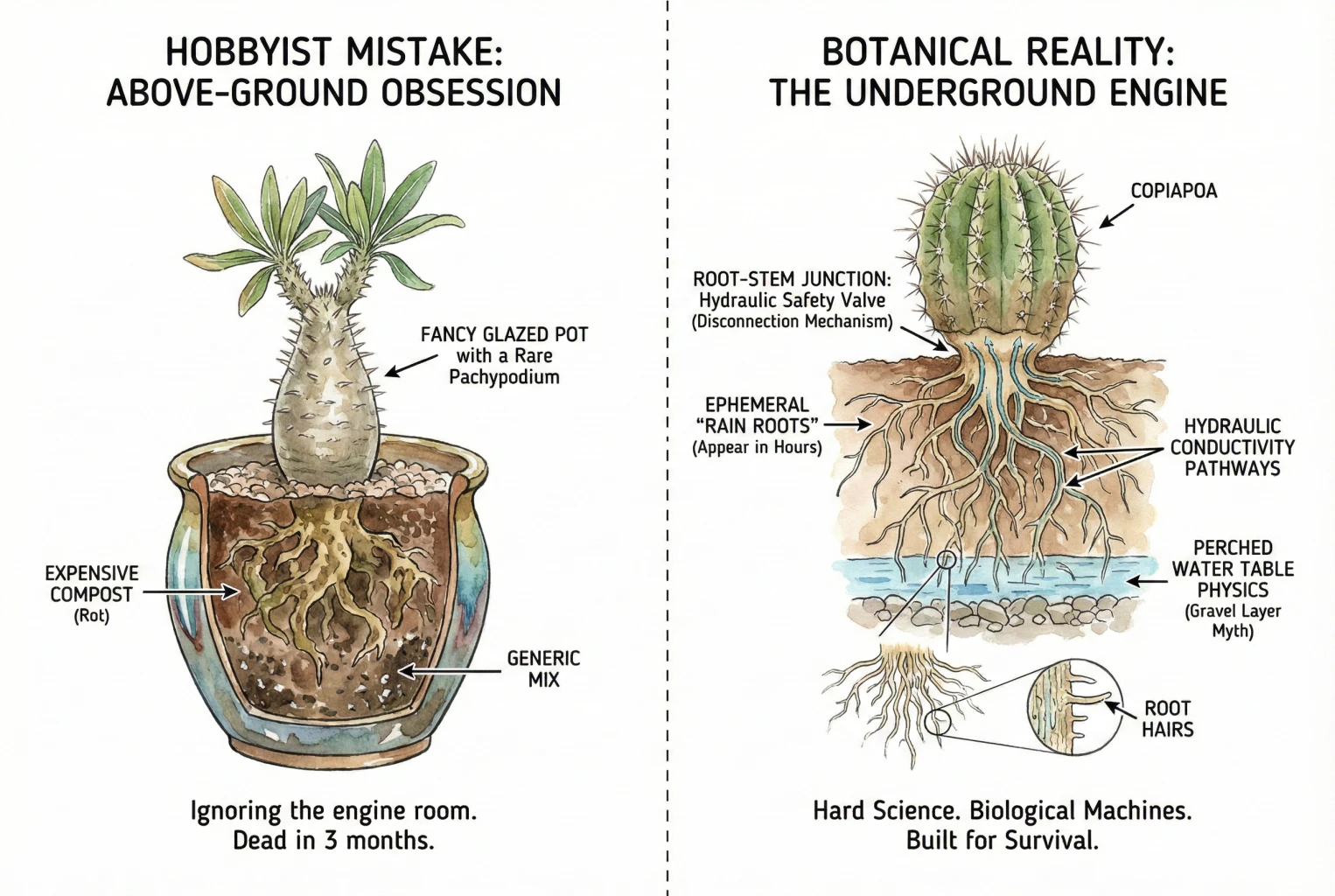
- Many hobbyists unknowingly kill their plants by focusing solely on above-ground aesthetics while ignoring the critical ‘engine room’ of the root system.
- Successful cactus care requires replacing outdated ‘common knowledge’ with hard science, including hydraulic physics, botany, and cellular biology.
- Understanding specific mechanisms like ‘rain roots,’ hydraulic safety valves, and water table physics is essential to engineering survival and avoiding fatal mistakes like using gravel for drainage.
Key Takeaways
- Roots are the Engine: Visible growth like spines and flowers are merely lagging indicators; the true health of the plant is determined underground.
- Science Over Myths: Move away from ‘grandmotherly advice’ and focus on recent research regarding drought recovery and root-stem junction mechanics.
- Hydraulic Mechanisms: Cacti function as ‘biological machines’ with specific operating manuals, featuring adaptations like ‘rain roots’ that appear in hours and roots that disconnect to save the plant.
- Physics of Survival: Concepts such as the physics of water tables prove that common practices, such as putting gravel at the bottom of pots, can actually be harmful.
Introduction: The Hidden Half of the Succulent Equation
Most common knowledge about cactus roots is wrong. You aren’t killing your plants with bad luck; you’re killing them with bad physics. Recent research into hydraulic conductivity and drought recovery proves that these plants are biological machines, not decorations.
We are going to break down the mechanics of the ‘root-stem safety valve,’ explain why roots intentionally disconnect from soil, and debunk the myth that gravel improves drainage. It’s time to stop guessing and start engineering.
Part I: Cactus Roots as Hydraulic Safety Valves

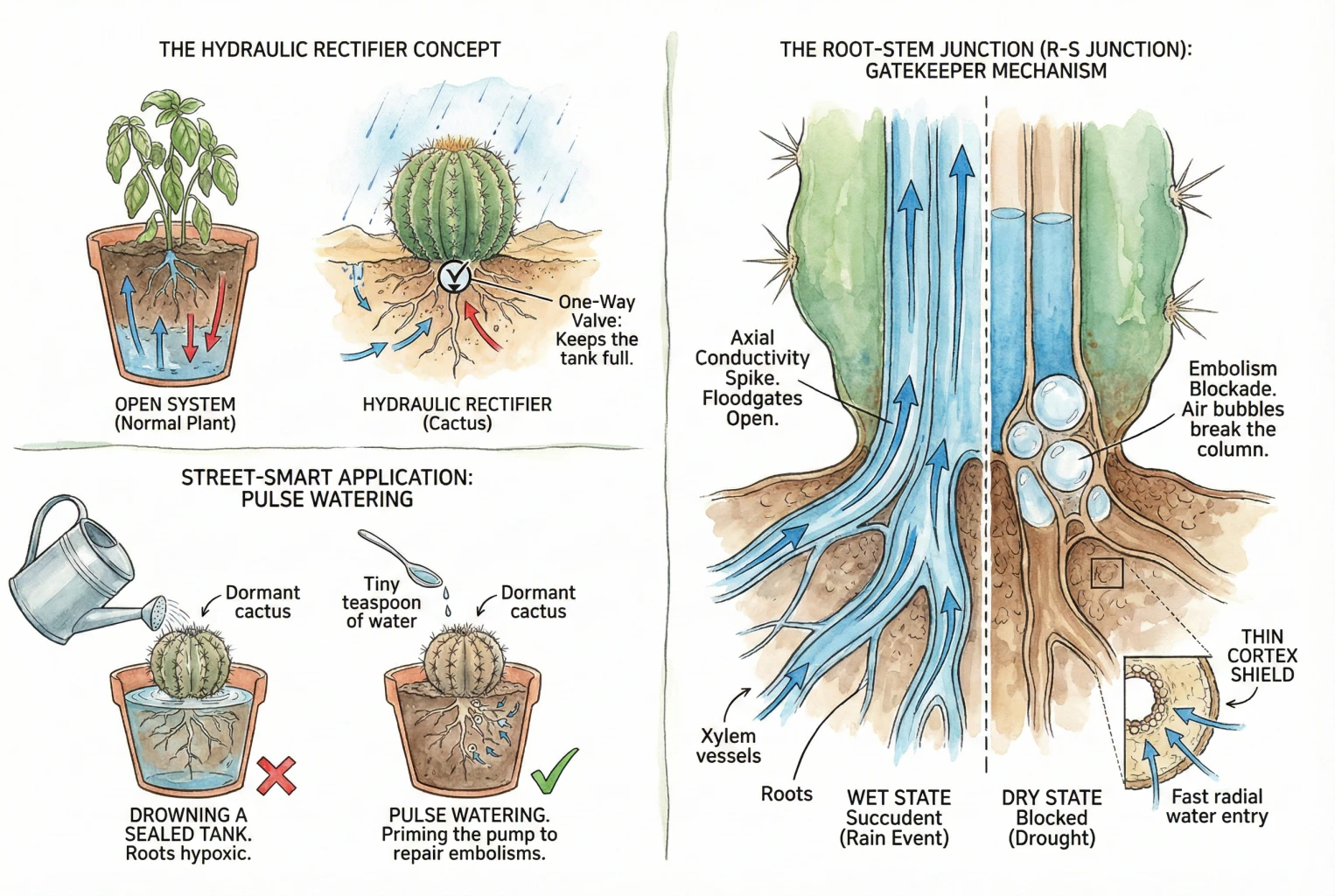
Let’s start with a concept that blows the minds of most casual growers: Cacti are hydraulic rectifiers.
In a normal plant—say, a basil plant in your kitchen window—water moves from the wet soil, into the roots, up the stem, and out the leaves via transpiration. It is a continuous column of water. When the soil dries out, the basil wilts because that column breaks. The plant is an open system, constantly flowing.
Cacti and caudiciforms play a completely different game. They are essentially tanks of water sitting in a dry environment. The fundamental problem of physics they face is: How do you get water in via the cactus roots when it rains, but prevent the dry soil from sucking the water out when the drought hits?
Soil has a ‘water potential’ When soil is dry, it has a massive negative pressure. It wants to steal water. It is a sponge that is drier than the plant. If cactus roots didn’t have a check valve, the dry desert sand would wick the moisture right out of the succulent stem, and the plant would shrivel and die in days.
The desert floor is a thief, and the cactus is a bank vault. The challenge is opening the door to make a deposit without letting the thief rob the vault.
The Root-Stem Junction: The Gatekeeper
Recent research using X-ray micro-imaging has revealed that the junction between the root and the stem (the R-S junction) acts as a literal hydraulic safety valve. This is not a metaphor; it is a structural mechanism that can be observed at the cellular level.
Here is the science:
- Axial Conductivity Spike: When water is available, the xylem vessels (the plant’s pipes) running from the cactus roots to the stem drastically increase in theoretical hydraulic conductivity. They open the floodgates to fill the tank. The plant detects moisture and essentially lowers the drawbridge.
- The Embolism Blockade: When the soil dries out, the plant allows the large xylem vessels in the roots to ’embolize’ An embolism is an air bubble. In most plants, air bubbles in the veins are death—it’s like an air bubble in a human artery. In cactus roots, however, they are a survival strategy. The plant effectively ‘breaks’ the water column at the root-stem junction.
This is a deliberate disconnection. The plant sacrifices the continuity of its plumbing to save the reservoir. It creates a physical barrier of air that water cannot cross.
The water in the stem stays in the stem because the path back to the soil is blocked by these air bubbles. This explains why a cactus can sit in bone-dry soil for six months and stay plump. It has physically disconnected its internal plumbing from the outside world.
The Cortex Shield
Furthermore, the cortex cell layer (the outer rind) of cactus roots is significantly thinner than in other plant species. This might seem like a weakness, but in the context of radial conductivity—moving water from the outside of the root to the inside—it is a speed modification.
A thinner cortex means less resistance to water entry when water is present. The plant is built for speed during those rare rain events. It wants to minimize the distance water has to travel to get into the safety of the xylem.
The Street-Smart Application
This matters for your watering schedule. When a cactus has been dry for a long time (winter dormancy or a long summer drought), the connection is broken. The valves are closed. The pipes are full of air.
If you take a dormant cactus and flood the pot with a gallon of water, the plant literally cannot drink it immediately. The hydraulic pathway in the cactus roots is filled with air.
You are just drowning the roots in stagnant water while the plant desperately tries to re-establish the connection. It takes time for the plant to metabolically reverse those embolisms and refill the vessels.
Pro Tip: Wake them up slowly. Use ‘pulse watering’—small sips—to signal the plant to repair the embolisms and reopen the safety valve before you hit them with the heavy drench.
You are essentially priming the pump. If you dump a bucket of water on a sleeping cactus, you are surrounding a sealed tank with water. That water sits there, hypoxic and stagnant, breeding rot bacteria, while the plant inside is still locked down. Give it a teaspoon. Wait three days. Then give it a cup.
Part II: The Incredible Shrinking Cactus Roots (and the ‘Air Gap’ Defense)

One of the most fascinating discoveries in recent years is the biomechanics of root shrinkage. We tend to think of roots as static anchors—sticks in the mud. They aren’t. cactus roots are dynamic, shapeshifting organs that move and change size in response to the environment.
The Elasticity Factor
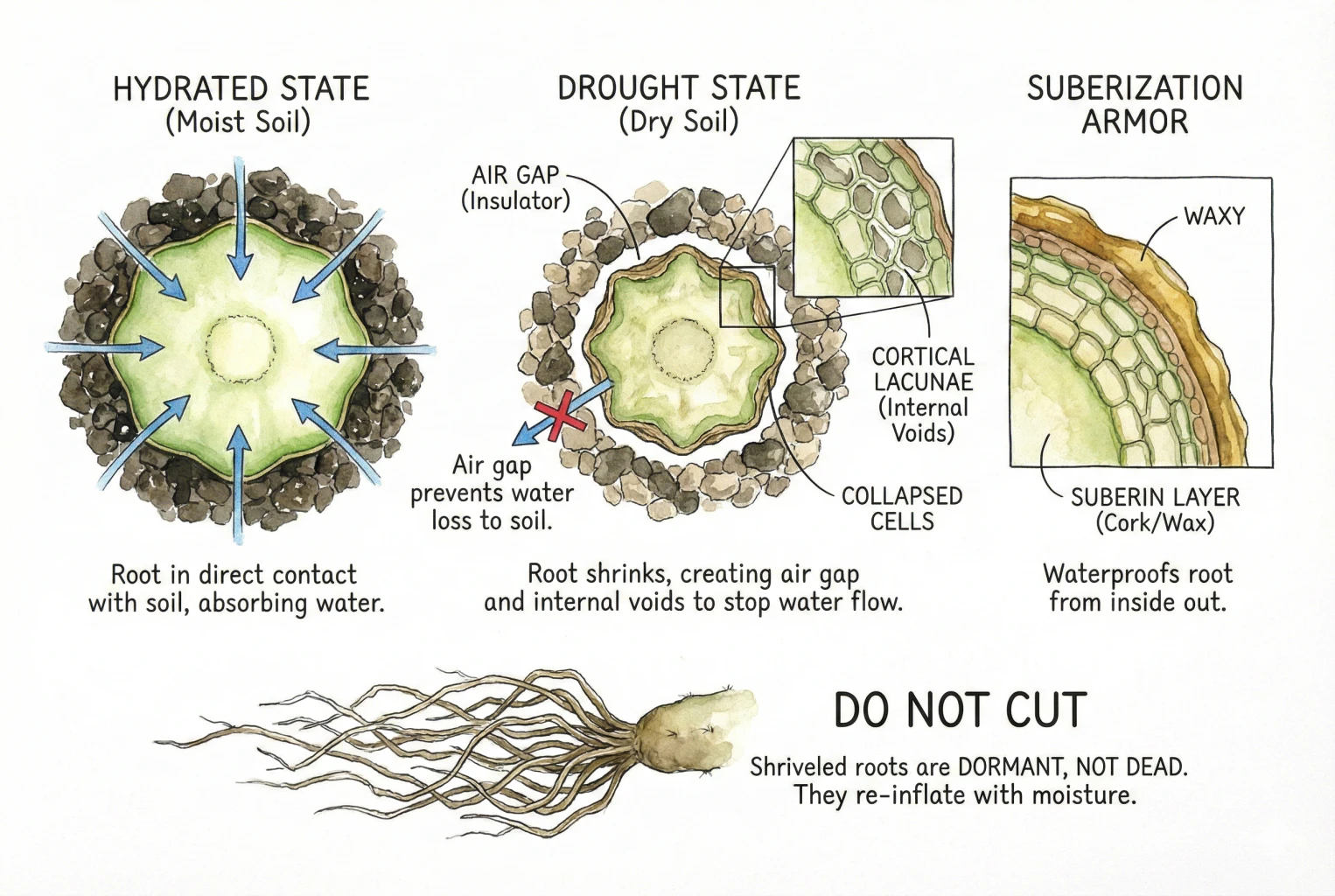
Research on Opuntia (prickly pear) and other succulents shows that as soil dries, the roots don’t just sit there. They shrink radially by up to 30-40%. Imagine your arm shrinking to the size of a broomstick when you get thirsty. That is what these roots do.
Imagine a root inside a pore of soil. It’s touching the soil particles on all sides, absorbing water. As the soil dries, the root dehydrates and shrinks, pulling away from the soil particles. This creates a physical Air Gap between the surface of the cactus roots and the soil.
This air gap is not an accident; it’s an insulator. Air has extremely low hydraulic conductivity. It is very hard for water to jump across an air gap.
By shrinking and creating this gap, the root minimizes the surface area touching the dry, ‘thirsty’ soil. It stops the soil from wicking water out of the root. It effectively puts on a space suit of air to separate itself from the hostile environment.
Cortical Lacunae: The Collapsible Lung
It gets deeper. Under extreme drought, the cells inside the root cortex (the outer layer of the root) undergo ‘cell wall folding’ They develop cortical lacunae—essentially gaps or cavities where the cells collapse in a controlled manner.
This mechanical failure is actually a ‘rectifier-like mechanism’ It disconnects the vascular cylinder (the core pipes) from the drying soil interface. It’s like a submarine sealing off a flooding compartment.
The root sacrifices its outer layers to protect the core. The cells fold in on themselves, creating internal voids that stop water flow. This ‘mechanical failure’ is actually a biological success. It preserves the integrity of the central stele where the life of the plant resides.
Visual Evidence of ‘Death’
This is where the hobbyist often goes wrong. When you unpot a cactus that’s been dry, you often see shriveled, wire-like roots. They look dead. They feel dry. A novice gardener cuts these off, thinking they are dead. STOP DOING THAT.
Those shriveled cactus roots are often just in their ‘air gap’ mode. They have suberized (corked up) and shrunk to survive. Once moisture returns, they can re-expand or branch out. If you cut them, you force the plant to burn massive amounts of energy growing an entirely new root system. You are essentially amputating a limb that was just asleep.
The research indicates that these ‘dead’ looking roots can re-establish hydraulic continuity relatively quickly once water returns. They re-inflate. The air gaps close. The contact with the soil is restored. It is a reversible process, provided the drought hasn’t been catastrophic.
The Suberization Armor
Along with shrinkage, the roots undergo suberization. Suberin is a waxy, corky substance. As the soil dries, the plant deposits suberin in the pericycle and cortex layers. This essentially waterproofs the root from the inside out.
While this makes it harder for the root to absorb water later, it makes it nearly impossible for water to leak out. It turns the root into a sealed pipe rather than a porous sponge. This is critical for survival in arid soils where the soil water potential can drop to -10 MPa or lower—pressures that would suck a normal plant dry in hours.
Part III: ‘Rain Roots’—The Pop-Up Shops of the Plant World

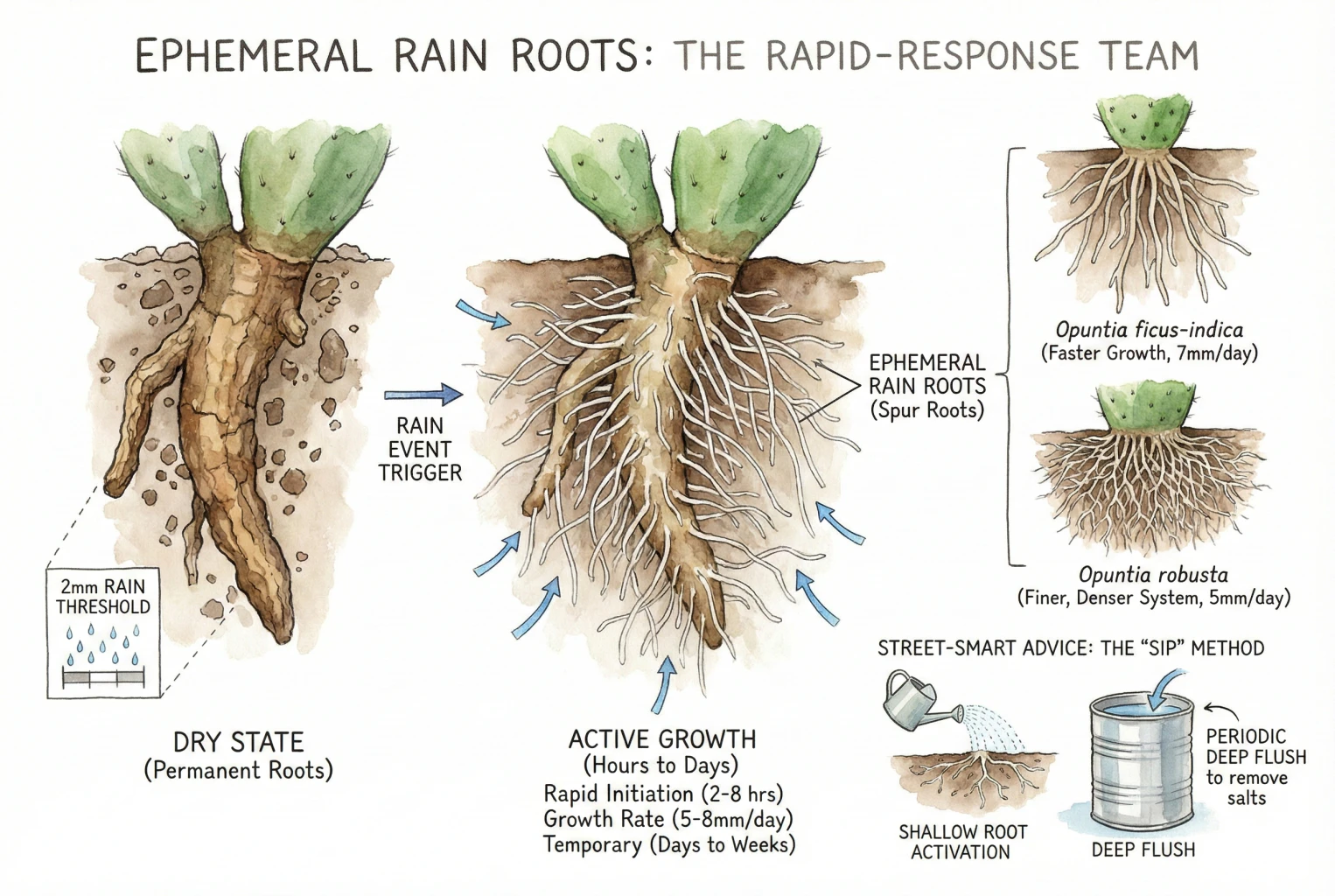
If the permanent roots seal themselves off and shrink away from the soil, how does the plant ever drink again? Enter the Ephemeral Rain Roots. This is, by far, the coolest adaptation in the succulent world. When a rain event happens, cacti don’t just rely on their old, corky cactus roots. They deploy a rapid-response team.
Speed is Everything
Research shows that within hours of soil re-wetting, cacti initiate the growth of new, ephemeral ‘rain roots’ (sometimes called spur roots).
- Initiation: Can happen within 2 to 8 hours. The plant detects moisture and immediately switches on the growth genes.
- Growth Rate: These roots can grow 5–8 mm per day. That is breakneck speed in the plant world.
- Lifespan: They are temporary. They might live for only 3 days or a few weeks. As soon as the soil dries, they shrivel and die, transferring their moisture to the main root system.
These roots are biologically ‘expensive’ to grow but ‘cheap’ to maintain because they don’t last long. They are designed to grab the water from a passing storm and then disappear. They are the ‘pop-up shops’ of the root system.
The 2mm Threshold
How much water triggers this? You might think you need a soaking rain. The data suggests otherwise. A precipitation pulse of as little as 2mm to 6mm is enough to trigger a response in shallow cactus roots. The plant detects the moisture change, metabolically activates, and pushes out these disposable absorption roots to grab the fleeting water.
This makes sense evolutionarily. In the desert, a 5mm rain might be the only water you see for months. If you wait for a 50mm soaking rain, you might die waiting. The cactus is optimized to capitalize on the drizzle.
Differences Between Species: Opuntia ficus-indica vs Opuntia robusta
Not all cacti are created equal. Research comparing Opuntia ficus-indica (the common prickly pear) and Opuntia robusta (the Robusta blue leaf) shows fascinating differences:
- O. robusta has a finer root system and produces more side roots per taproot than O. ficus-indica.
- O. robusta rain roots grow slightly slower (5mm/day) compared to ficus-indica (7mm/day), but its overall adaptation to drought appears superior due to that finer mesh of roots.
This suggests that even within the same genus, plants have different ‘bet-hedging’ strategies. Some go for speed (ficus-indica), while others go for density and fineness (robusta).
Street-Smart Advice: The ‘Sip’ Method Validated
There is a huge debate in the cactus community: ‘Deep watering vs. Misting/Sipping’ The ‘Deep Water Only’ crowd screams that light watering encourages weak roots. But the science of rain roots suggests otherwise for established plants during the growing season.
In nature, these plants often subsist on light rains that never penetrate deep into the soil. They are adapted to grab that surface moisture.
The Strategy:
While deep watering is best for flushing salts and fully hydrating the pot, don’t be afraid of light waterings during active growth, especially for shallow-rooted genera like Mammillaria or Opuntia.
You are stimulating the natural production of rain roots. If you only water deeply once a month, you are missing out on the plant’s ability to utilize those shallow ‘snacks’ in between the ‘meals’ Just ensure you do a deep flush periodically to prevent salt buildup from the tap water.
Part IV: The Rhizosheath—Why You Should Never ‘Wash’ Your Cactus Roots

If you watch YouTube repotting videos, you see people taking a hose and blasting every grain of soil off the cactus roots until they are sparkling white. They treat the old soil like it’s toxic waste.
This is scientifically horrifying.
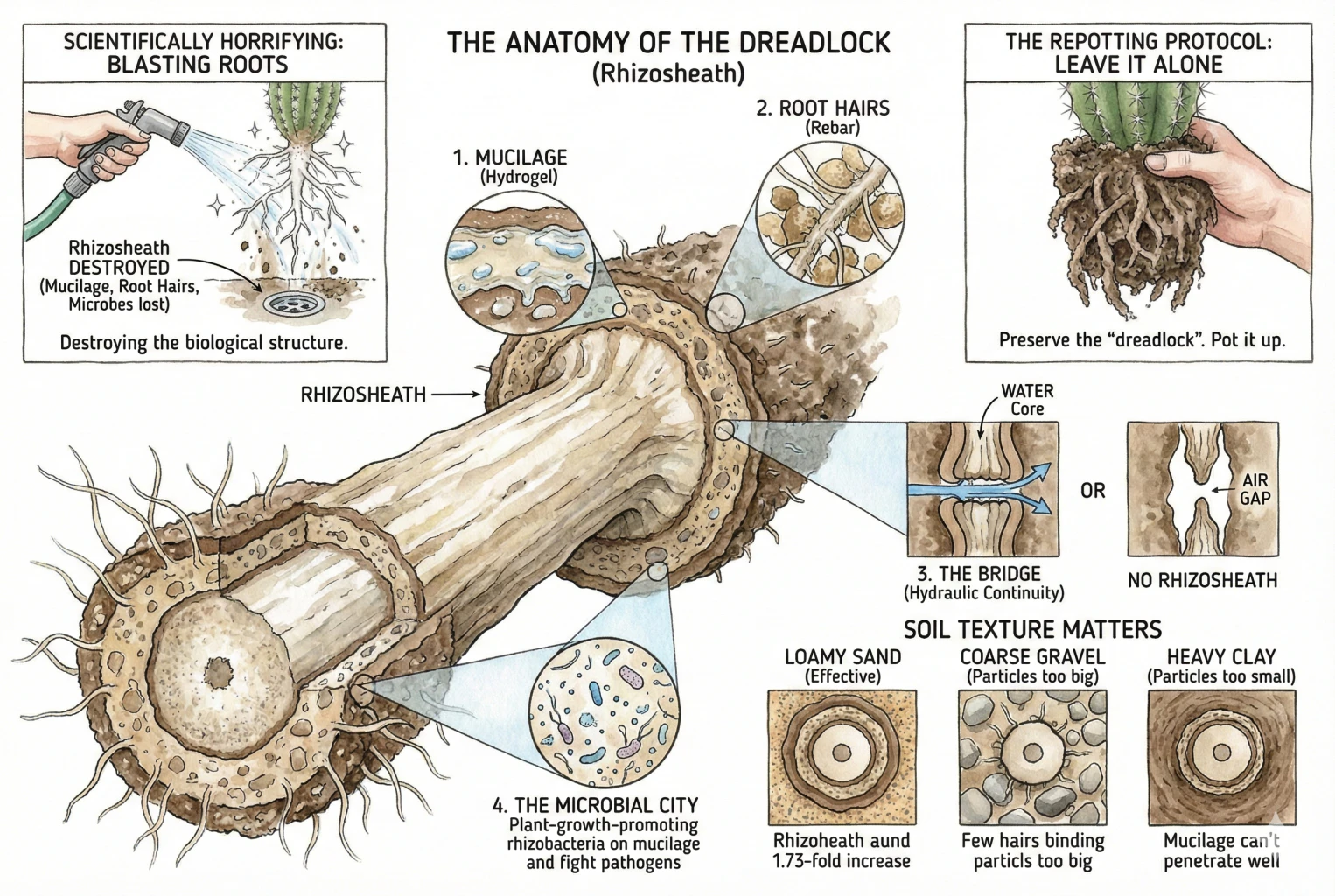
You are destroying the Rhizosheath.
The Anatomy of the Dreadlock
The rhizosheath is a layer of soil particles, sand, and organic matter that is cemented to the root surface. It’s not just dirt sticking to the root; it is a biological structure constructed by the plant.
- Mucilage: The root secretes sticky mucilage. This isn’t just slime; it’s a hydrogel. It absorbs water and holds it.
- Root Hairs: These hairs grow into the soil pores and physically bind the particles. They act like rebar in concrete.
- The Bridge: Remember the ‘Air Gap’ problem? The rhizosheath bridges the gap. Even when the root shrinks, the rhizosheath stays attached to the root, maintaining a hydraulic continuity. It holds moisture right against the root skin, allowing uptake even when the bulk soil is drying out.
Research explicitly states that the rhizosheath ‘virtually eliminates root-soil air gaps, facilitating water uptake’. It acts as a hydraulic bridge. Without it, the root shrinks, the gap opens, and uptake stops. With it, the root shrinks, but the sheath moves with it, keeping the moisture contact live.
The Microbial City
The rhizosheath is also a hotspot for microbial activity. It favors ‘plant-growth-promoting rhizobacteria’. These bacteria help solubilize nutrients and fight off pathogens. The mucilage serves as food for these microbes. It is a symbiotic city that the plant builds around its toes.
Soil Texture Matters
Interestingly, research shows that rhizosheaths form best in specific soil textures. Loamy sand is particularly effective, showing a 1.73-fold increase in rhizosheath mass compared to loam soil.
The particle size matters. If the particles are too big (coarse gravel), the root hairs can’t bind them. If they are too small (heavy clay), the mucilage can’t penetrate.
This validates the use of sand in cactus mixes—not fine play sand, which turns to cement, but coarse builder’s sand or loamy sand. It provides the perfect scaffolding for rhizosheath construction.
The Repotting Protocol
When you unpot a cactus and see a clod of soil clinging tightly to the cactus roots—looking like a dreadlock—LEAVE IT ALONE.
That is the rhizosheath. If you wash it off, you are:
- Ripping off the root hairs (the actual drinking straws).
- Removing the mucilage layer.
- Destroying the microbial colony.
- Forcing the plant to rebuild its entire interface with the soil.
The Fix: Shake off the loose soil. Leave the bound soil. Pot it up. Done. The plant worked hard to build that sheath; don’t ruin its work for the sake of a ‘clean’ photo.
Part V: The Physics of Pots (Busting the Gravel Myth)

Now we move from biology to physics. This is where most root rot happens. It’s not about ‘overwatering’ in the sense of frequency; it’s about the Perched Water Table and the geometry of your container.
The Perched Water Table (PWT)
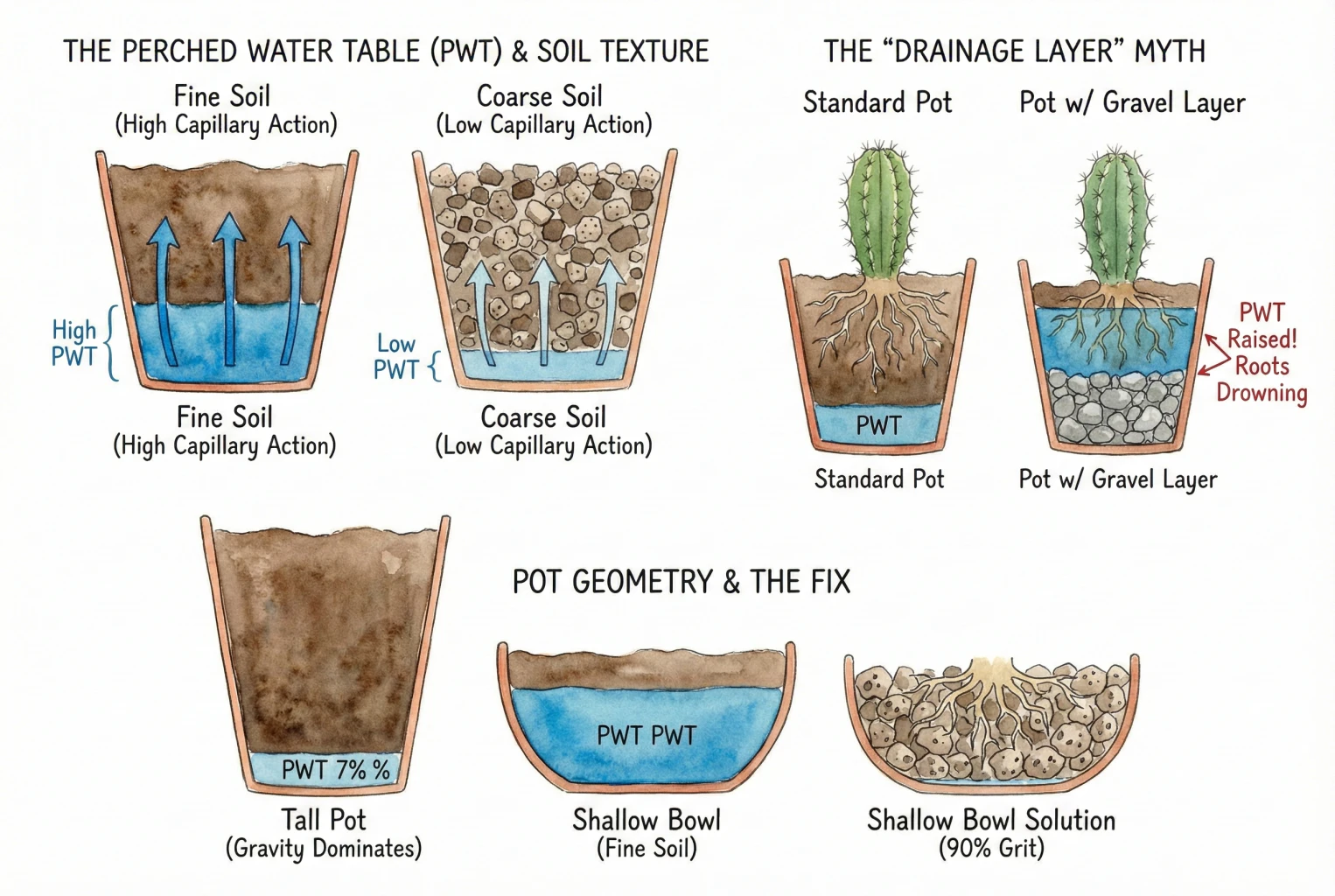
Every pot has a PWT. This is a layer of saturated soil at the bottom of the container where gravity is not strong enough to pull the water out against the capillary action (wicking power) of the soil.
Water ‘perches’ there. It’s physics. You cannot stop it. The finer the soil (peat, sand, compost), the stronger the capillary action, and the higher the PWT. The coarser the soil (pumice, grit, bark), the weaker the capillary action, and the lower the PWT.
The ‘Drainage Layer’ Lie
For 50 years, people have put gravel at the bottom of pots ‘for drainage’ Grandmothers swear by it.
Physics says this is wrong.
When you put a layer of gravel under fine soil, the water does not drain easily into the gravel. The fine soil acts like a sponge. It holds onto the water until it is fully saturated.
Water does not like to move from a fine texture (soil) to a coarse texture (gravel) until the fine texture is completely soaked. This is due to the difference in capillary pull. The soil pulls hard; the gravel pulls practically not at all.
By adding gravel, you are just moving the Perched Water Table UP, closer to the cactus roots.
If you have a 6-inch pot and put 2 inches of gravel in, you effectively now have a 4-inch pot. The PWT height is determined by the soil mix, not the pot depth. So if your soil supports a 2-inch PWT, that 2 inches of sludge is now sitting 2 inches higher in the pot—right where your cactus roots are sitting.
Table 1: The Effect of Pot Shape and ‘Drainage Layers’ on Root Zone Saturation
| Pot Configuration | PWT Height (Example) | Usable Root Space | Risk of Rot |
|---|---|---|---|
| Standard Tall Pot | 1 inch at bottom | 90% Aerated | Low |
| Shallow Bowl/Pan | 1 inch at bottom | 50% Aerated | High |
| Tall Pot w/ Gravel Layer | 1 inch above gravel | Reduced by Gravel Vol. | Increased |
| Shallow Bowl w/ Gravel | 1 inch above gravel | Almost Zero | Critical |
Tall Pots vs. Shallow Bowls
We often hear ‘cacti have shallow roots, so use shallow pots’
Research shows Opuntia and Mammillaria often have roots in the top 10-30cm. However, physics dictates that Tall Pots Drain Better.
Gravity works vertically. A taller column of soil creates more downward pressure (gravitational potential). This pushes the water out of the bottom more effectively. A shallow pan has very little gravitational pressure, so it stays wetter (higher PWT percentage).
The Conflict:
- Botany says: Roots want to spread wide and shallow.
- Physics says: Shallow pots stay soggy.
The Solution:
If you use shallow ‘azalea’ pots or bowls for aesthetic reasons (which look great with caudex plants), your soil mix must be incredibly coarse. You cannot use standard potting soil in a shallow bowl. You need 70-90% grit/pumice/akadama/turface to destroy the capillary action, because gravity won’t help you there. You have to manually lower the PWT by increasing particle size.
Part VI: The Oxygen Wars (Why Compaction Kills Cactus Roots)

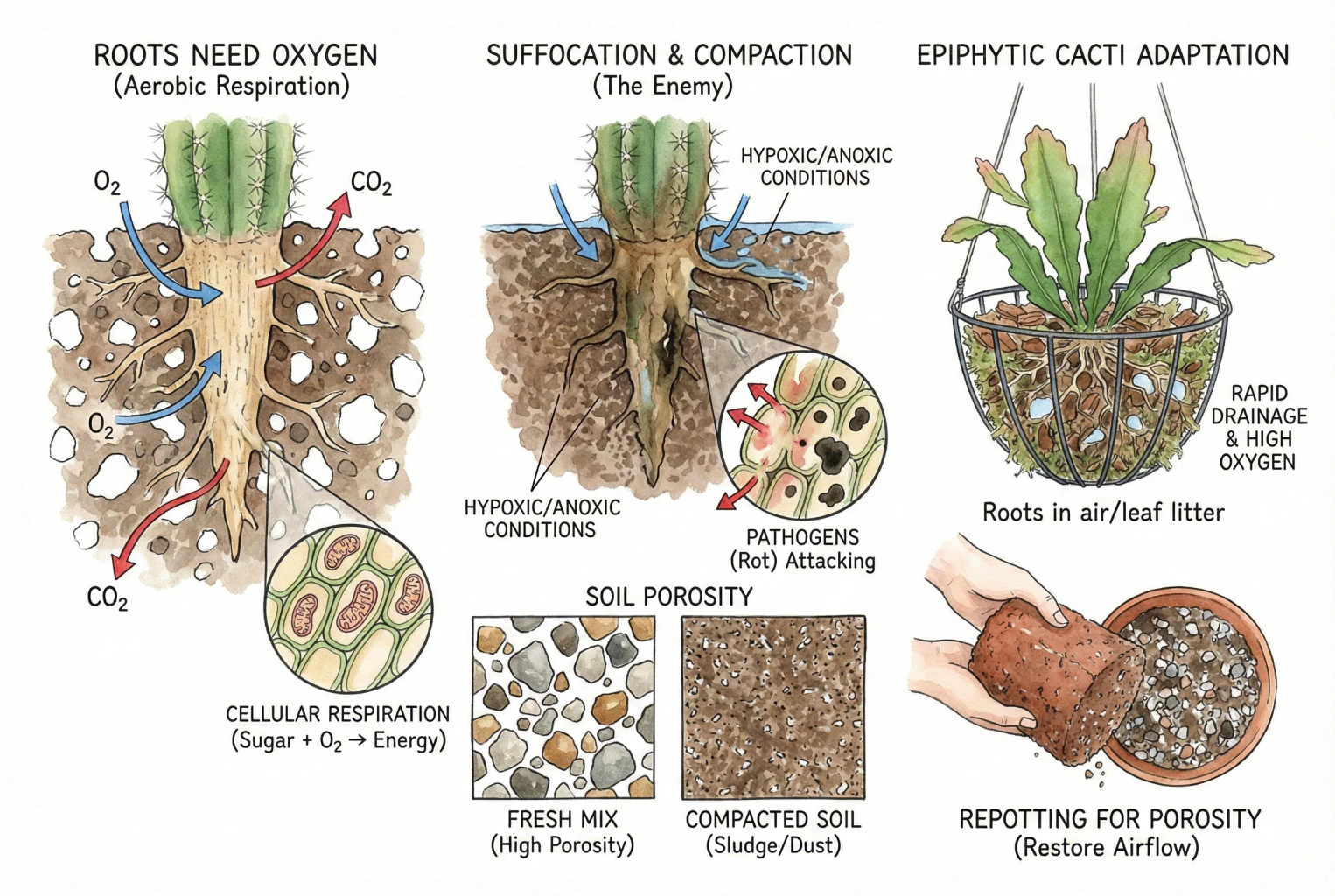
cactus roots don’t just drink water; they breathe oxygen. This is a concept that is often lost. Roots are aerobic organs. They perform cellular respiration just like we do. They burn sugar to make energy, and they need oxygen to do it.
In waterlogged soil, oxygen diffusion stops. Water blocks the pores. The roots go hypoxic (low oxygen) or anoxic (no oxygen). When this happens, energy production crashes. The root cells can’t maintain their cell membranes, and they start to leak. This leakage attracts pathogens (rot). The ‘rot’ is often a secondary infection; the primary cause was suffocation.
Aerenchyma: The Scuba Gear
Some plants (like rice or wetland species) grow ‘aerenchyma’—air tubes in their roots—to pipe oxygen down from the leaves. Desert cacti are generally terrible at this. They did not evolve in swamps. They rely entirely on soil porosity to bring oxygen to them.
However, epiphytic cacti (like Rhipsalis, Epiphyllum, Christmas Cactus) are different. They come from tropical forests, often growing in pockets of humus on trees. They deal with ‘episodic’ moisture. Research suggests they are slightly better adapted to moister conditions, but they still rely on rapid drainage and high oxygen environments. Their roots in nature are hanging in the air or buried in loose leaf litter. They are not buried in mud.
The Enemy: Soil Compaction
Over time, organic soil breaks down into dust. Peat moss decomposes. Bark rots. This dust fills the pores between the grit. This creates ‘soil compaction’
Research confirms that compaction significantly reduces root length, diameter, and the ability to find water.
- Porosity Reduction: Compaction kills the large pores (>500 microns) that cactus roots need to penetrate and breathe.
- Mechanical Impedance: It literally becomes too hard for the roots to push through. The ‘elongation rate’ of the root drops to zero if the soil strength is too high.
The Takeaway:
You aren’t repotting to give the plant ‘more room’ Cacti like tight shoes. You are repotting to restore porosity. You are repotting to get rid of the sludge/dust that is suffocating the roots. If your pot feels like a brick, your plant is suffocating, even if you are watering correctly.
Part VII: Temperature Stress – The Goldilocks Zone

We worry about freezing our plants, but we rarely worry about cooking the cactus roots. We should.
The Shallow Root Hazard
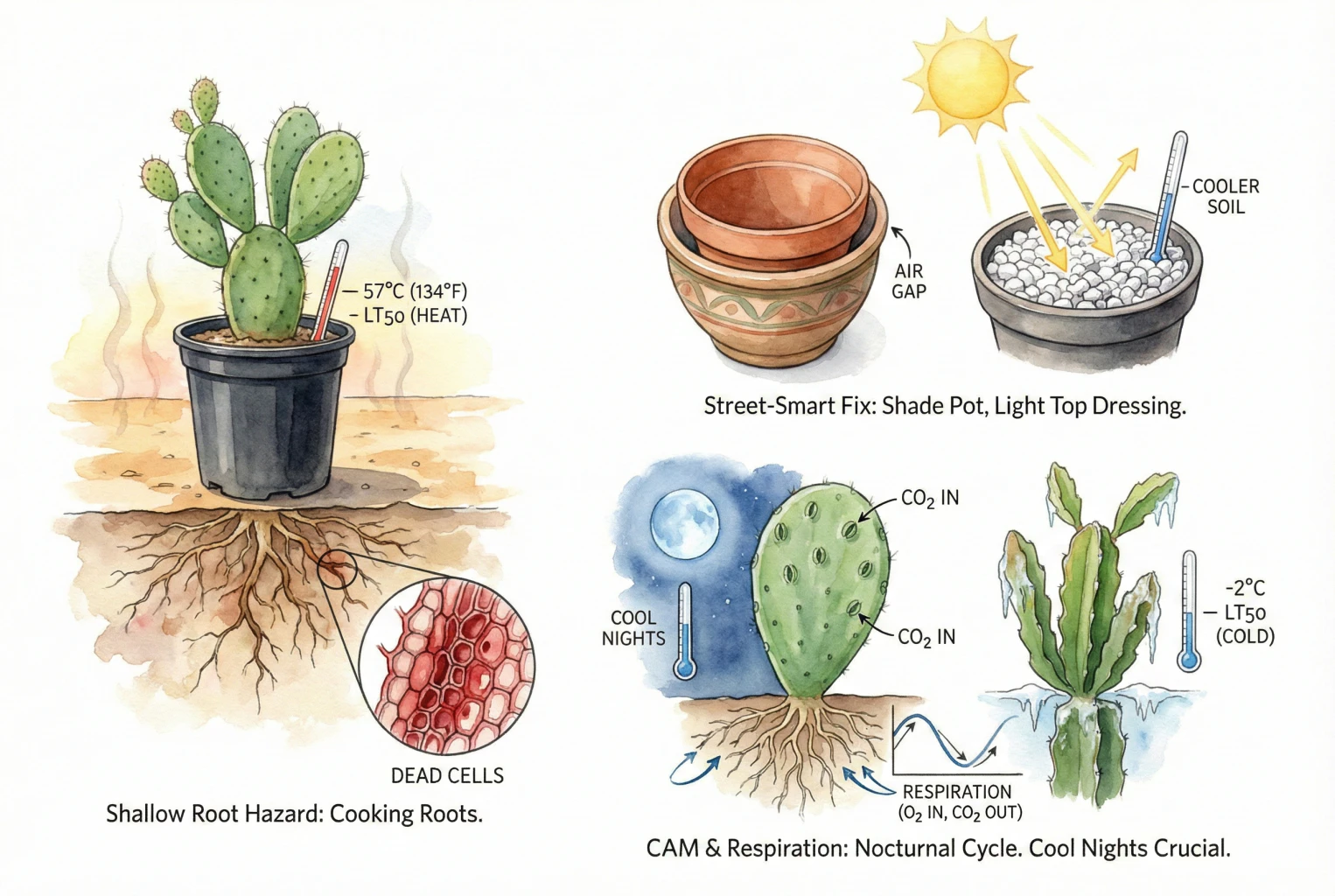
Because cactus roots are naturally shallow (often in the top 10cm of soil to catch that light rain), they are exposed to extreme temperature fluctuations. The soil surface gets incredibly hot in the sun and incredibly cold at night.
Lethal Temperatures (LT50)
Research has quantified the ‘Lethal Temperature 50’ (LT50)—the temperature at which 50% of the root cells die.
- Heat: For Opuntia, the root LT50 is around 57°C (134°F).
- Cold: The root LT50 is around -7°C (19°F).
- Hylocereus (Dragon Fruit): Is much more sensitive. Its cold limit is -2°C, and heat limit is 52°C.
Why This Matters:
In a black plastic pot sitting in the afternoon sun, soil temperatures can easily exceed 50°C. You might be cooking your roots without knowing it. The plant looks fine, but it stops growing because its feeder roots are being pasteurized daily.
Street-Smart Fix:
- Shade the Pot, Not the Plant: If you have sensitive specimens, put the pot inside a larger decorative pot (double potting) to create an air gap insulation layer.
- Top Dressing: Use a light-colored gravel top dressing (like white pumice or quartzite). This reflects sunlight and keeps the soil underneath cooler. Dark lava rock absorbs heat.
CAM Metabolism and Respiration
Cacti use Crassulacean Acid Metabolism (CAM). They open their pores (stomata) at night to breathe CO2, saving water.
Interestingly, soil respiration (roots breathing) under cactus crops tracks this CAM rhythm. The roots are metabolically active and respiring, but the whole system is tuned to this nocturnal cycle.
This implies that night-time conditions are crucial. If the nights are too hot (tropical nights), CAM photosynthesis becomes inefficient. The plant burns up its reserves just trying to stay alive. Cool nights are the secret to happy cactus roots and happy cacti.
Part VIII: The Fog Drinkers – Foliar Uptake
We have focused on cactus roots, but we have to mention the ‘other’ root system: The Leaves/Spines.
Research on the Coast Redwood ecosystem showed that 80% of dominant species utilize foliar uptake of fog. But this isn’t just for redwoods. Desert cacti are masters of this too.
- Trichome Clusters: Cacti like Opuntia have trichome clusters and microscopic structures on their spines and epidermis designed to capture fog and dew.
- Inflow Pathways: The water condenses on the spines, runs down to the areole (the spine base), and is absorbed directly into the cortex.
The Implications:
In extremely arid environments where rain never falls, fog is the only water source. The ‘roots’ might be completely dormant, but the plant is sipping from the air.
In cultivation, this means misting can actually be beneficial, but only if done correctly. It mimics the coastal fog. However, if you mist in a stagnant, humid room, you invite fungus. Misting works best with high airflow—mimicking the wind-blown fog of the habitat.
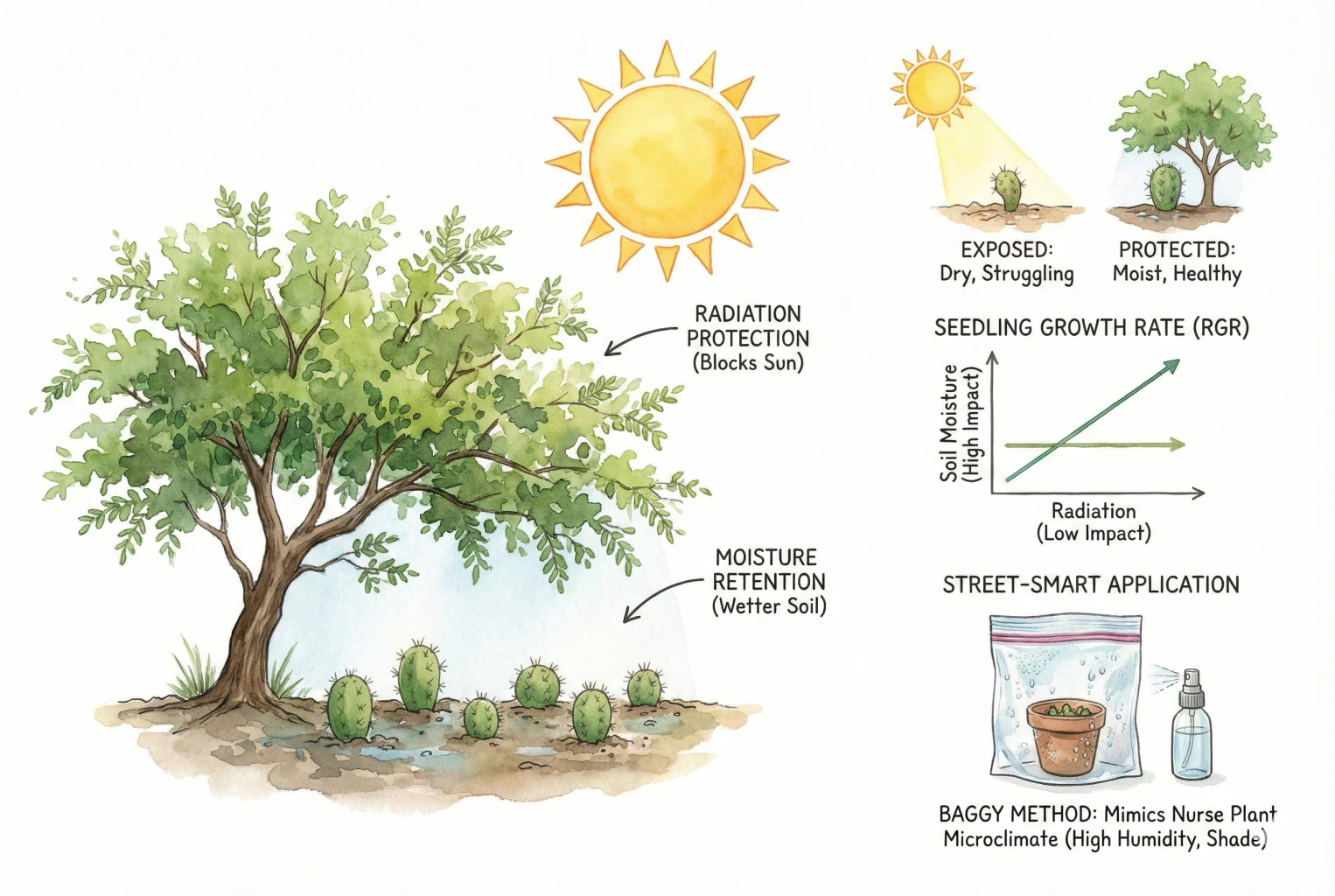
Part IX: The ‘Nurse Plant’ Effect and Seedlings

If you are growing from seed, the rules are different. Adult cacti are tanks; seedlings are water balloons.
In nature, cactus seedlings almost always establish under Nurse Plants (shrubs, bushes, or even other cacti).
- Radiation Protection: The nurse plant blocks the scorching sun. Research shows radiation levels under nurse plants are significantly lower.
- Moisture Retention: The soil under a nurse plant stays wetter longer.
- Root Competition: You might think the nurse plant would steal the water, but the benefit of the shade outweighs the cost of the competition.
Research on Growth Rates:
Studies on Mammillaria and other genera show that seedlings respond massively to soil moisture but show no response to radiation treatments in terms of growth rate (RGR). This means that for a baby cactus, water is the limiting factor, not light.
Street-Smart Application:
When sowing seeds, don’t blast them with 100% sun. They don’t need it yet. They need consistent moisture. The ‘Baggy Method’ (sealing pots in ziplock bags) works because it mimics the humid, protected microclimate under a nurse plant. Keep them wet and shaded until they develop their first true spines and thickened skin.
Part X: Soil Mix – The Holy Grail Recipe
Based on all this science—hydraulic conductivity, rhizosheaths, air gaps, and oxygen—what is the ‘Best’ soil mix for cactus roots?
There is no single ‘best,’ but there is a ‘best principle’
The Principle: You need a mix that holds water in micro-pores (for the rhizosheath and root hairs) but drains water from macro-pores (for oxygen and to prevent the perched water table).
The Components:
- Pumice / Scoria (50-70%): These are volcanic rocks. They are full of holes. They hold water inside the rock (micro-pores) but allow air to flow around the rock (macro-pores). This is superior to Perlite, which floats and crushes.
- Coarse Sand / Decomposed Granite (10-20%): This provides the ‘matrix’ for the cactus roots to anchor and build rhizosheaths. Remember, loamy sand was the best for rhizosheaths. You need some grit, not just big rocks.
- Organic Matter (10-20%): Coir, sifted potting soil, or worm castings. This provides the nutrient exchange sites. But keep it low to prevent compaction.
The ‘Anti-Mix’:
- Avoid Peat Moss: It becomes hydrophobic when dry (hard to re-wet) and a sponge when wet. It compacts.
- Avoid Fine Sand: It fills the air gaps between the big rocks and turns into concrete.
- Avoid ‘Drainage Layers’: We already busted this myth. Mix your grit into the soil, don’t put it at the bottom.
Conclusion: The Expert’s Manifesto
We have covered hydraulic valves, shrinking mechanics, soil physics, and fog drinking. Here is your cheat sheet for applying this decade of science to your cactus roots and collection this weekend:
- Respect the Dormancy Valve: If a plant has been dry for months, do not flood it. Its safety valve is closed. Give it a small ‘pulse’ of water (a few tablespoons) and wait 3-5 days for the roots to re-inflate and the embolisms to repair before deep watering.
- Save the Rhizosheath: When repotting, never wash the roots clean. Preserve the ‘dreadlocks’ of soil. That is the plant’s bridge to the world.
- No Gravel at the Bottom: Fill the pot with uniform soil mix from top to bottom. If you want better drainage, mix the gravel into the soil, not under it.
- The Shallow Pot Rule: If you use a shallow pot, your soil must be chunkier. If you use a deep pot, you can get away with slightly more organic matter because gravity helps you drain.
- Don’t Fear the Wrinkle: Shriveled cactus roots during a repot aren’t necessarily dead; they are just in ‘air gap’ mode. Plant them. They will likely wake up.
- The 2mm Rain Rule: During the hot growing season, light sprinklings that simulate a 2-6mm rain event can trigger massive feeder root growth without the risk of deep soil rot.
- Mind the Temperature: Don’t cook your roots. If your pots are in baking sun, shade the pot or top-dress with light gravel.
Gardening isn’t magic. It’s engineering. These plants are survivors, but they are surviving based on a specific set of physical laws. Treat your cactus roots like the sophisticated hydraulic machines they are, and they’ll reward you with growth that defies logic.
Now, go get your hands dirty.
Technical Appendix: Key Research Concepts Simplified
| Concept | Scientific Definition | Street-Smart Translation |
|---|---|---|
| Hydraulic Rectifier | Mechanism allowing water flow in one direction while resisting backflow. | A check valve. Water checks in, but it doesn’t check out. |
| Rhizosheath | Mucilage-bound soil sheath around roots. | The root’s ‘wet suit’ Keeps it moist even in dry sand. |
| Rain Roots | Ephemeral roots induced by moisture pulses. | ‘Pop-up’ roots. Cheap, fast, disposable. |
| Perched Water Table | Saturated zone at the pot bottom due to capillary action vs. gravity. | The ‘Soggy Bottom’ layer. Unavoidable, but manageable. |
| Root Shrinkage | Radial reduction in root diameter during drought. | The root gets skinny to stop touching dry dirt. |
| Suberization | Deposition of suberin (cork) in cell walls. | Waterproofing. Turning the root into a sealed pipe. |
| Cortical Lacunae | Collapsed cell spaces in the cortex during drought. | Controlled collapse. The root sacrifices the skin to save the core. |
| Lethal Temperature (LT50) | Temp at which 50% of cells die. | The cooking point. 57°C for Opuntia. |
Citations & Further Reading
Here are the key scientific papers and sources used to build this guide:
On Drought Recovery & Rain Roots:
https://www.biorxiv.org/content/10.1101/2022.05.01.490238.full
On Root Shrinkage & Air Gaps:
On Hydraulic Safety Valves:
https://www.biorxiv.org/content/10.1101/2022.05.01.490238.full
On Rhizosheaths:
On Pot Physics & The ‘Gravel Myth’:
On Temperature Stress:
https://www.ishs.org/ishs-article/811_52
On Foliar Uptake:


Leave a Reply