
Succulent Care Tips: Evidence, Light, Water, and Stress Color
Evidence-led succulent care tips covering light spectrum, winter root oxygen, seedling water needs, and the trade-off between stress color and growth.
Nathan Brooks · 2025-12-28 · Updated 2026-03-07 · 15 min read
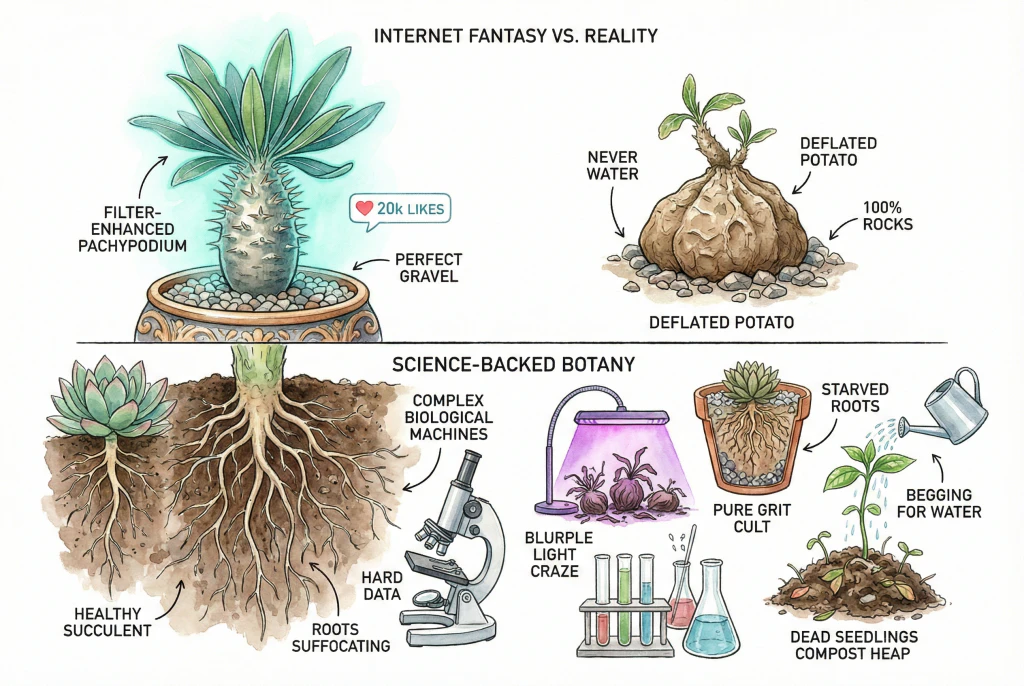
Key Takeaways
- Full-spectrum white LEDs are a great, practical choice for succulents. Green light reaches deeper into leaves and white makes pests and problems far easier to spot, but good red/blue "blurple" lights grow plants well too.
- Both waterlogging and cold can hurt roots in winter, so favor a gritty, free-draining mix and water sparingly when cold. Don't assume every winter loss is "suffocation" rather than cold, dryness, or disease.
- Young seedlings are less drought-hardened than mature succulents, so keep them lightly moist, not bone-dry. Still avoid the sogginess that causes damping-off.
- Deep red/purple "stress color" often reflects protective pigments, and pushing hard for color can cost some growth. Healthy, well-grown plants can also be colorful, so treat it as a trade-off to manage, not an either/or.
- Cooler nights can encourage color, but mind each plant's cold tolerance. Near-10 °C nights chill tropical succulents like Adenium, so don't treat a cold snap as universally safe.
What Should Succulent Care Prioritize?
Healthy succulent care starts with root oxygen, measured light, developmental water needs, and stress kept within the plant’s tolerance.
Appearance can be a useful clue, but it is not a substitute for checking the actual root zone and growth response.
1. Succulent Care Tips for Roots: Oxygen and Water Balance
A common care mistake is treating drainage as a single number or material choice.
Adenium can grow in mineral-rich mixes, but other blends can also work when particle size, pot, climate, and watering are matched.
Keep Root-Zone Oxygen in View
Roots do not just take up water. They also need oxygen.
The root-zone science explains why a mix that stays saturated can become risky in winter even when the surface appears well drained.
1.1 Winter Waterlogging Risk
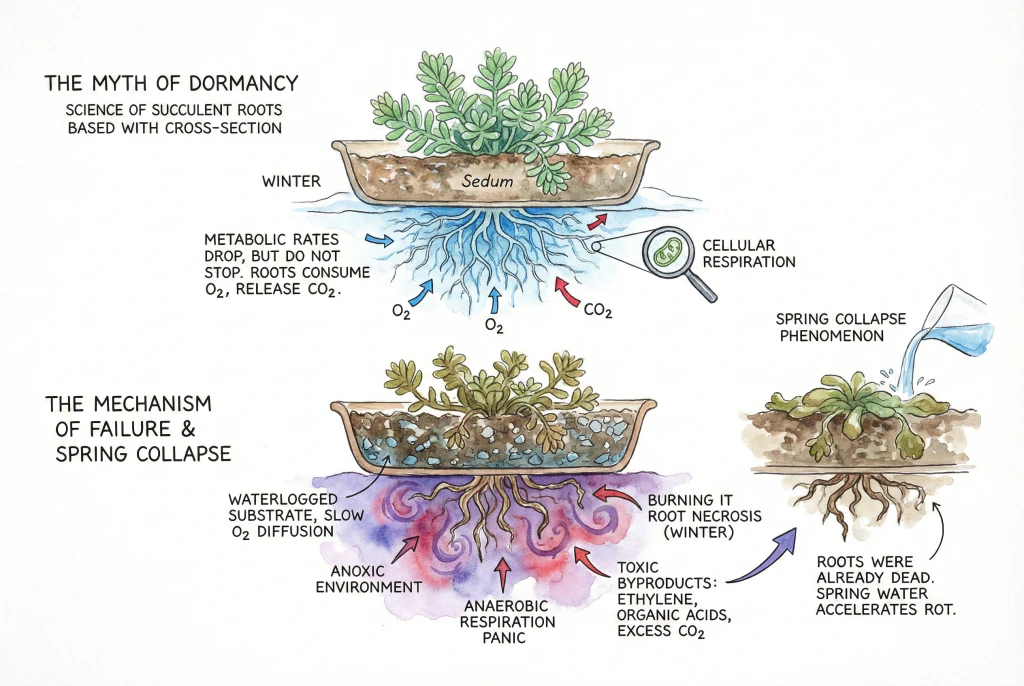
You’ll sometimes see a 2024 study on Sedum on green roofs cited to prove that shallow winter substrates drown roots.
It’s worth reading carefully, because it actually found the opposite. Across the watering treatments it tested, there was no consistent adverse effect on root mortality or on spring root regrowth. The substrates stayed porous enough to keep gas exchange going.
So it doesn’t show that a well-draining winter mix kills roots. If anything it reassures.
Treat what follows as the mechanism that can occur if a mix really does stay waterlogged and airless, not as a proven verdict on your pot.
Dormancy Is Not Complete Shutdown
Dormancy is often described as sleep, but that picture is incomplete.
Metabolic rates usually drop in the cold rather than stopping, so roots may continue respiring and consuming oxygen.
The Mechanism of Failure
In waterlogged substrate, oxygen moves far more slowly than it does through air, so diffusion and root demand can leave the root zone short of oxygen.
The size of that effect depends on porosity, temperature, particle packing, and how long the mix stays saturated.
When oxygen becomes limiting, roots can shift toward anaerobic metabolism and accumulate stress-related byproducts.
- Ethylene, a hormone that can signal stress and, at high levels, contribute to tissue injury.
- Organic acids, which can alter local pH and add to tissue stress.
- Excess carbon dioxide, which displaces still more oxygen.
Where a mix really does stay saturated and airless, these byproducts can build up and damage fine roots.
Note that ethylene is not simply a death signal. It also triggers useful adaptations to low oxygen, so this is a risk pathway rather than an inevitability.
The ‘Spring Collapse’ Phenomenon
Sometimes a plant looks fine all winter, then turns to mush after the first spring watering.
Waterlogged, low-oxygen roots over winter are one plausible cause, but they’re not the only one.
Cold injury, freeze-thaw damage, desiccation, salt buildup, and disease can all leave a plant that looks okay until it’s stressed by watering.
So resist the tidy verdict that it was already dead in January and none of it was your watering. The honest answer is that late-winter/early-spring collapse has several possible causes, and a too-wet, too-cold root zone is just one to rule out.
1.2 Carbon and the Growing Medium
What about the pure-grit crowd who prize soilless mixes as sterile?
A review of root exudates notes that plants in soilless systems can show higher total carbon exudation than in natural soil.
It’s a real observation, but a much narrower one than it’s often made out to be.
A carbon ‘cost’? Maybe, but don’t overstate it
Plants do release sugars and carbon that help support a root-zone microbiome.
It’s a reasonable idea that a low-organic mix changes exudation.
But the review itself says exudation depends heavily on species, plant age, nutrients, light, temperature, and method, and that the effect of growing-media composition is still not well understood, so pure pumice wastes so much sugar it starves your caudex goes well beyond the evidence.
Keep the sterile-mix claim bounded
A soilless mix isn’t truly sterile in practice because microbes colonize it from water, air, and the roots. Adding organic matter also doesn’t automatically create a beneficial microbiome, since fine or decomposing organics can reduce air space.
A gritty mineral mix works well for many caudiciforms. If you want some biological buffering you can add a little quality organic matter, but you don’t have to in order to avoid starving the plant.
1.3 The Scientific Soil Mix: Data-Driven Succulent Care Tips
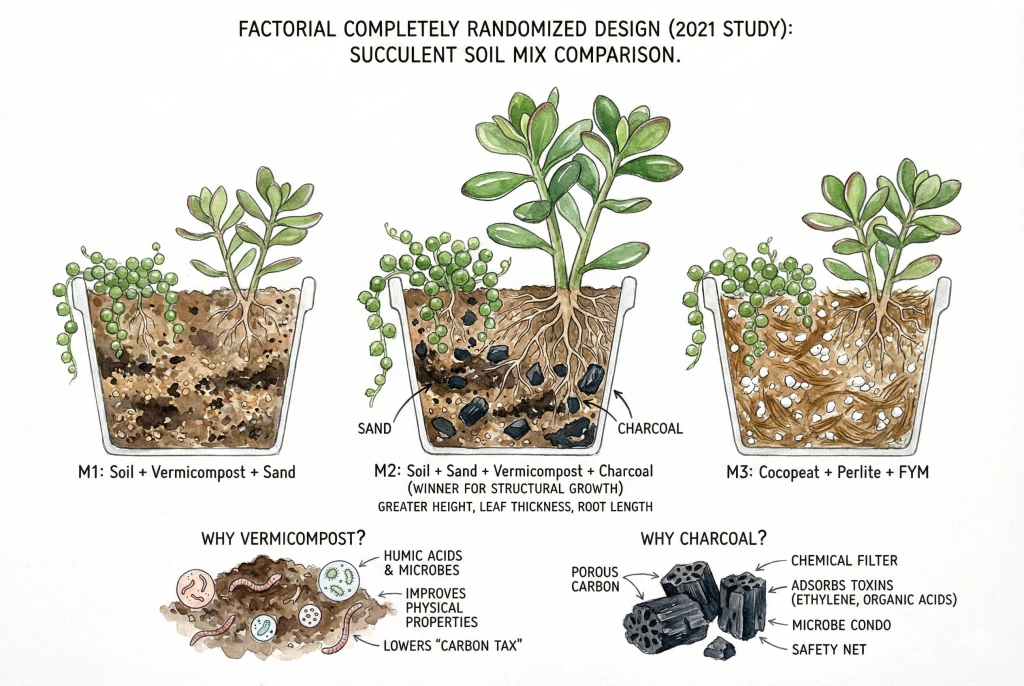
So if pure grit starves the plant and heavy soil drowns it, what wins?
A 2021 trial tested several media on succulents including Senecio rowleyanus and Crassula ovata.
They compared three mixes.
- M1: soil, vermicompost, and sand.
- M2: soil, sand, vermicompost, and charcoal.
- M3: cocopeat, perlite, and farmyard manure.
In that trial, one mix performed better for the measured growth traits, but the result does not prove that the same ingredients or ranking apply to every succulent, pot, or climate.
Why Vermicompost?
Vermicompost can add nutrients and biological material, while peat-based mixes may behave differently as they dry.
Neither ingredient automatically fixes a root-zone problem. Particle size, water quality, and dry-down still control performance.
Why Charcoal?
Charcoal is a porous amendment whose effects vary with feedstock, particle size, and pH.
It is not reliable overwatering insurance and should be treated as optional rather than a detoxifier.
Use the mix as a starting point
A mix along these lines is a sensible starting point, not a validated recipe because the cited trial did not test this exact blend or these ratios.
- A mostly gritty inorganic base (pumice or scoria, not fine sand) for drainage and air, with the proportion adjusted to the pot and climate.
- A modest organic fraction, such as vermicompost, only if the mix still dries and re-oxygenates predictably.
- Optionally a little horticultural charcoal.
Treat charcoal as optional
If you want to include charcoal, horticultural charcoal is widely available. Be honest about what it does, though. It is an optional amendment whose effects vary with feedstock, particle size, and pH, and there’s no good evidence it adsorbs winter toxins enough to serve as overwatering insurance. It’s not a fertilizer, and it isn’t essential. A plain gritty mix with a little organic matter can also be workable.
1.4 Size Matters: The Root Diameter Connection
Do not borrow root-anatomy claims
Do not assume that fleshy-rooted caudiciforms have built-in snorkels (aerenchyma) that make them rot-resistant. The study usually cited for thicker roots having higher porosity is a rice-breeding paper about flooded-rice genotypes. It did not examine Adenium, Cyphostemma, Pachypodium, or any succulent, and it does not establish that caudex roots have aerenchyma or resist rot.
So don’t assume fat-rooted succulents are safe in wet soil.
Caudiciforms can be vulnerable to root rot in cold, wet conditions, and a fast-draining mix plus careful watering matters for them just as it does for fine-rooted Echeveria.
2. Succulent Care Tips for Lighting: White and Red/Blue Spectra
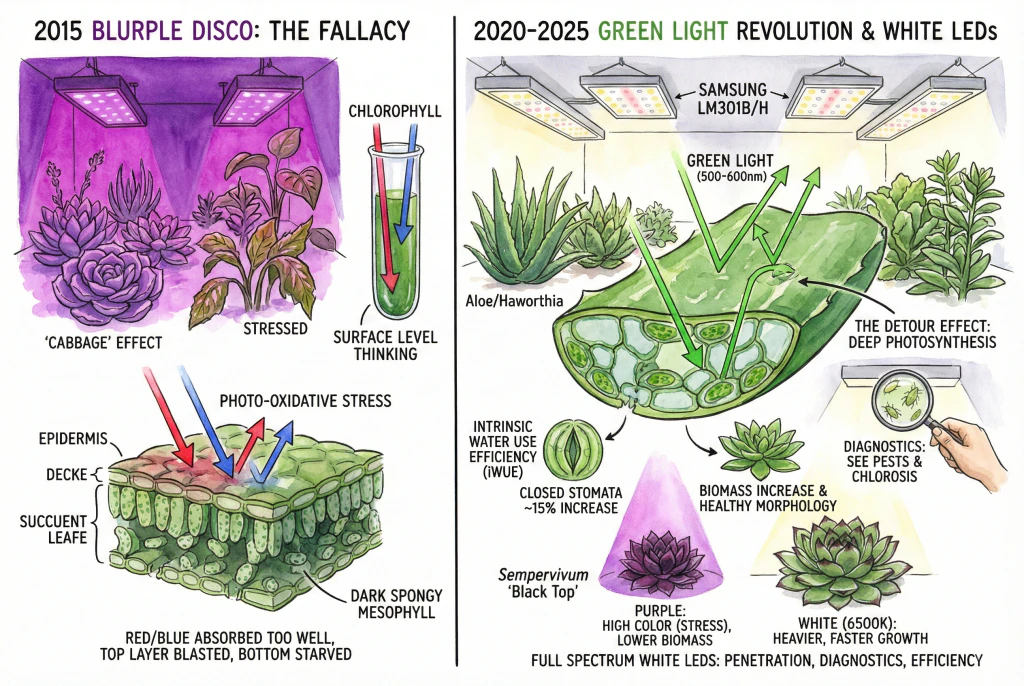
Red-and-blue fixtures became popular because chlorophyll absorbs those bands strongly in simplified experiments.
Whole leaves and whole canopies respond to spectrum, geometry, intensity, and heat together.
Recent work highlights that green wavelengths can also contribute to photosynthesis in deeper leaf layers, but no single spectrum wins in every plant or fixture.
2.1 Why Spectrum Claims Need Context
Here is why red and blue lights took off.
Pull chlorophyll out of a leaf and into a test tube and it absorbs blue and red strongly while ignoring green, so engineers concluded that everything but red and blue was waste.
The problem is that a leaf is not a test tube.
It is a layered 3D structure, and red and blue light are absorbed so well that the very top layer snatches them up.
- The upper leaf layers can absorb strongly, while deeper mesophyll receives a different balance of light.
- Under some red/blue setups, canopy geometry and intensity can create self-shading. Fixture design and coverage still matter.
2.2 Green Light and Deeper Leaf Layers
Thick leaves can respond differently to spectrum because strongly absorbed wavelengths are attenuated near the surface.
Green wavelengths may penetrate deeper and contribute to photosynthesis in lower layers, but the size of the effect depends on species, intensity, and leaf structure.
- Green light can contribute to photosynthesis in deeper leaf layers, especially in thick foliage, but it is not automatically more efficient in every setup.
- Water-use response varies with species and intensity. A green component is not a substitute for sound watering and root care.
2.3 White LEDs as a Practical Option
| Feature | ‘Blurple’ (Red/Blue) | Full Spectrum (White) | Why It Matters |
|---|---|---|---|
| Leaf Penetration | Depends on spectrum and leaf structure | May reach deeper layers | Useful context for thick succulent leaves |
| Water Efficiency | Variable | Variable | Do not infer watering from colour alone |
| Visual Check | Harder to assess by eye | Natural-looking, easier to inspect | Colour and pests are easier to see |
| Ease of use | Depends on fixture | Depends on fixture | Coverage and output still require measurement |
Read spectrum claims in context
A 2024 meta-analysis found that adding green light gave broadly similar dry biomass to red/blue light, not clearly more, so white grows bigger plants while blurple stunts them overstates it.
The honest case for white is penetration into thick leaves plus much easier visual inspection, not a proven biomass win over good blurple fixtures.
For many indoor collections, a broad white spectrum is a practical choice because it supports useful plant growth and makes pests and colour changes easier to inspect.
Good red/blue fixtures can also work. The fixture’s output and coverage matter more than a slogan.
Three practical reasons to prefer white LEDs
- Potential penetration into thicker leaves, depending on the spectrum and leaf structure.
- Diagnostics, because plant colour and pests can be harder to assess under purple light, while a high-CRI white light makes inspection easier.
- Practical fixture efficiency and coverage, which must be checked from the actual model rather than inferred from colour alone.
Choose white for inspection, not a guaranteed biomass advantage
White light is an excellent, easy daily driver, but the claim that blurple necessarily yields smaller, lower-biomass plants isn’t well supported.
Pick white for penetration and easy inspection, not because blurple is doomed to stunt your plants.
A high-CRI white LED bulb works well as a simple white source. Colour temperature varies between bulbs, so check the current specification rather than assuming a fixed range, and confirm the light reaching the canopy with a meter if possible. If you want to compare fixtures on hard numbers, it helps to choose a grow light by PPFD and DLI rather than wattage or colour alone.
Position any lamp according to its measured canopy output and acclimate gradually. The suitable photoperiod depends on the plant and fixture.
Match fixture coverage to the shelf
One bulb covers a small footprint, while a bar or panel can spread light more evenly.
3. Succulent Care Tips for Seedlings: Developmental Water Use
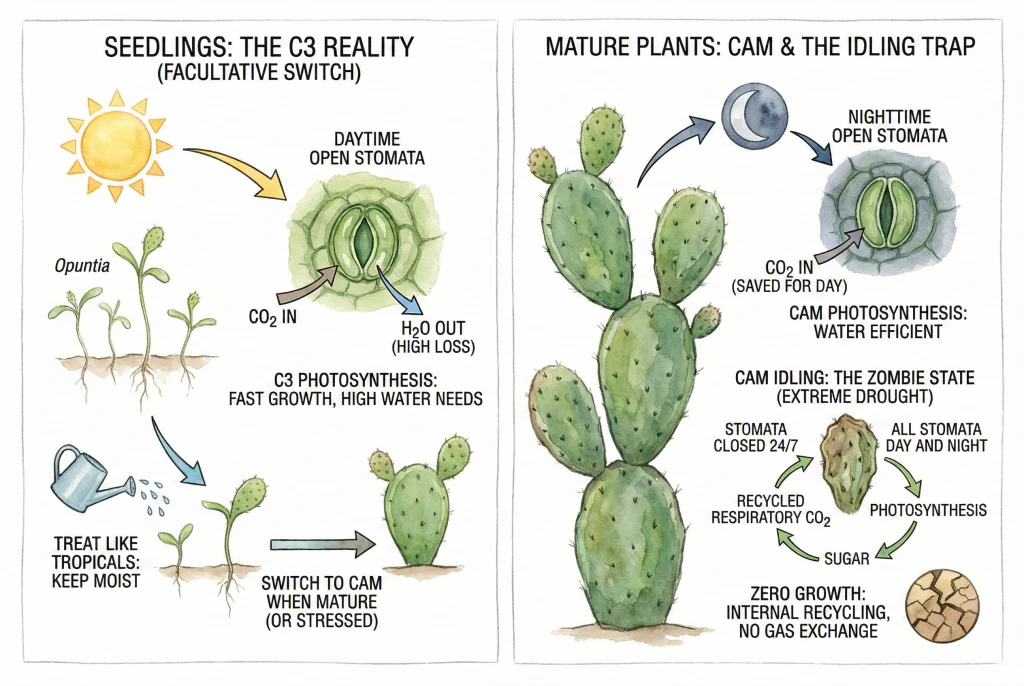
Succulents are often described through CAM photosynthesis, in which stomata open at night and close by day to limit water loss.
That shorthand can lead to strict watering and harsh dry spells being applied to every succulent, even though species and developmental stage differ.
Keep Seedling Care Separate from Adult Drought Rules
Seedlings and mature plants can have different water-use and light responses, so adult drought rules should not be copied without observation.
3.1 The ‘Facultative’ Switch
Research on Opuntia, the prickly pear, found that young seedlings can rely more on C3 photosynthesis before CAM becomes dominant.
The study tracked gas exchange in Opuntia elatior. Other succulent genera may differ.
- In that study, seedlings below an early developmental size relied mainly on C3 photosynthesis. Do not transfer the reported height to every genus.
- C3 is normal daytime photosynthesis, with stomata open by day, faster water loss, and faster growth.
- They did not shift to night-time CAM until they developed true pads, or were forced over early by drought stress.
If you treat a young seedling like a mature drought-adapted plant and let it dry for too long, growth can stall.
Keep the root zone lightly and evenly supplied with moisture while avoiding saturation, then taper as the plant develops and the medium dries predictably.
3.2 CAM Idling Under Water Stress
Under severe water limitation, some CAM plants enter an idling state with very low gas exchange.
This is a stress response, not a target growing condition.
During severe water limitation, a CAM plant can close stomata and recycle internal carbon dioxide, reducing net carbon gain while maintaining basic metabolism.
- Growth can approach zero while the plant maintains basic metabolism.
- A summer stall can have several causes, heat dormancy, root problems, or simply too little water, so don’t assume it’s always “CAM idling from drought.”
- Not every succulent is CAM. The group includes CAM, facultative-CAM, and plain C3 species, and the same plant can behave differently by age and organ.
- Where a plant is genuinely water-limited, watering enough to keep it functioning without waterlogging is the fix.
4. Succulent Care Tips on Stress Color and Growth
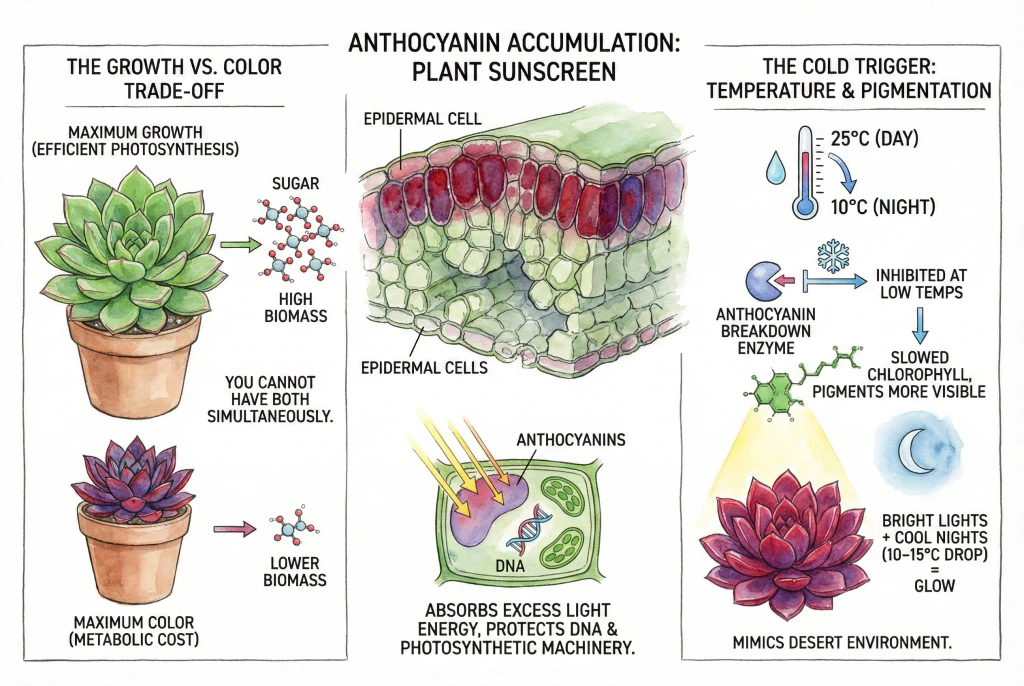
Those deep reds and purples often come from protective pigments. They are commonly anthocyanins, which act as a light screen in the outer cells to absorb excess light that could otherwise cause photo-oxidative damage.
Keep Pigment Explanations Bounded
Color can also come from carotenoids, loss of chlorophyll, or, in many succulent lineages, betalains rather than anthocyanins. The sunscreen role described here is mainly about visible-light and excess-light screening, not proven DNA protection.
4.1 The Metabolic Cost of Protective Pigments
Making those pigments requires carbon and metabolic energy.
Some studies find that plants under strong stress light allocate more to pigmentation and less to biomass, but the size of that trade-off varies.
- There is a genuine trade-off. Pushing hard for deep color, especially through strong light or stress, can come at some cost to growth. It is not a strict either-or choice, and healthy, well-grown plants can still color up nicely.
- A reasonable approach if you want size: grow the plant well and let it bulk up, and lean into color-inducing conditions in moderation rather than deliberately stressing a plant to the edge just for a photo. Don’t sacrifice the plant’s health for the camera.
4.2 Cooler Nights as One Possible Cue
Cooler nights can deepen pigmentation in some succulents such as Senecio, but temperature is only one cue and must stay within the species’ tolerance.
- The mechanism is that low temperatures slow the enzymes that break down anthocyanins, and they also slow chlorophyll, which makes the red pigments more visible.
- Keep light bright and let nights run cooler than days. Mind each plant’s cold tolerance, though: a large night-temperature drop toward ~10 °C can chill or damage cold-sensitive tropical succulents (Adenium, Pachypodium and the like), so this is not universally “safe”. Use a modest, species-appropriate cool-down, not an extreme one.
5. Conclusion: Evidence-led Succulent Care
The Practical Boundaries
Root oxygen depends on the whole water-and-air balance, spectrum claims need a measured fixture and plant context, seedlings do not always share adult drought behavior, and stress color should not replace healthy growth.
- Mind the air, not just the drainage. Roots need oxygen, so use a gritty, free-draining mix and don’t keep it soggy, especially in cold weather. A little organic matter is fine, but a mineral mix isn’t a “dead” mix.
- White LEDs are a great, easy choice: green light penetrates thick leaves and you can actually see your plants. Good blurple lights still work, so it’s a “prefer white,” not a “blurple is useless.”
- Go easy on seedlings. They’re less drought-hardened than adult succulents, so keep them lightly moist (not soggy) rather than bone-dry.
- Manage color gently. Cooler nights and good light can bring out color without starving or extreme-drought-stressing the plant, but respect each plant’s cold tolerance.
Use oxygen, photons, water balance, temperature, and plant response as the decision framework. Record the setup and adjust one variable at a time so an attractive appearance does not replace evidence of healthy growth.
Before I trust a styled surface, I insert a wooden skewer to the same root depth. When the skewer comes out dry, I empty the cachepot and weigh the complete setup as its dry reference.
After watering thoroughly, I wait until the drainage holes stop dripping, empty the cachepot, and record the drained mass. I reweigh at the same hour every 24 hours, always noting and emptying any water that has collected below the nursery pot.
If the surface looks dry while the mass remains above the reference, I delay watering and inspect the drainage holes and lower mix. The scale reveals retained water that an opaque cachepot or decorative top layer can hide.