
Jatropha Cathartica Caudex Care: Watering Without Rot
Jatropha cathartica caudex care and watering: why berlandieri is the same plant, how to ID look-alikes, and how to keep a dormant caudex from rotting without over-restricting water.
Rachel Torres · 2026-06-14 · Updated 2026-07-08 · 16 min read
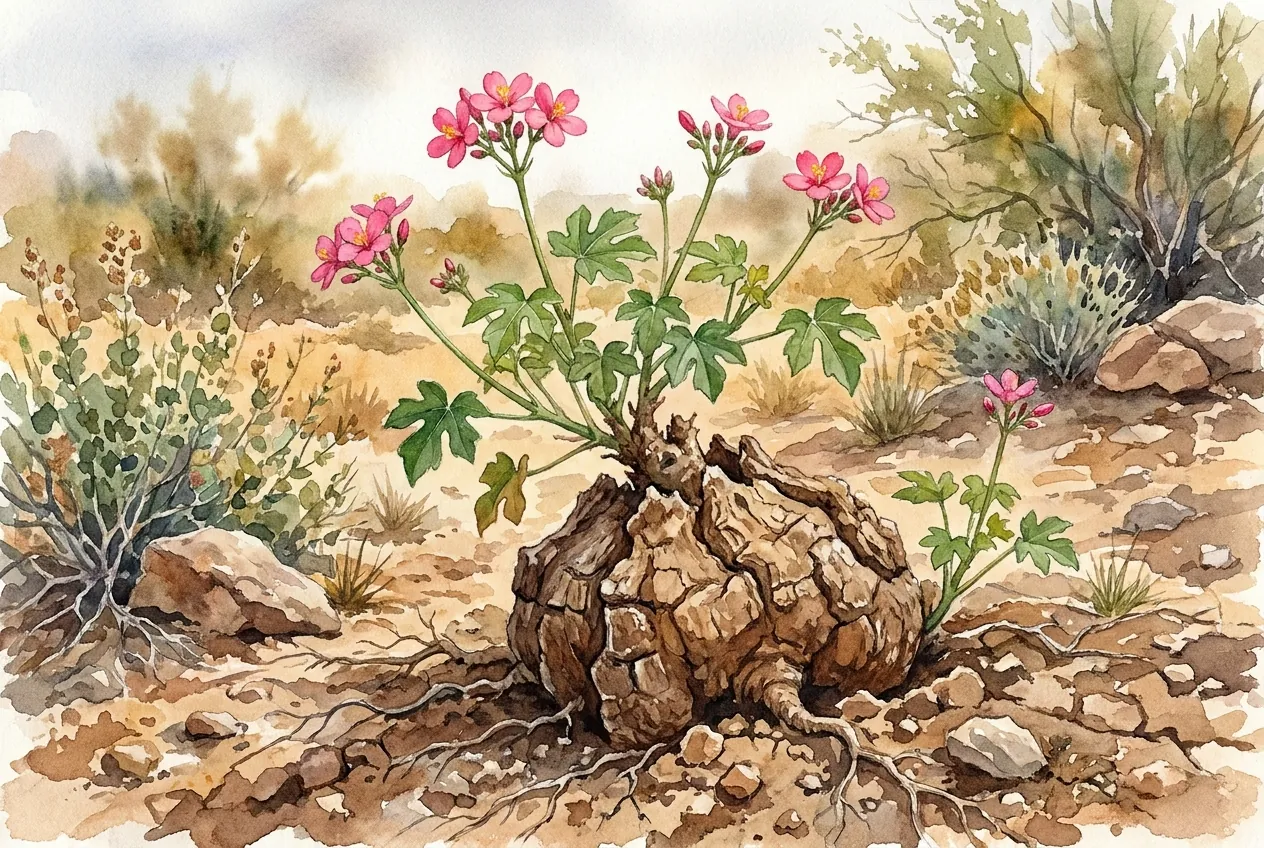
Key Takeaways
- Jatropha berlandieri is a synonym of J. cathartica, so one species may appear under two trade names. Verify the plant and its provenance.
- The common name Buddha Belly is used inconsistently in trade. Compare caudex position, leaf shape, flowers, and dormancy rather than relying on the name.
- A leafless caudex has lower water demand, but dormancy does not make water uptake zero. The main risk is a cool, wet, poorly aerated root zone.
- Use an airy mix, water to active growth and drying conditions, and protect the plant from prolonged cold combined with wet substrate. That combination, not water itself, drives rot.
- Treat the milky sap as a potential irritant and poisoning risk, and wear gloves and eye protection when handling cuts. Species-specific toxicology remains uncertain.
Jatropha berlandieri and Jatropha cathartica are treated as one species under different names.
Distinguish this species from other caudex-forming Jatropha, then match watering and dormancy decisions to the plant actually in front of you.
Is Jatropha berlandieri the same plant as Jatropha cathartica?
Yes. Jatropha cathartica is the accepted scientific name, and Jatropha berlandieri is a synonym for it.
Plants of the World Online, the taxonomic backbone maintained by the Royal Botanic Gardens at Kew, records Jatropha cathartica Teran and Berland. (1832) as the accepted name and lists two synonyms.
Both synonyms are heterotypic. They were described from different specimens and later judged to represent the same species. The names are Jatropha berlandieri Torr. (1859) and Adenoropium berlandieri (Torr.) Small (1926).
What should be checked before purchase?
A nursery may list the same species under either name. Compare caudex condition and root health, then ask how the plant was propagated and where it came from.
Published conservation discussions do not provide a single settled status. That uncertainty makes seed-grown or legally propagated stock, nursery provenance, import records, and current local rules important parts of a responsible purchase.
Why do nurseries still sell both names?
Trade names can persist long after taxonomic treatments change. The berlandieri name entered horticulture before the synonymy was widely accepted, so sellers may still use it for a plant now catalogued as cathartica.
The Henry Shaw Cactus and Succulent Society also notes that the caudex-forming plant may be offered as J. berlandieri. A second label does not by itself indicate a second species.
Where is Jatropha cathartica native?
Current Kew records place it in Texas and New Mexico in the United States and in northeastern Mexico.
Older horticultural sources use narrower or different regional summaries, so range wording should be treated as a source-dependent description.
Jicamilla and Berlander’s nettlespurge are common names, not substitutes for checking the accepted scientific name.
How do you tell Jatropha cathartica from its real look-alikes?
Check four observations together. Look at the caudex position and surface, leaf shape, flower color, and seasonal behavior.
Jatropha podagrica is a frequent comparison, but Buddha Belly is a trade common name rather than an exclusive taxonomic label.
The synonym berlandieri does not create an identification problem. The harder task is separating cathartica from other caudex-forming Jatropha.
What is the fastest way to identify the caudex?
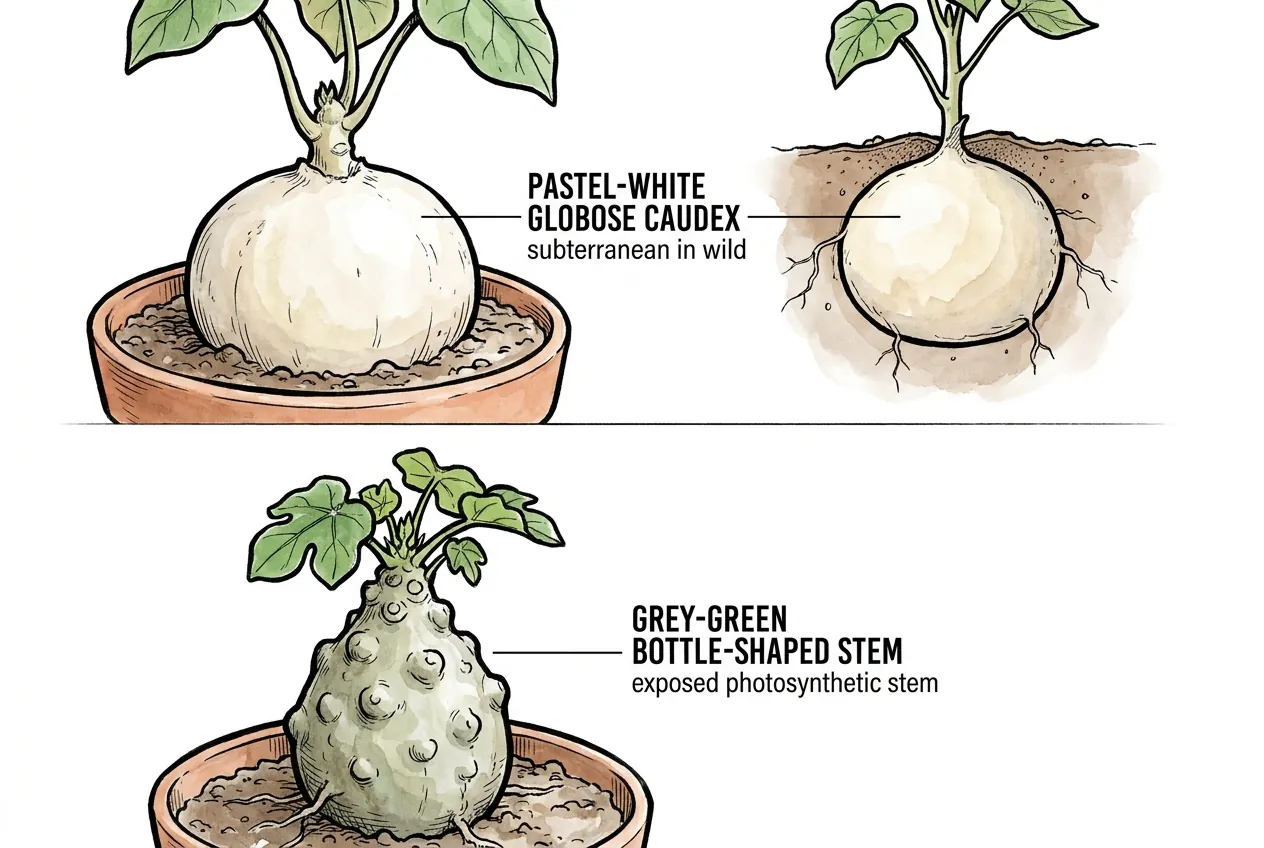
What the caudex can and cannot tell you
Wild plants have a rounded, subterranean woody caudex. A potted specimen may be raised or exposed, and its surface can change with age, light, corking, soil, and handling.
Color and shape are therefore useful clues rather than a stand-alone species test.
Jatropha podagrica usually has a grey-green, knobby, bottle-shaped stem above ground. That appearance explains why the Buddha Belly name is often attached to podagrica in horticultural trade, but common names vary.
Direct descriptions also distinguish overall plant height from caudex diameter. A horticultural listing that combines those measurements should not be read as a universal cultivated size.
Quick caudex test
A rounded caudex that is consistent with subterranean growth supports a cathartica identification, while a green, knobby, bottle-shaped stem points toward podagrica.
Confirm the impression with leaves, flowers, provenance, and the plant’s full growth habit.
How do the leaves and flowers differ?
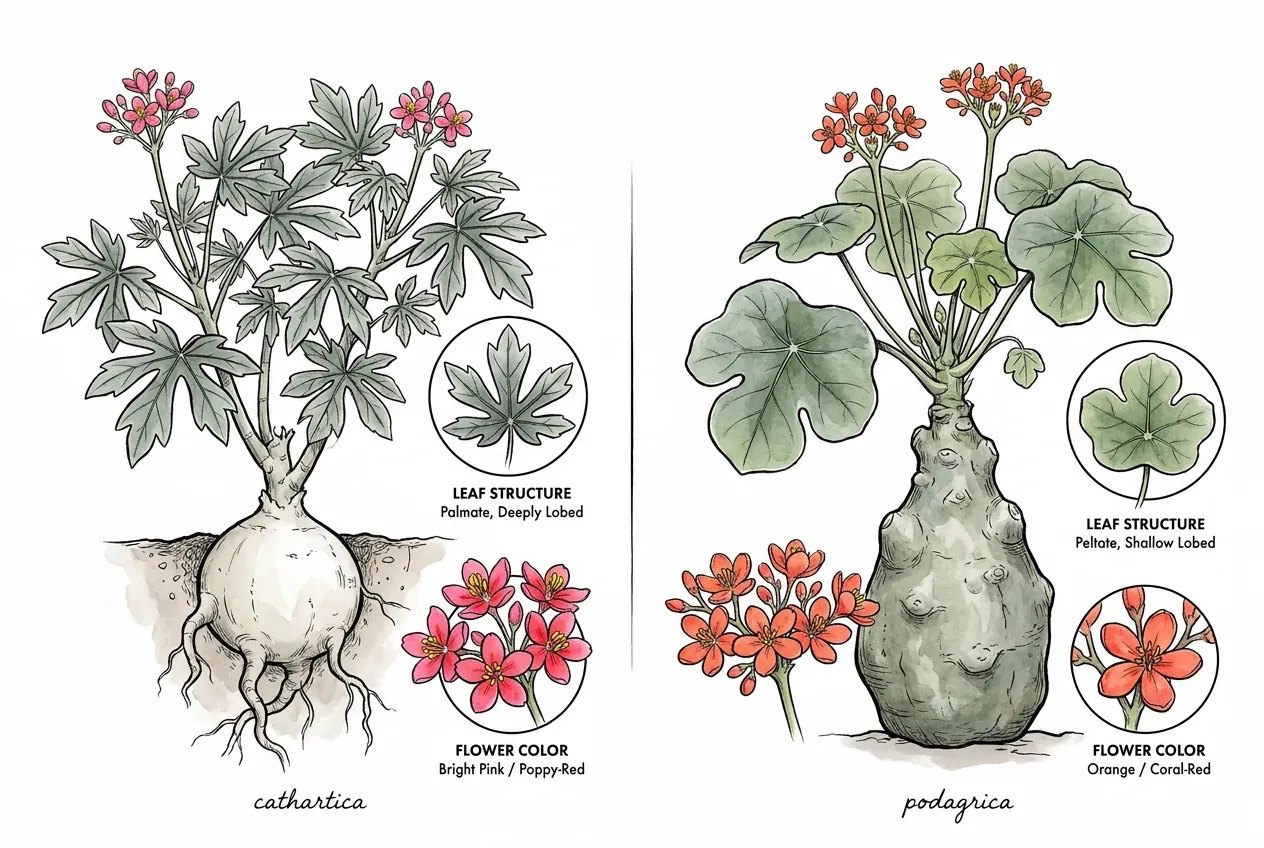
The leaves provide another useful check. Cathartica leaves are gray-green, palmate, and deeply lobed five to seven times, with blades reported to about 10 cm long.
Podagrica leaves are peltate. The petiole attaches inside the blade like a shield, and the blade usually has three or five shallow lobes.
Leaf shape is more informative when it agrees with the caudex and flower characters.
Flower color adds another comparison. Cathartica is described with bright pink to poppy-red flowers, while podagrica is commonly described with orange to coral-red flowers.
The comparison below is a practical orientation aid, not a substitute for a botanical determination.
| Feature | J. cathartica (= berlandieri) | J. podagrica (common trade reference) |
|---|---|---|
| Caudex color | Often pale in botanical descriptions | Grey-green |
| Caudex shape | Rounded, subterranean in the wild | Knobby, bottle-shaped, above ground |
| Leaves | Palmate, deeply 5-7 lobed, to 10 cm | Peltate, 3-5 shallow lobes |
| Flowers | Bright pink to poppy-red | Orange to coral-red |
| Dormancy | Deciduous seasonal rest is commonly reported | Often grown with a longer active season |
| Origin | Texas, New Mexico, NE Mexico | Central America, S Mexico |
Why does dormant watering require caution?
A leafless plant often has much lower water demand, but roots can still take up and move some water during dormancy.
The risk comes when a cool-season pot stays wet and poorly aerated for too long.
Start with Botanical Identity
Jatropha cathartica is commonly described as deciduous, with leaves and short branches dying back for a seasonal rest.
Keep the dormant setup drier than an actively growing one, while recognizing that the dangerous combination is prolonged cold and wet substrate rather than water itself.
What does the dormancy cycle actually look like?
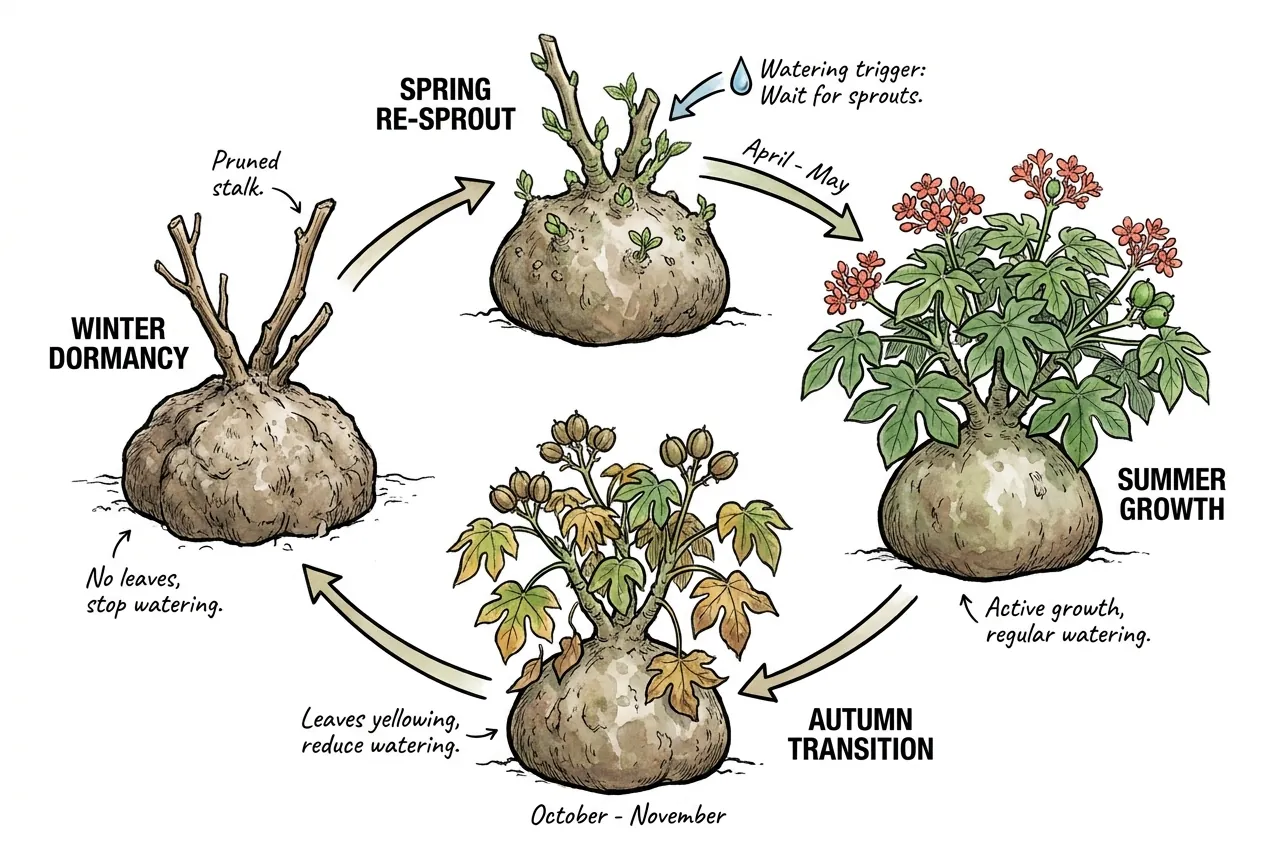
In a seasonal rest, leaves and short branches may dry and fall, leaving a bare caudex in cultivation.
New shoots can emerge when the plant, roots, temperature, and light return to active-growth conditions.
Deciduous behavior reduces transpiring surface and changes demand. It does not prove that internal transport or root uptake has stopped.
What should trigger a seasonal watering change?
New growth is a more useful trigger than a calendar date. A personal grower report may mention spring months for a particular latitude, but that timing is not a fixed biological schedule for every indoor or outdoor collection.
Before increasing water, check for active buds, root condition, temperature, light, and how quickly the medium dries. These observations are more transferable than a universal month-by-month rule.
What is the mechanism behind the rot?
Leaves drive much of a plant’s transpiration, so leafless growth usually means lower demand and a slower drying cycle.
That change does not make root uptake or internal water movement equal to zero.
How does wet medium create risk?
Water-filled pores contain less air. The resulting root stress can be followed by disease involving water molds or fungi such as Phytophthora, Pythium, Rhizoctonia, or Fusarium.
Low-oxygen and cold injury can also damage tissue without an infection, after which secondary pathogens may become involved.
LLIFLE describes very soft and gummy stems when this plant is kept cold and damp.
That observation supports avoiding the combination, but it does not establish that every soft stem is infectious rot.
How do you water Jatropha cathartica without rotting the caudex?
Watering should follow active growth, root condition, and the drying behavior of the pot.
A dormant plant usually needs less frequent input, but the goal is to avoid prolonged saturation, not to enforce a universal zero-water rule.
Use the framework below as a starting point. Adjust it when the plant, pot, medium, temperature, or local season changes.
What is the active-season watering cadence?
During active growth, water enough to wet the root zone and allow excess to drain.
Rewater when the medium has dried to the degree appropriate for its particle size, root mass, temperature, and airflow.
Deep watering followed by a meaningful dry-down can reduce constant wetness. General extension guidance supports that direction, but it does not supply an interval for this species in every container setup.
As leaves senesce and growth slows, lengthen the interval and reassess the plant before watering again.
A dormant pot should not be treated like an actively transpiring one.
What should the substrate accomplish?
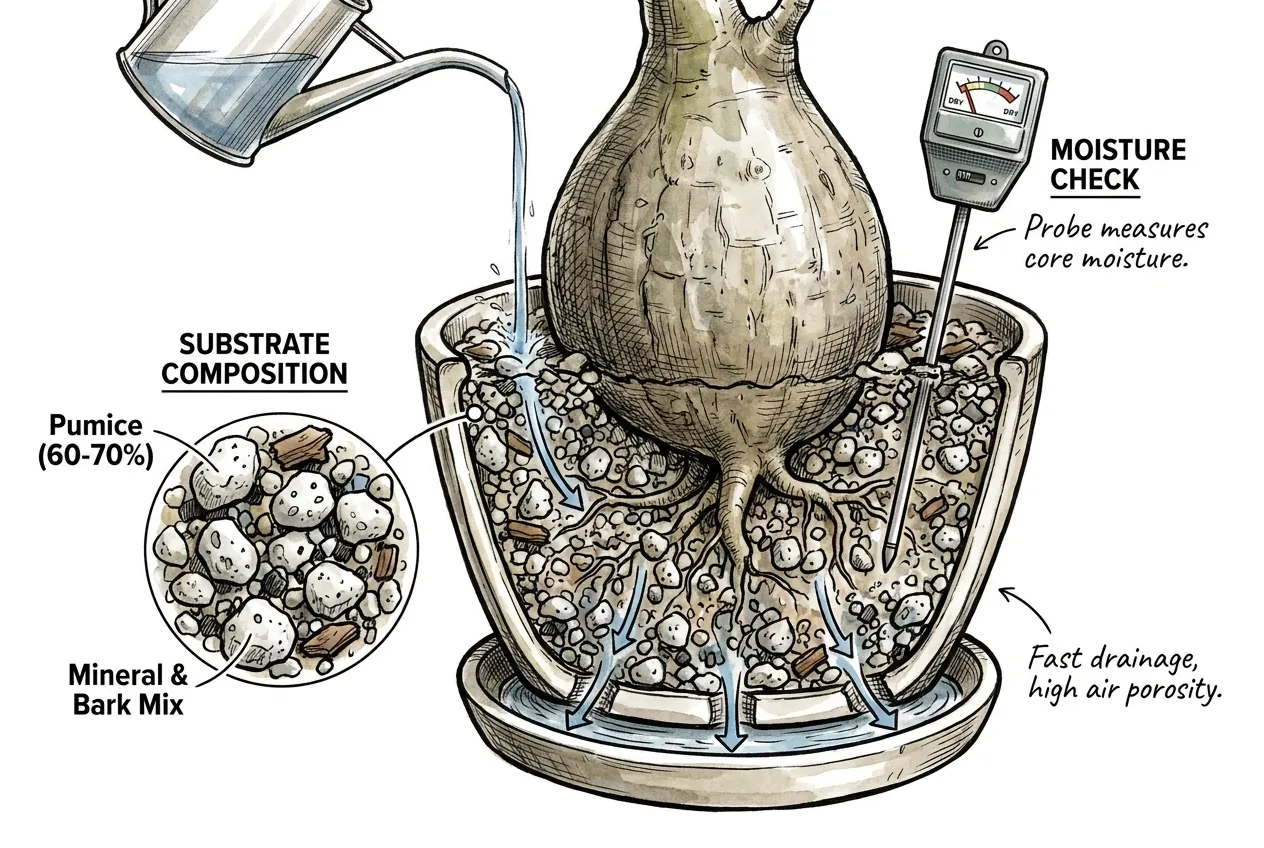
The medium should let excess water leave and air return to the root zone without drying so abruptly that fine roots are repeatedly damaged.
Particle size, organic fraction, pot shape, climate, and irrigation style all affect the result.
A high-mineral component such as screened pumice can resist breakdown, but a named percentage is not a validated recipe for this species.
Build the mix from the actual pot and environment, then observe how long it stays wet at root level.
Bonsai Jack pumice is one screened mineral option. Availability and shipping vary by region, and the product does not prove any fixed mix ratio.
Pumice also contributes little nutrition, so active plants may still need a labeled fertilizer used according to its instructions.
How should a moisture meter be used?
A probe can add a relative view of moisture that is not visible at the surface.
It should be compared with pot weight, drainage behavior, and a known wet and dry reference for the actual medium.
XLUX meter is a no-battery analog probe with a 1 to 10 dial.
Very loose pumice-heavy media can produce unreliable contact and readings, so do not turn its dry end into an automatic watering command.
How should a softening caudex be assessed?
Softness, discoloration, seepage, or odor that is spreading deserves prompt inspection. Do not cut solely because a dormant or dehydrated caudex has wrinkled.
If a localized area is confirmed as dead, salvage may involve removing compromised tissue and allowing a clean wound to dry before a cautious re-rooting attempt.
If the central storage tissue is broadly affected, recovery may be unlikely.
How do you tell healthy tissue from rot?
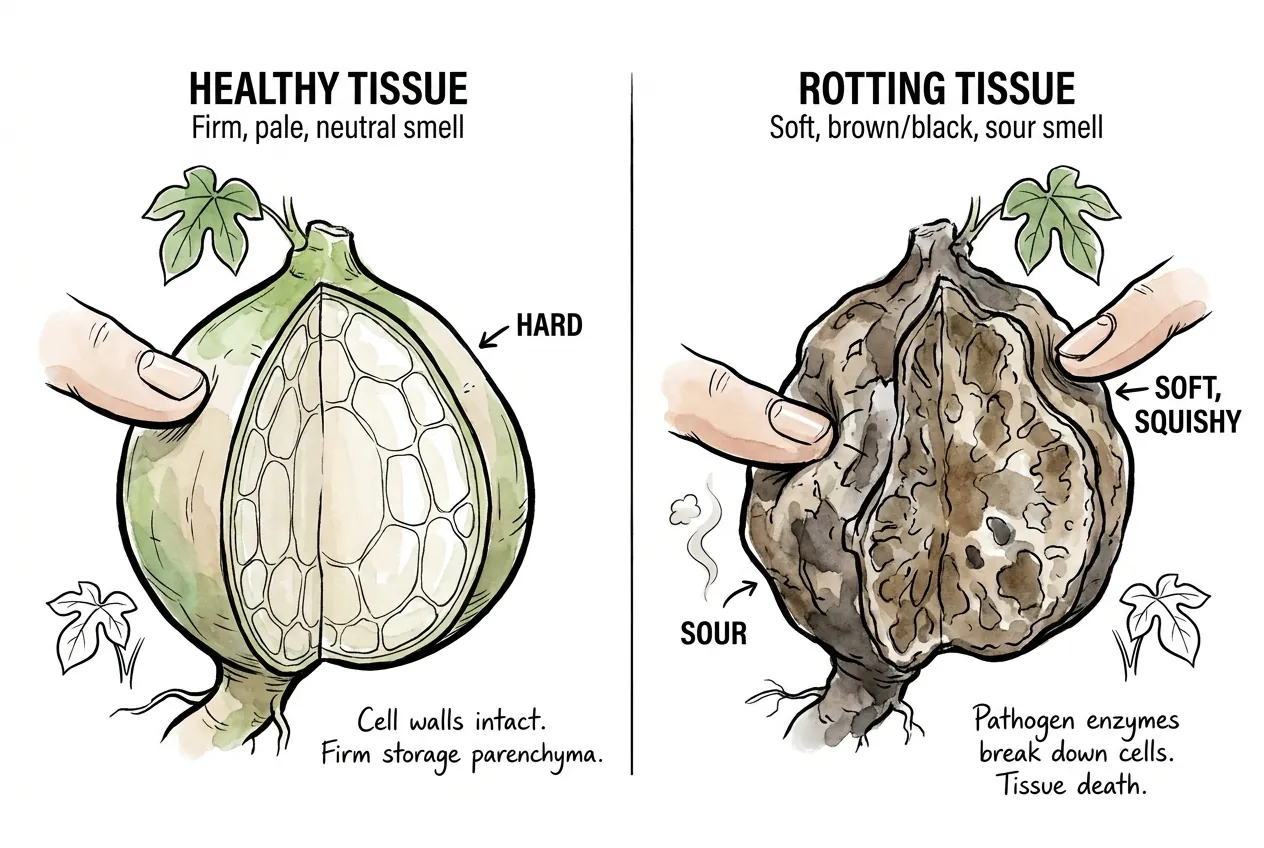
Firmness is a clue rather than a verdict. Soft, gummy, browning, or sour-smelling tissue is concerning, but dormancy and dehydration can also produce wrinkles or a softer feel, while early infection can remain hidden under firm, odorless skin.
Compare firmness with color, smell, location, progression, and recent watering and temperature history.
This broader view lowers the chance of cutting into living storage tissue because of a single ambiguous sign.
Species reported from succulent rot studies include Fusarium, Neocosmospora, Phytophthora, and Pythium.
Those studies describe organisms associated with cacti and other succulents, not a universal surgery protocol for Jatropha cathartica.
| Sign | Often reassuring | Concerning signs |
|---|---|---|
| Firmness | Firm in context | Progressive softness or gumminess |
| Color | Stable color for the specimen | Spreading brown or black change |
| Smell | No unusual odor | New sour or fermenting odor |
What is a cautious salvage sequence?
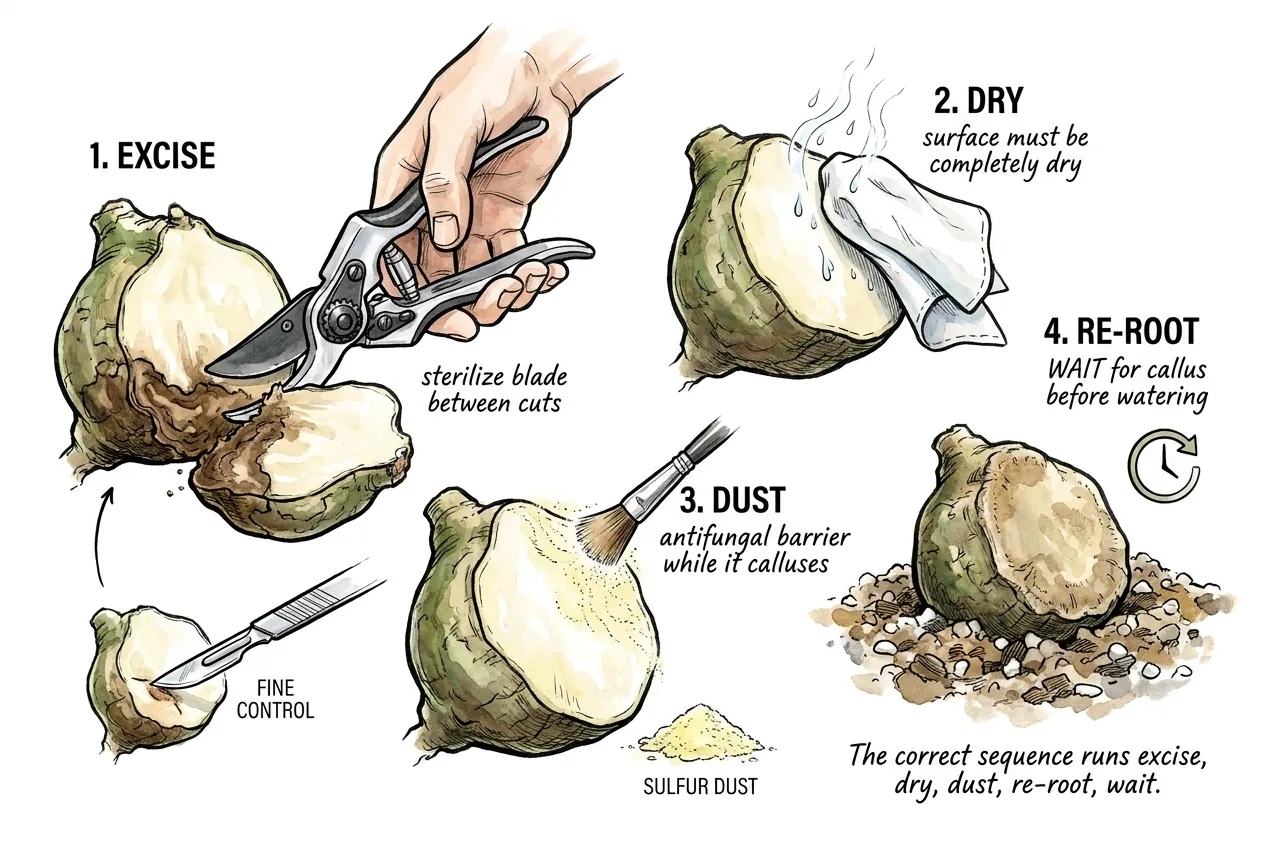
Assess before cutting
Isolate the plant and inspect the root zone, recent watering, temperature exposure, and progression of the symptom.
If the evidence is ambiguous, seek an experienced second opinion before removing storage tissue.
If cutting is justified
Use gloves and eye protection because the sap may irritate skin and eyes.
Remove only tissue that is clearly compromised, use a sharp clean blade, and remove visible soil and sap before disinfecting the tool between cuts. Disinfection reduces transfer risk but does not create laboratory sterility.
Vascular or systemic infection can extend beyond a visible margin. Treat any excision as a salvage attempt, discard removed tissue and contaminated medium responsibly, and keep the specimen separated from other plants.
After the cut
Let the wound dry and callus in clean, airy conditions. Avoid unlabelled wound treatments. A sulfur product label that does not mention Jatropha caudex wounds should not be presented as a treatment for this procedure.
Use a fast-draining medium appropriate to the remaining roots and reintroduce water cautiously when the wound and root system support it.
There is no universal waiting period because wound size, tissue condition, roots, temperature, and humidity differ.
How do you handle a freshly imported bare-root caudex?
Start by checking firmness, roots, pests, wounds, and the condition of the import paperwork.
A bare-root plant with bruised or trimmed roots needs a slower moisture assessment than a well-rooted specimen, but the first watering is not automatically forbidden.
What should be checked before watering an import?
Healthy roots that remain attached can still absorb water. A completely rootless or freshly wounded caudex may need more time to callus, while an excessively long dry hold can worsen desiccation and delay new rooting.
Quarantine the arrival away from other plants and inspect it for pests and disease.
Confirm phytosanitary or import records and legal provenance where those documents apply.
Pot it in a fast-draining medium suited to the remaining roots. Reintroduce water lightly and gradually when wounds have callused and the plant shows signs that the root system can respond.
A small test watering is safer than assuming that every import should receive either a deep soak or no water at all.
If the plant arrives dormant, keep the medium on the dry side while maintaining a temperature and light level that do not compound cold-and-wet stress.
General society guidance also emphasizes porous soil and caution with winter watering.
What light, temperature, and feeding does it need?
Bright light after acclimation, protection from prolonged cold-and-wet conditions, and light feeding during active growth form a conservative baseline. The suitable range still depends on the plant and its setup.
Light, temperature, drainage, and nutrition interact with watering. A change in one part of the setup can change how quickly the root zone dries.
How much light and warmth does it want?
Provide bright light after acclimation. The plant may tolerate different light levels, but direct sun should be introduced gradually to reduce scorch risk.
Good light supports active growth and can change water use, but it does not prevent rot by itself. Root-zone temperature, drainage, and watering remain important.
How should temperature be read?
Keeping the plant above about 50°F (10°C) is a conservative comfort guideline rather than a hard failure line.
Cold becomes more hazardous when the medium is wet, and exposure duration and acclimation also matter.
Feed lightly during active growth. A dormant deciduous caudex usually needs little fertilizer, while a pumice-heavy mix holds few nutrients.
Use a dilute, balanced product only as the current label and plant response support.
At a seasonal transition, I place a loose colored tie below the newest extending node and check it every seven days. I measure extension from the tie, count retained leaves, and record pot mass and the overnight minimum temperature. The fixed node distinguishes continued growth from a calendar assumption.
I do not increase watering after a single static week. Renewed extension and faster 24-hour mass loss from a weight taken after 30 minutes of free drainage across two checks support an increase. Softness or continued leaf loss triggers inspection, while two checks prevent one warm night from dictating the schedule.
Is Jatropha cathartica toxic, and how do you prune it safely?
Handle the plant as a potential irritant and poisoning risk. The species name and reports of livestock poisoning justify caution, but they do not identify every toxic compound or establish a complete dose profile.
What is known about the sap?
Texas A&M reports poisoning incidents involving cattle and deer while noting that the toxic principle is unknown and little studied.
Detailed claims about all parts, seed ranking, or curcin come from related Jatropha species and should not be presented as confirmed chemistry for J. cathartica.
How should the sap be handled?
Wear gloves and eye protection for cutting or any task that may release sap.
Keep the plant and seeds away from children and pets, and do not ingest any part.
Inspire gloves are a conditional disposable-nitrile option. Check the selected size and fit, and do not infer chemical permeation performance from thickness alone.
Put on a fresh pair for each task and discard contaminated gloves.
DEWALT goggles are a conditional eye-protection option. Confirm the exact lens variant, markings, and face fit because a general impact rating does not by itself prove a sealed chemical-splash barrier.
What should be done after exposure?
Wash sap from skin with soap and plenty of water. If it enters an eye, rinse with clean water for 15 to 20 minutes and seek medical or poison-control advice if pain or vision changes persist.
If any part is swallowed, contact poison control and do not induce vomiting unless instructed by a professional.
How should pinching be interpreted?
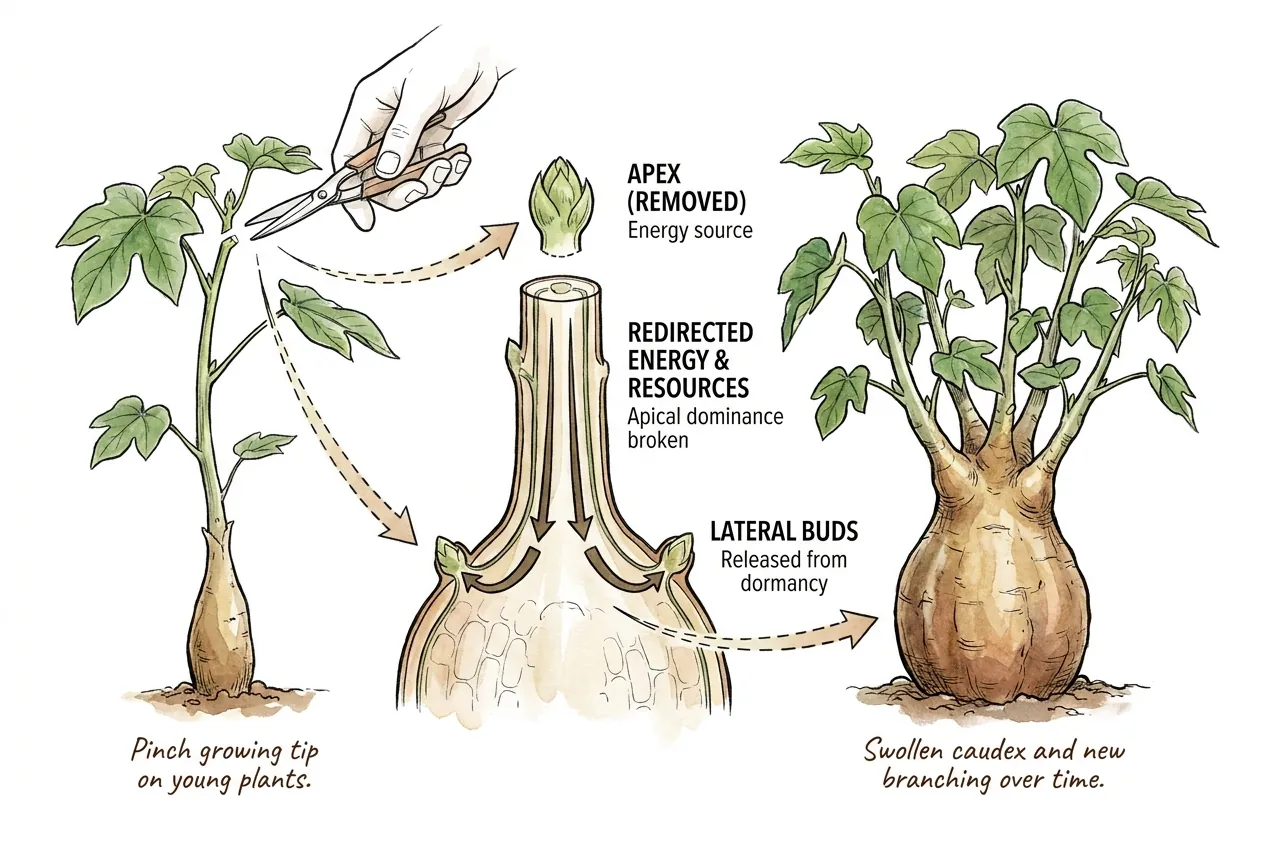
Removing a growing tip can reduce apical dominance and encourage lateral branching.
That general principle does not show that the caudex will become thicker in this species.
Some swelling advice comes from other Jatropha species, including J. podagrica and J. capensis.
There is no species-specific evidence here that strict pinching fattens J. cathartica.
The apex is a growing meristem, not an energy source. Leaves produce photosynthates, and removing a tip can also reduce leaf area.
Use pinching mainly for shape and branching, then remove a dried stalk during dormancy only when the tissue is clearly dead.
Affiliate Disclosure
This article contains Amazon affiliate links. As an Amazon Associate I earn from qualifying purchases. If you use these links, the site may earn a commission at no extra cost to you. Product availability, price, and specifications can change. Check the current listing before buying.