
Tylecodon & Othonna Summer Dormancy: Alive or Dead?
Tell Tylecodon and winter-growing Othonna dormancy from rot, decide when to water, protect seedlings, restart growth, and handle toxic plants safely.
Nathan Brooks · 2026-07-20 · Updated 2026-07-29 · 11 min read
Key Takeaways
- A gradual spring leaf drop can be normal for Tylecodon and for summer-dormant, winter-rainfall Othonna species. Confirm the exact species first. Leaflessness alone does not prove dormancy.
- For a healthy, established plant in confirmed summer rest, reduce watering sharply and follow species-specific guidance. Some need little or none. Others receive occasional cultivated moisture, so there is no genus-wide rule.
- Do not use firmness, a scratch, or a fixed month as a verdict. Read the seasonal pattern, pot mass, base, roots, temperature, and whether any lesion is spreading.
- Give seedlings and recent cuttings a separate water margin. They have less stored water and cannot take an adult-style drought. Track pot mass rather than imposing a monthly ration.
- Tylecodon is toxic (bufadienolides), so keep it inaccessible to children and animals or choose not to grow it. Wear gloves and eye protection when cutting damaged tissue.
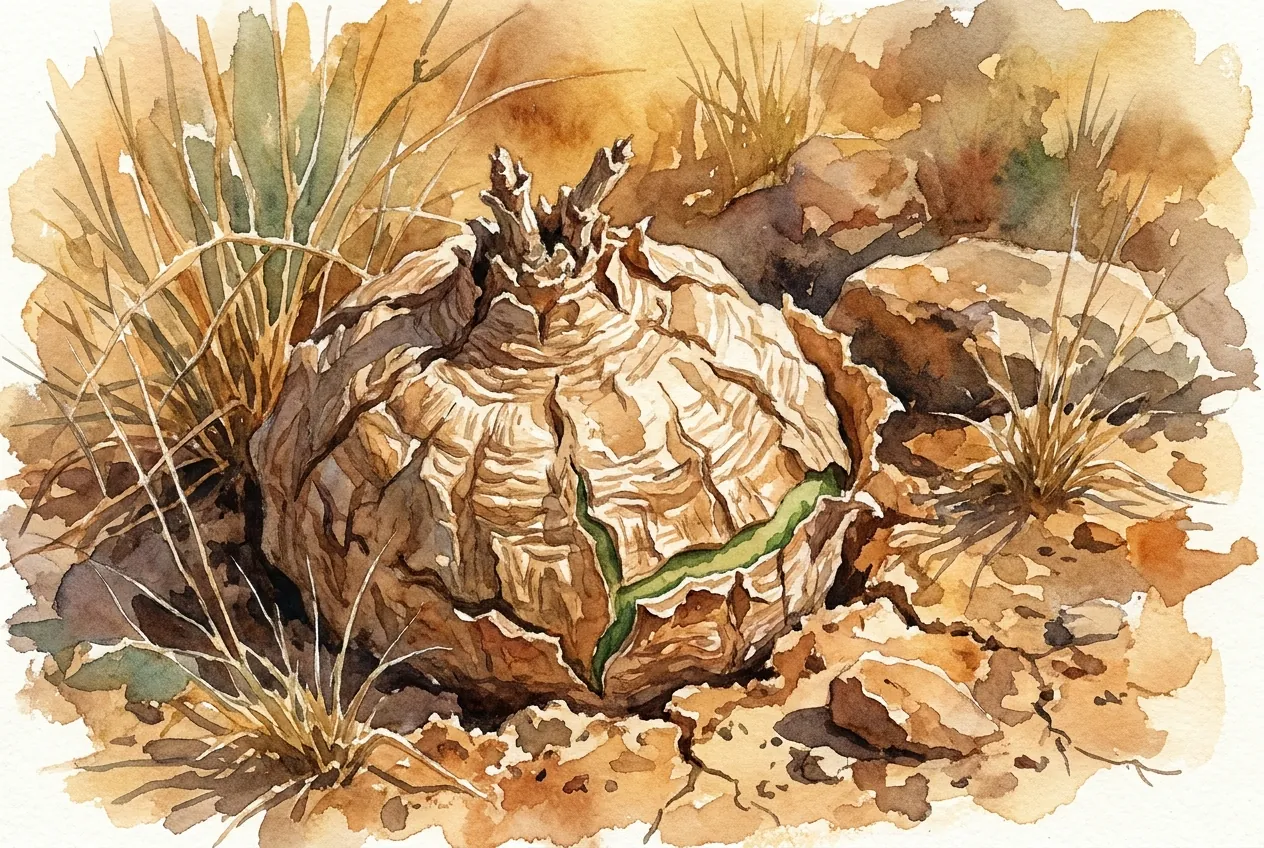
A bare summer caudex can look alarming because every leafy plant around it is growing. A better first response is neither water it immediately nor ignore it until October. First decide whether the plant is following its normal cycle.
Is your plant dormant, dehydrated, or dying?
| Pattern | What it supports | Next step |
|---|---|---|
| Leaves yellow and detach gradually at the expected end of a known winter-growing season | Normal dormancy is plausible | Stop feeding, reduce water, and record pot mass and location |
| The bare plant remains structurally stable with no expanding soft or dark area | A healthy resting plant is plausible | Leave it undisturbed and monitor |
| The whole caudex wrinkles gradually while the pot stays very light | Reserve use or dehydration is possible | Check species guidance, plant size, roots, and heat before adding water |
| A localized area becomes wet, soft, dark, or rapidly larger | Rot, injury, or heat damage is possible | Isolate the plant and inspect the root collar and roots |
| Leaves collapse suddenly while the pot remains wet | Do not assume dormancy | Check roots, temperature, and the base before waiting or watering again |
Use Non-Destructive Evidence First
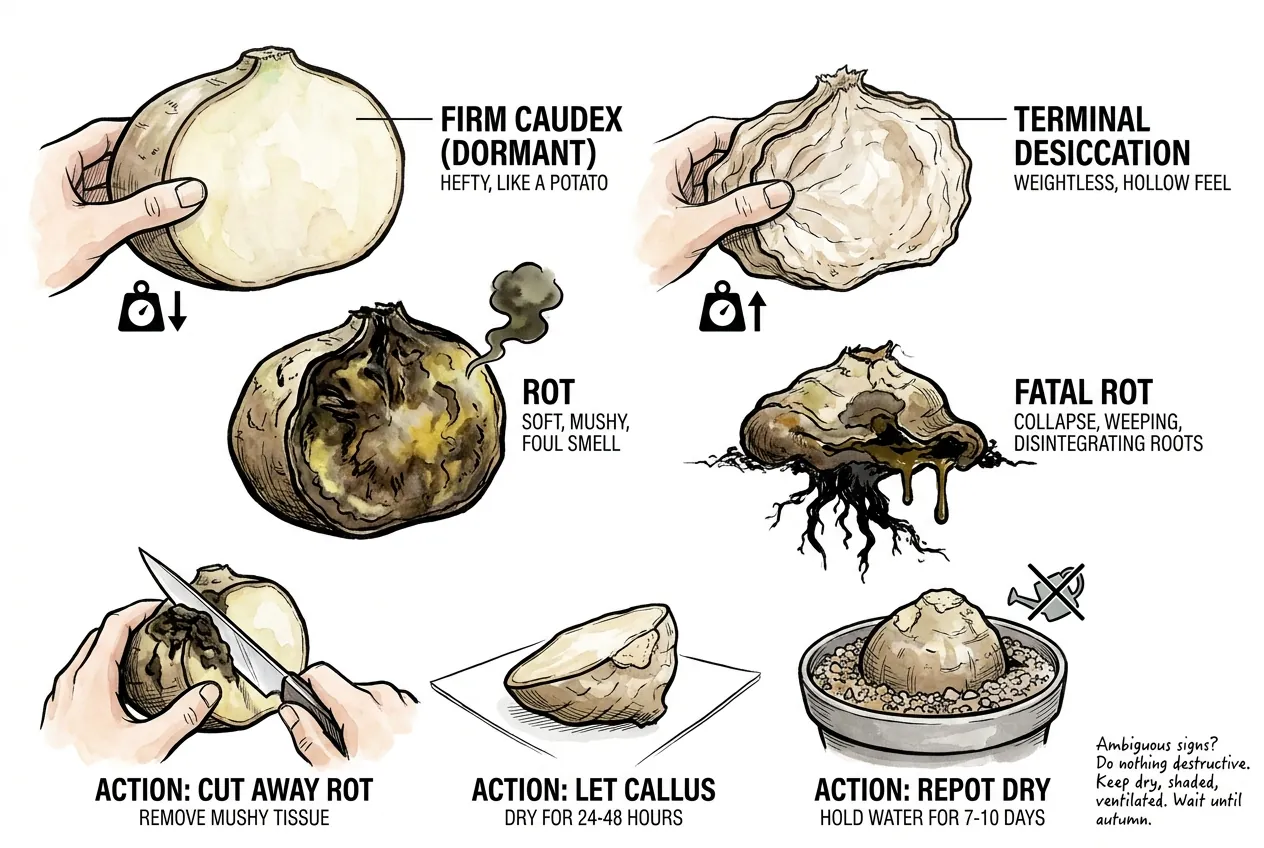
Firmness is useful only as a comparison with the same plant. A dehydrated caudex can soften, and some rot begins internally before the outside feels mushy. Smell may appear in advanced decay but is neither required nor specific.
Identify the Winter-Growing Tylecodon and Othonna Plants
Confirm the Named Species and Its Cycle
Tylecodon species are associated with southern Africa's winter-rainfall regions and are commonly winter-growing and summer-deciduous. SANBI describes Tylecodon wallichii, for example, as growing in winter, dropping its leaves during the dry summer, and producing new leaves in autumn.
Othonna needs more caution. It is a varied genus, and a label that says only Othonna is not enough to assign a watering calendar. Apply this schedule only to identified winter-rainfall, summer-dormant species such as Othonna herrei, not to every member of the genus.
Do not force a Southern Hemisphere date range onto an indoor plant in another climate. Light, temperature, water, and genetics can shift timing. Record when your identified plant actually leafs out, flowers, yellows, and rests from year to year.
What does normal summer dormancy look like?
Read Dormancy as a Sequence of Changes
Normal dormancy is a sequence, not one dead-looking snapshot. Growth slows, mature leaves yellow or dry, leaves detach, and the plant remains bare while the stem or caudex persists. Some species flower after the leaves have dried.
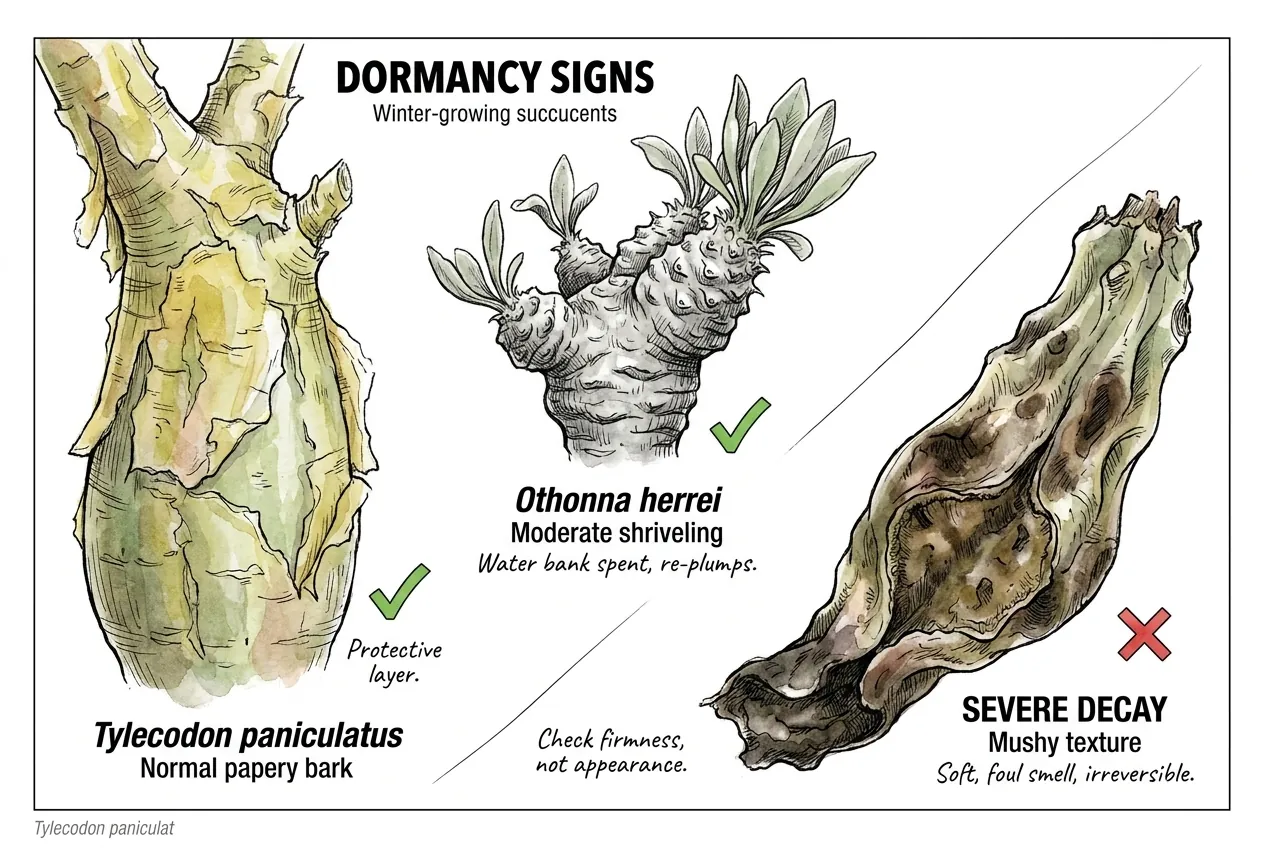
Surface texture is species-specific. SANBI describes the yellowish-green, papery bark of Tylecodon paniculatus and the shiny, silvery-black stem with persistent conical leaf bases of Othonna herrei. Those features should not be peeled away in search of green tissue.
Gradual, even wrinkling can reflect use of stored water. It becomes more concerning when it progresses rapidly, is strongly one-sided, coincides with extreme heat, or appears with damaged roots. Cosmetic plumpness alone is not a reason to water a dormant root system.
Should you use the bark scratch test?
Prefer Observation Over a Bark Scratch
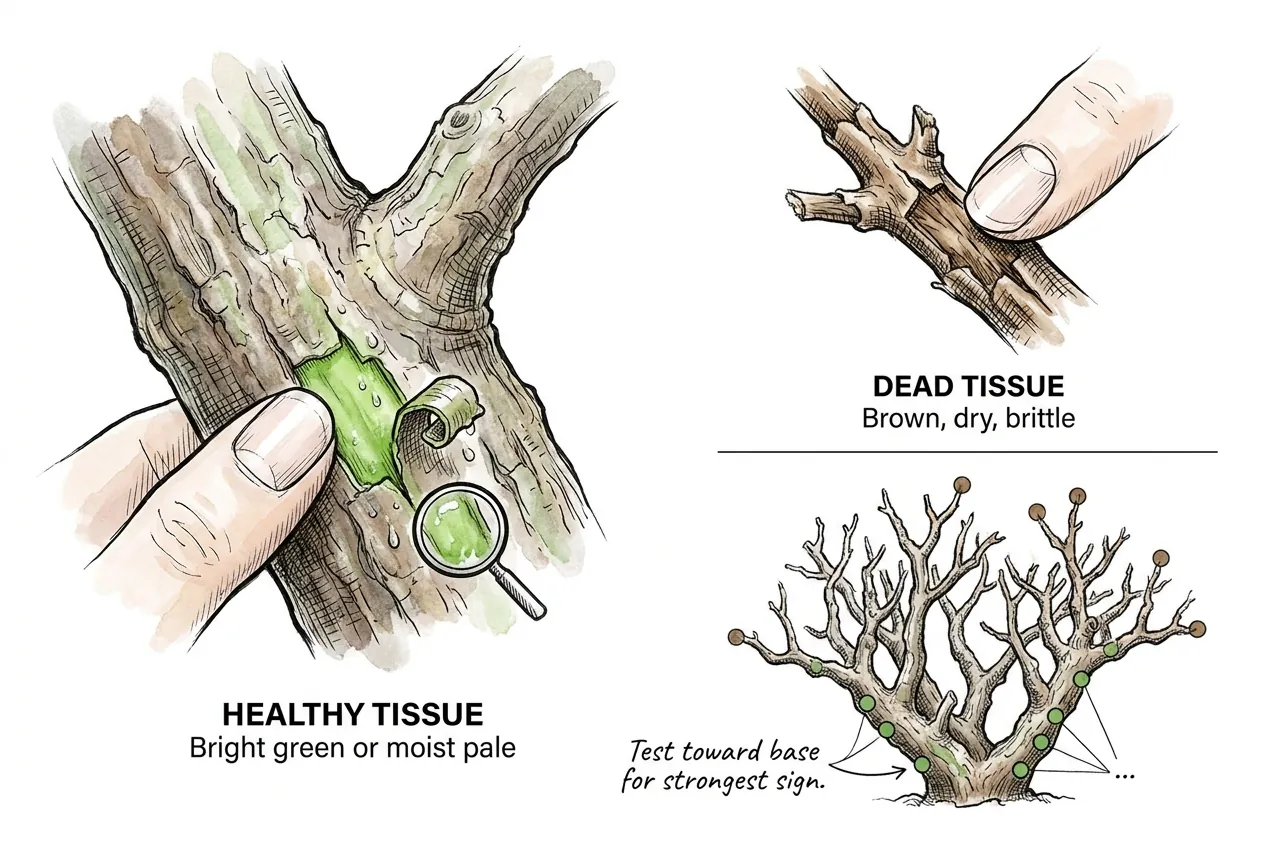
Usually, no. The scratch test is a woody-twig heuristic, not a definitive test for a fleshy caudex. Green tissue at one nick does not prove the roots or the rest of the plant are healthy. Brown tissue in one superficial spot does not prove the plant is dead.
A scratch also creates a wound and, with Tylecodon, exposes you to a poisonous plant. Start with non-destructive evidence. Compare pot mass, inspect the base, check whether damage is expanding, and review the plant's prior seasonal pattern.
What do firmness, pot mass, and root signs tell you?
Combine Pot Mass, Firmness, and Root Signs
Pot mass helps separate a dry root zone from one that is still holding water, but it does not diagnose living tissue. Firmness helps you notice change, but it does not identify a pathogen. Roots and the pattern of damage provide stronger evidence when an inspection is warranted.
Escalate when you see several of these together
- A wet pot that remains heavy far longer than its established pattern.
- Dark, soft, or translucent roots that slough apart.
- A lesion expanding from the soil line or a wound.
- Skin that slips over collapsing tissue.
- unexpected decline after cold, heat, repotting, or prolonged saturation.
If rot is plausible, isolate the pot and use the caudex root-rot diagnostic guide. Appearance alone cannot distinguish Fusarium, Neocosmospora, oomycetes, bacteria, or noninfectious injury, so do not select a fungicide from color or smell.
Should you water during summer dormancy?
Let Species Guidance Set the Summer Response
There is no honest genus-wide yes or no. SANBI says dormant Tylecodon wallichii needs little or no summer water, while its cultivation note for Tylecodon paniculatus describes occasional summer moisture. That difference is enough to reject a universal bone-dry rule.
Use this order of decisions
- Confirm the species and cycle. A summer-growing plant that lost leaves from stress needs a different response.
- Confirm root-zone moisture. Do not add water to a pot that is still heavy or damp below the surface.
- Consider plant size. A large established stem has more reserve than a first-year seedling or recently rooted cutting.
- Consider heat and container. A small terracotta pot on a hot bench loses water differently from a large plastic pot indoors.
- Follow the named species guidance. If occasional water is appropriate, apply it in a way you can track and let excess drain.
Track every watering decision
Do not water merely to make a dormant caudex look smooth. Do not mist it as a substitute for root-zone irrigation. If water is warranted, know where it went and how long the pot takes to return toward its dry-season mass.
The top-versus-bottom watering guide explains how to wet a resistant root ball without leaving it in a reservoir.
Do seedlings need different summer care?
Give Seedlings a Separate Water Margin
Yes, but not because every first-year seedling needs a prescribed 5 or 10 mL sip. Young plants have less stored water, shallower roots, and less margin for a forced adult-style drought. Some also continue growing rather than entering a complete rest.
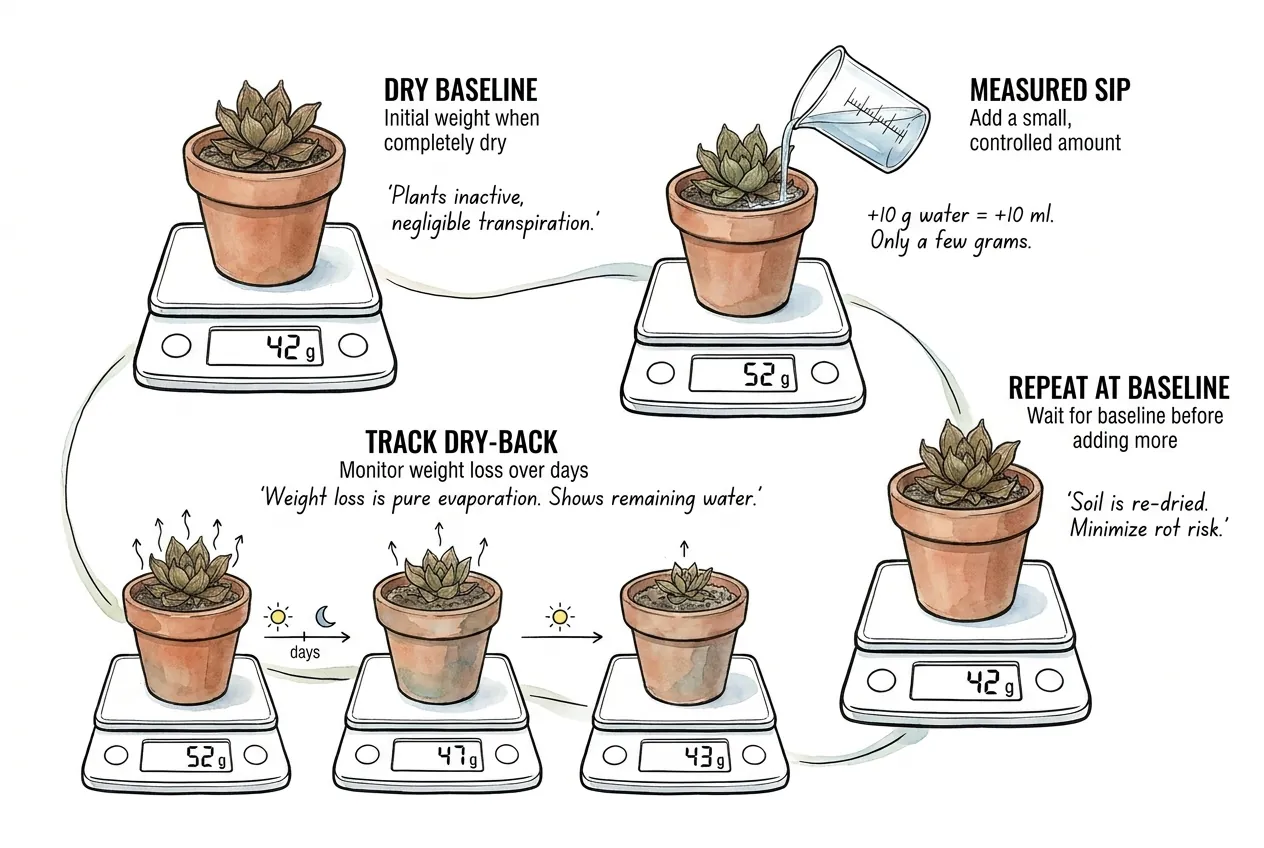
For a small plant, record three things. Its mass after appropriate watering and drainage, its mass as it approaches the species-appropriate dry point, and the time between them. Do not create a completely desiccated baseline by sacrificing fine roots. Recalibrate as the plant grows or substrate is lost.
A small kitchen or pocket scale with roughly 0.1 g readability and a tare function is a reasonable aid for small pots, making consistent records easier. Match its capacity to the watered pot. Skip a scale if the wet pot approaches its maximum, the platform cannot hold it safely, or lifting a single plant already gives you a clear trend. If you want help matching a scale to dormant dry-down tracking, see the caudex watering-tools guide.
A scale records change. It does not tell you the species' safe water content. Water a growing seedling according to its roots and substrate. For a genuinely resting small plant, intervene only after comparing mass, tissue change, temperature, and species guidance rather than following a monthly alarm.
Which substrate helps during dormancy?
Choose the Finished Substrate by Dry-Down
The useful mix is one whose wetting and dry-down you understand. It should accept water evenly, drain excess, and retain enough moisture for the root size without staying saturated. There is no mandatory 70/30 mineral ratio for Tylecodon and Othonna.
A pre-screened gritty succulent-and-cactus mix is a convenience option for an established plant when the label confirms the grade and formula you want. A blend that contains pine bark is not all-mineral, regardless of how gritty it looks. A ready-screened bag can save you from sourcing components, but skip it for very fine roots or a hot small pot if it dries faster than you can monitor.
If the current mix stays wet too long, change it at a suitable active-root period rather than automatically disturbing a stable dormant plant. Use the substrate comparison to choose a small trial by particle size, pot depth, and observed dry-down.
Where should you place a dormant caudex?
Control Heat and Light Without Forcing Dormancy
Keep the plant within the light and temperature range appropriate to its species and previous exposure. Leafless does not mean heatproof. A potted caudex can overheat on metal shelving, concrete, dark trays, or hot glass even when the air temperature seems acceptable.
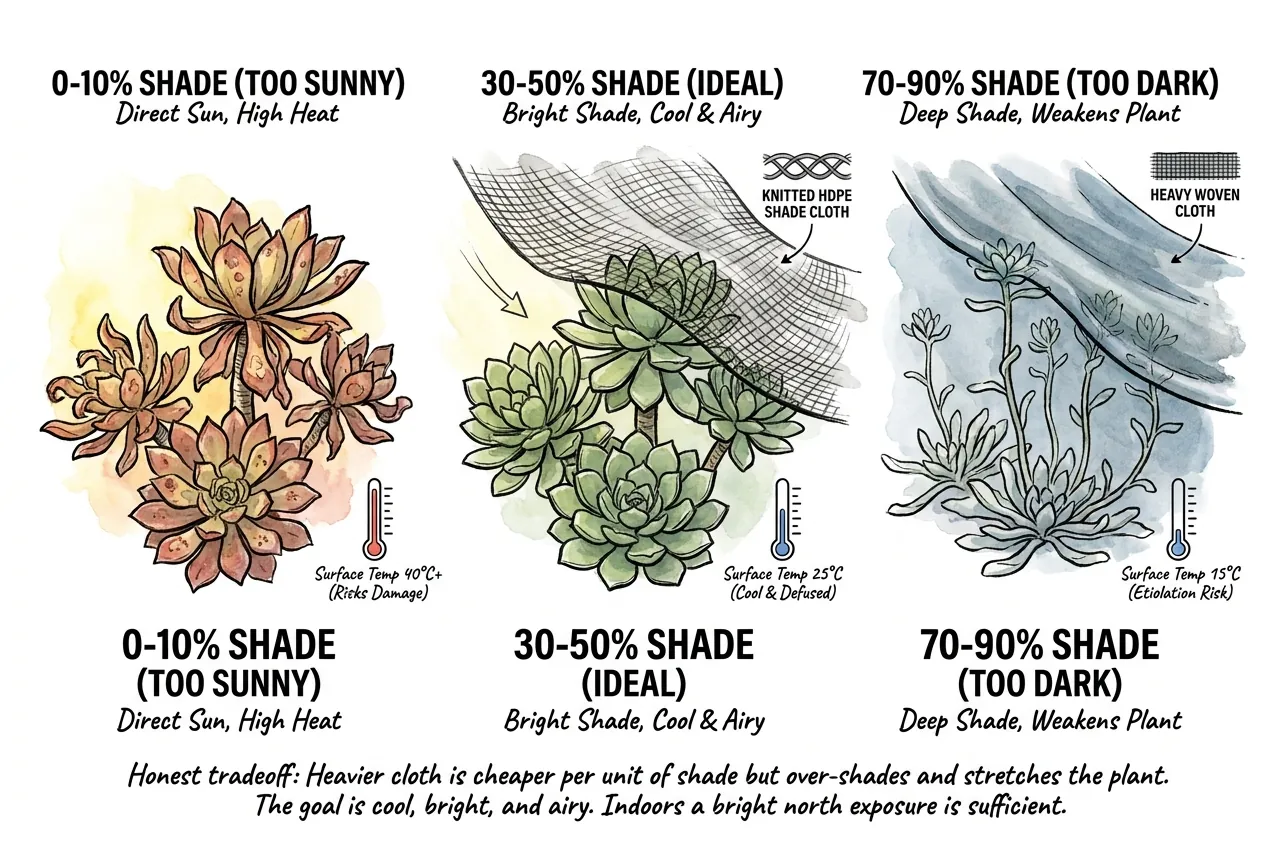
Do not prescribe one 30% or 50% shade cloth for every plant. A species acclimated to full outdoor sun, a greenhouse plant, and an indoor windowsill plant start with different tolerances. If heat is the concern, measure the pot or caudex surface at the hottest part of the day, move it off the hot surface, and adjust shade gradually.
Gentle air movement is useful in a stagnant, humid enclosure, but a fan is not mandatory in a naturally ventilated space. Avoid a direct blast that destabilizes the pot or accelerates seedling water loss. The goal is a stable, dry-season environment, not maximum wind or minimum light.
To find heat that the nearby air-temperature reading misses, I compare three marked surfaces. The pot wall, tray, and shelf are measured at the hottest part of the day. I repeat that route after moving a pot, changing shade, or replacing a tray that may hold heat.
That simple route has caught a hot support or glass edge that room-air readings missed. It does not define a species limit, but it tells me where to reduce avoidable heat before changing a dormant plant’s water.
How do you restart watering when growth returns?
Restart Irrigation from Active Growth
Visible buds or new leaves are strong evidence that the shoot is active again. They are not a command to jump immediately to a fixed two-week watering schedule. Check whether the root zone is dry, apply a measured initial watering appropriate to the plant and pot, let excess drain, and watch the dry-down.
Increase watering only as expanding growth and healthy roots begin to use it faster. Move the plant toward its active-season light gradually so new growth does not stretch or scorch. Wait to fertilize until growth is established and the root system is demonstrably taking up water.
If the expected season arrives without growth, return to the diagnosis. Confirm the species, review recent temperatures and roots, and look for a changing lesion. Repeated scratches and calendar-driven soaking add damage without answering those questions.
Is Tylecodon poisonous?
Treat Tylecodon as a Toxic Plant
Yes. SANBI warns that the leaves and stems of Tylecodon wallichii are poisonous when eaten and does not recommend the plant for homes with livestock, pets, or children. Tylecodon species contain bufadienolide compounds associated with serious livestock poisoning. The human and companion-animal dose literature is limited, so absence of a known dose is not evidence of safety.
The most honest buying and placement advice is simple. If ingestion cannot be reliably prevented, do not grow the plant. Otherwise label it, keep it physically inaccessible, avoid food-preparation surfaces, and use gloves and eye protection when cutting or handling damaged tissue. The caudex protective-gear guide covers task-specific protection.
If a person may have swallowed any part, do not guess or induce vomiting. In the United States, contact Poison Control at 1-800-222-1222 or use webPOISONCONTROL. Elsewhere, contact the local poison center. For a pet exposure, contact a veterinarian or animal poison service promptly. For skin or eye contact, rinse with room-temperature running water and obtain expert guidance.
What is the summer dormancy checklist?
Work the checklist in order. Identify the species, read the pattern, reduce water during established rest, and restart according to new growth.
- Confirm the exact species and whether it is a winter-rainfall, summer-dormant plant.
- Record the normal leaf-loss sequence instead of diagnosing from one bare day.
- Check pot mass, the base, and the pattern of tissue change without scratching.
- Reduce water sharply for an established dormant plant, then follow species-specific guidance.
- Monitor seedlings and recent cuttings separately. Do not impose an adult drought.
- Keep the pot off hot surfaces and adjust light by prior exposure and measured heat.
- Restart irrigation from plant activity and actual dry-down, not a calendar date.
- Keep Tylecodon inaccessible to children and animals, or choose not to grow it.
Sources and scope
- SANBI PlantZAfrica: Tylecodon wallichii cycle, cultivation, and toxicity.
- SANBI PlantZAfrica: Tylecodon paniculatus bark, deciduous cycle, cultivation, and poisoning risk.
- SANBI PlantZAfrica: Othonna herrei morphology and complete summer rest.
- SANBI PlantZAfrica: Succulent Karoo climate and winter-rainfall context.
- Peer-reviewed study of Fusarium and Neocosmospora associated with succulent rot.
- Peer-reviewed review of cumulative neurotoxic bufadienolides in South African plants.
- Poison Control: current first-aid and expert-contact guidance.
Keep the Scope and Evidence Limits Visible
No single watering calendar fits every Tylecodon or Othonna. Product formulas can change, and suspected poisoning or plant disease needs situation-specific professional advice.