
Root Tuber vs Stem Caudex Watering: One Rule Kills the Other
Root caudex vs stem caudex watering differs by anatomy. Learn the surface check, rot entry points, and the September taper that saves both plant types.
Maya Ellison · 2026-09-01 · 12 min read
Key Takeaways
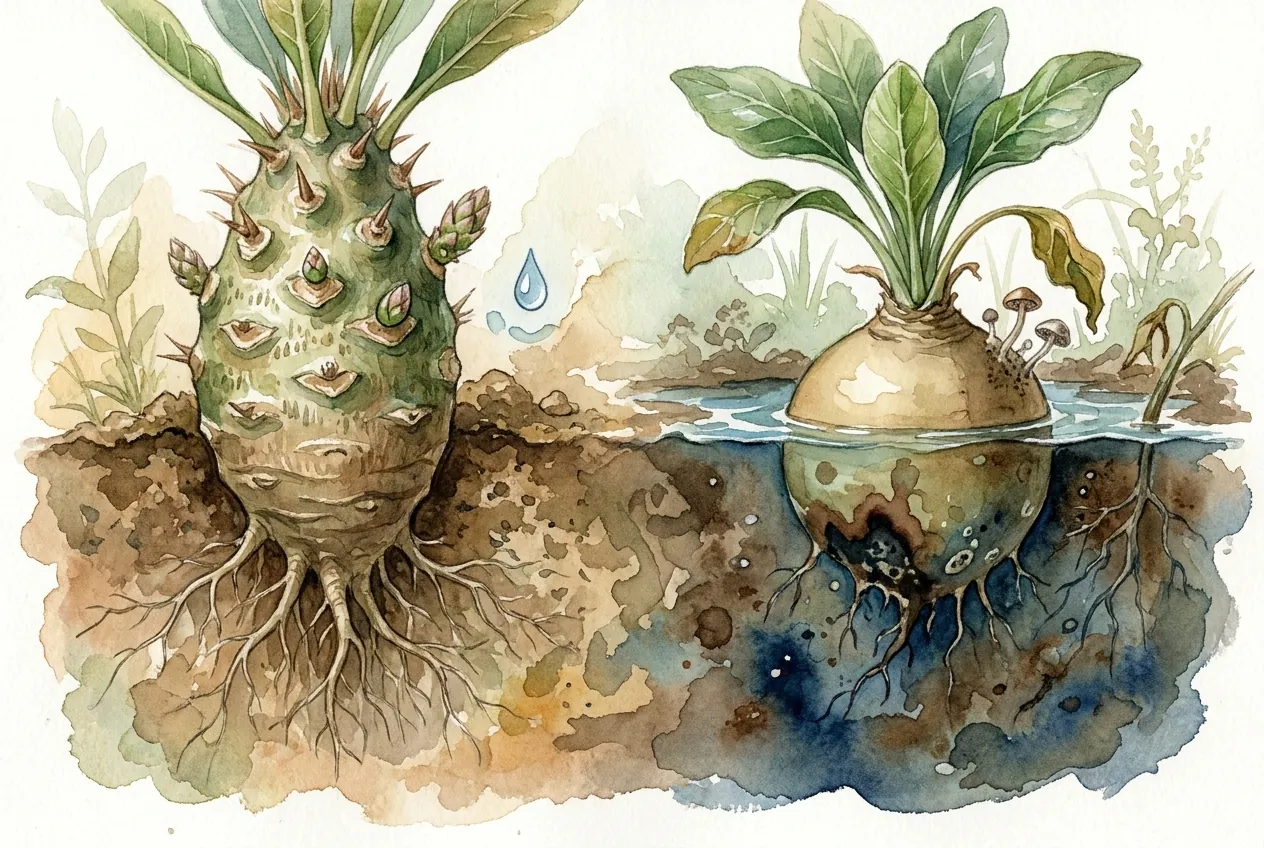
- A caudex can be stem, root, or hypocotyl. Identify the organ before you pick a watering rule.
- Leaf scars, spine bases, or buds on the organ mean stem rules. A smooth single-crown organ means tuber rules.
- Stem caudex plants rot at the collar. Tubers rot at the shoulder. Keep both surfaces dry.
- Water tubers at the rim and check moisture deep with a skewer. Soak stem types and drain sharp.
- In September, taper summer growers as nights cool and start watering winter growers when vines emerge.
A summer soak schedule that keeps an Adenium fat can turn a dormant Stephania crown to mush within weeks. Same shelf, same watering can, opposite outcomes. The word caudex is doing too much work.
Hobby labels call every fat plant a caudex plant. Botanically, some of those swollen organs are stems, while others are roots or hypocotyls. Identify the organ first, because the right watering rule follows anatomy, not the label on the pot.
September makes the question urgent. Summer growers need a taper starting now, while winter-growing tubers are about to wake up and ask for their first drink.
Why one watering rule cannot cover every caudex
The split between organ types is not cosmetic. The two anatomies are built by different developmental programs, fail at different entry points, and refill on different schedules.
Two organs, two blueprints
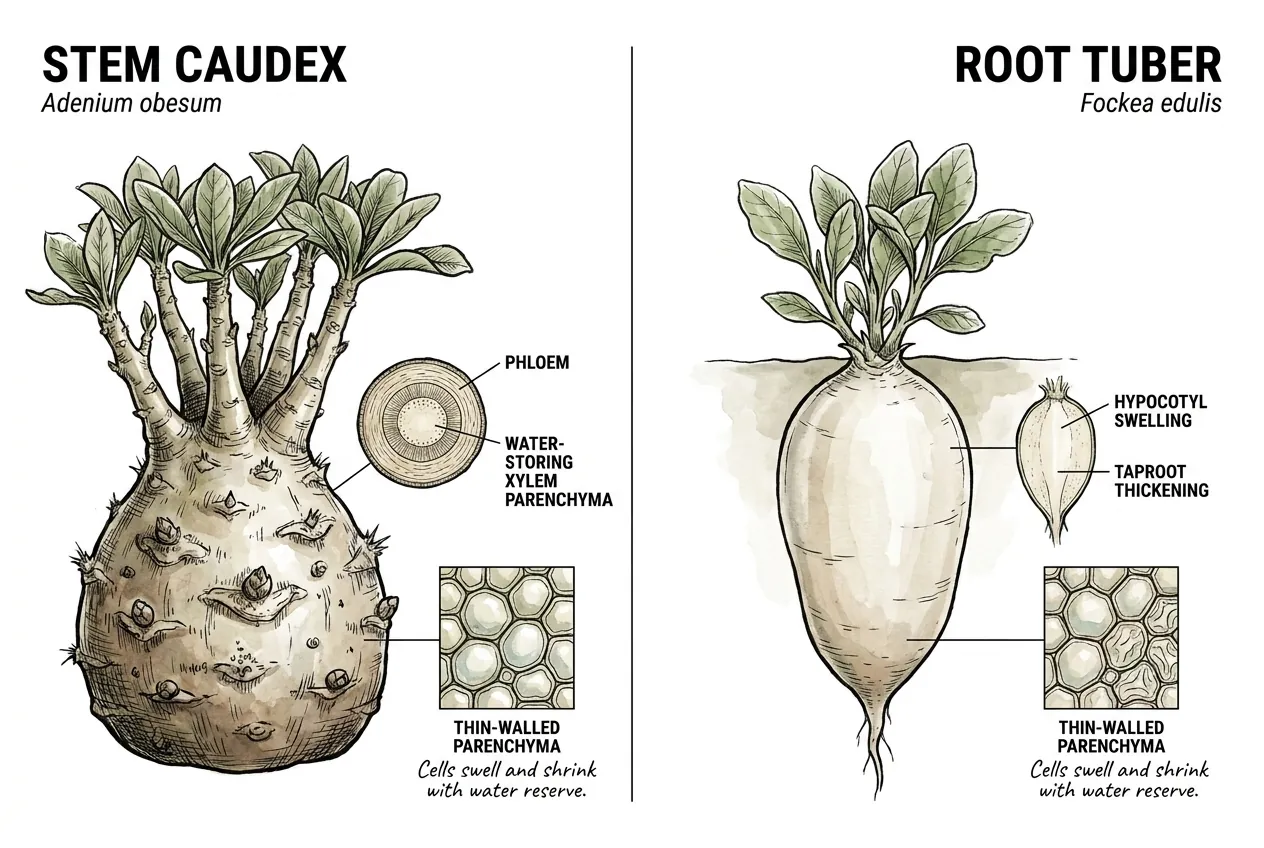
A stem caudex is a thickened stem. A 2023 comparative study of caudiciform development found that Adenium obesum thickens through a cambium that lays down solid rings of phloem and water-storing xylem parenchyma.
Because the organ is stem tissue, leaf scars, spine bases, and dormant buds persist on its surface.
Root and hypocotyl tubers follow a different program. In Fockea edulis, the same study found the hypocotyl swelling from the seedling stage, with the taproot thickening the way a radish does.
The result is a smooth organ with no nodes, where every shoot rises from one crown point.
A 2022 anatomical survey of ten succulent species across eight plant families found the water itself always sits in the same tissue class.
Thin-walled parenchyma cells swell and shrink as the plant spends and refills its reserve. That is why healthy organs of both types visibly plump and wrinkle through the year.
What the fat reserve actually buys
The reserve is a seasonal buffer, not a daily canteen. Field measurements on baobabs, the largest stem-storage plants on Earth, make the point. Only a small fraction of the stored water can be withdrawn before the tissue runs out of spendable reserve.
Pachycaul succulents mostly spend that water at season transitions. They drop leaves at the start of the dry season and use stored water to push the next flush of growth just before the rains return.
A fat trunk forgives a missed watering, but it does not replace a schedule.
Where common genera actually fall
Most hobby caudiciforms sort cleanly once you know what the organ is. The table below routes the common ones.
| Plant | Storage organ | Watering rules |
|---|---|---|
| Adenium obesum | Swollen hypocotyl and stem | Stem rules, tolerates exposure |
| Pachypodium lamerei, P. namaquanum | Stem trunk | Stem rules |
| Pachypodium succulentum | Swollen stem base, half buried in habitat | Tuber-style caution on the buried base |
| Cyphostemma juttae | Stem trunk | Stem rules |
| Operculicarya decaryi | Stem trunk | Stem rules |
| Adenia glauca | Stem | Stem rules |
| Fockea edulis | Root and hypocotyl tuber | Tuber rules |
| Dioscorea elephantipes | Tuber, winter grower | Tuber rules, inverted season |
| Sinningia leucotricha | Tuber | Tuber rules |
| Stephania species | Tuber | Tuber rules |
Genus reputation is not enough. SANBI describes the turnip-shaped storage base of Pachypodium succulentum growing half buried in habitat, while its famous relatives hold their water in fully exposed trunks.
Route each plant by its own organ, not by the name on the tag.
The one-minute check I run before trusting any label
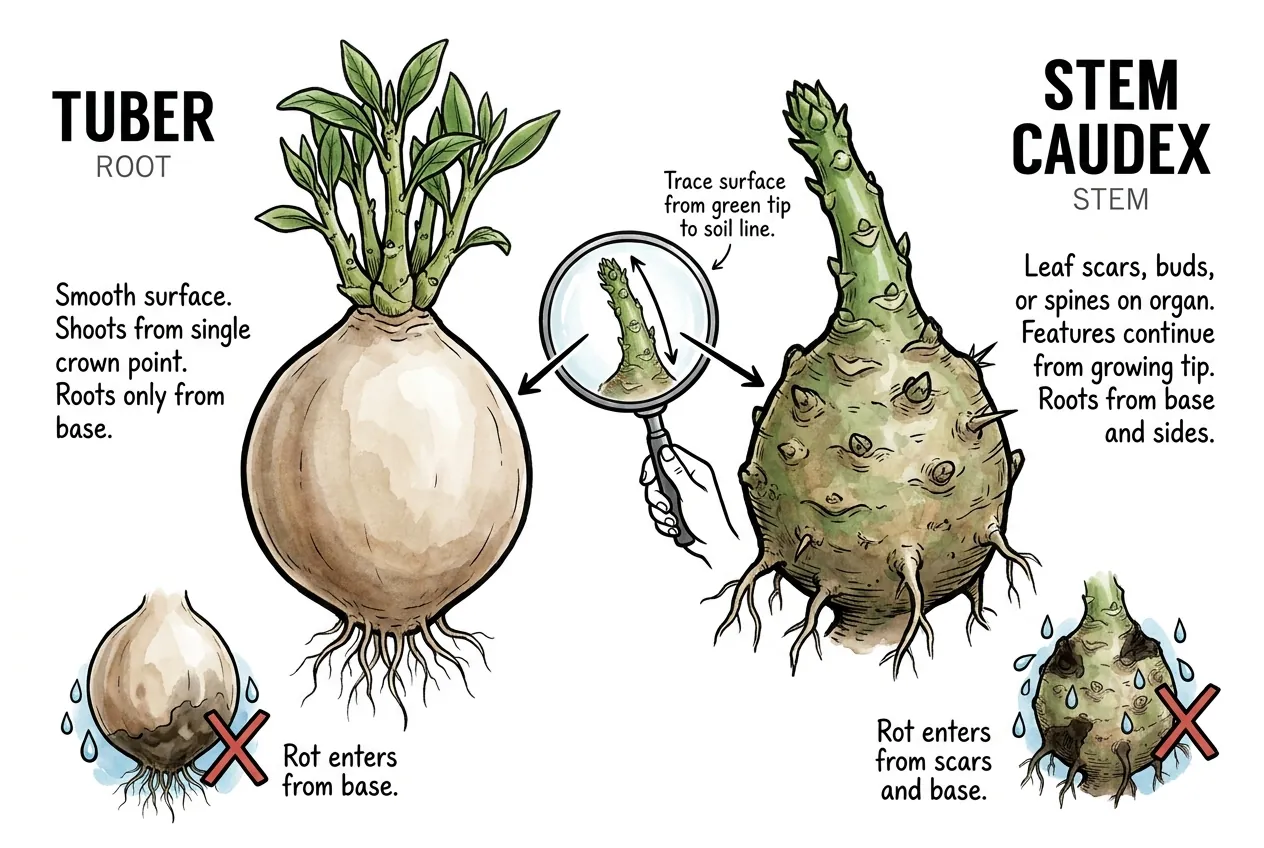
Before a new plant gets a watering schedule, its organ gets a one-minute read. Starting at a green growing tip, where nodes and leaf scars are unmistakable, I trace the surface down toward the soil line.
The question is whether those stem features continue onto the swollen organ.
Any leaf scar, spine base, or dormant bud on the organ itself means stem tissue, so the plant gets stem-caudex rules.
A smooth organ that sends every shoot from a single crown point, with roots emerging only from its base, gets tuber rules.
On grafted plants I read only the tissue below the graft union.
When the surface stays ambiguous, as it can on young hypocotyl tubers, I default to tuber rules.
That default is my own operating choice, not a published standard. Misapplying the tuber rule costs some growth speed, while misapplying the stem rule can cost the plant.
Each organ type rots through a different door
Overwatering does not kill these plants in the abstract. Rot enters at predictable surfaces, and the surface differs by organ type.
Stem caudex plants fail at the collar
The weak point of a stem caudex is the last stretch of trunk touching the substrate.
In 2021, basal stem rot caused by the fungus Neocosmospora ipomoeae hit roughly 2,000 desert roses in a single commercial nursery.
The infection door was the stem base sitting against warm, moist substrate.
The pathogens behind these failures live in the substrate itself. A 2022 survey of fusarioid rots across 29 succulent species found the fungi persisting in soil as dormant spores, with first symptoms appearing 7 to 20 days after infection.
A soft collar today usually indicts a watering decision made one to three weeks ago.
Root tubers fail at the shoulder
A tuber’s vulnerable surface is its crown and shoulder, where shoots break through the skin. Growers of tuberous Sinningia report that warm indoor temperatures make a wet tuber far more likely to rot.
The South African National Biodiversity Institute is blunt about the same risk in Dioscorea elephantipes. Overwatering the tuber during its leafless rest can shorten its life span by at least half. Water reaches the plant only through its fine roots, so the tuber’s own skin should stay dry at all times.
The two rules, side by side
Both rules start from the same principle and diverge at delivery, checking depth, and organ contact.
| Decision | Stem caudex | Root or hypocotyl tuber |
|---|---|---|
| Water delivery | Overhead soak, full drain | At the pot rim or from below, never onto the organ |
| Dry-down check | Top layer dryness plus pot weight | Skewer read at depth near the rim |
| Organ contact | Collar must dry fast after watering | Shoulder stays dry at all times |
| Leafless season | Near zero water | Near zero water, enforced more strictly |
The stem caudex rule
In active growth, a stem caudex is a classic soak-and-dry succulent. NC State Extension’s prescription for Adenium is a sandy or gravelly mix with sharp drainage, because wet soil can lead to root rot.
Arkansas Extension adds a sizing rule, since a pot kept relatively small for the plant lessens the odds of overwatering.
Soak the whole surface until water runs from the drain holes, then let the mix dry before the next round.
The collar zone dries fast in a sharp mix, and that speed is the point. If your current mix holds water against the trunk for days, fix the substrate before touching the schedule, and the pumice, akadama, and gritty mix comparison covers that decision.
The root tuber rule
My watering decisions for raised tubers run on a bamboo skewer. It slides in at the pot rim to about two thirds of the pot’s depth, sits for a few minutes, and comes out readable.
Damp mix sticks to the wood and darkens it, the same principle Maryland Extension applies with a wooden dowel.
A dry skewer means I water at the rim only, until the pot drains. A damp skewer means I wait two or three days and test again.
I use two thirds depth because the feeder roots of a raised tuber sit near the pot base.
No published cutoff exists for pot-depth moisture, so the conservative read is deep and dry.
The exposed shoulder itself never gets irrigated, and the contact ring around it stays free of mulch and debris.
Raising a tuber is a display choice with a real cost. A widely used plant database records that Fockea grows faster with its swollen base buried just under the soil surface.
A raised organ trades growth speed for visibility, and the dry-shoulder discipline is the price of that trade.
Growers who prefer instrumented dry-down over a skewer can compare weight and sensor methods in the caudex watering tools guide.
Read the organ before you reach for the can
Leaves cannot arbitrate a watering decision. Maryland Extension notes that overwatered plants show the same wilting and yellowing as drought-stressed and root-rotted plants.
The organ and the pot weight tell the truth the canopy hides.
Healthy reserve spending is uniform. A dormant organ that gives slightly and evenly under a thumb, with intact color, is spending water on schedule.
Rot is local, so one soft darkening spot at a stem collar or tuber shoulder against otherwise firm tissue is pathology, not thirst.
Remember
A clean check today is also not an all-clear. Because rot symptoms surface 7 to 20 days after infection, any recently soaked plant deserves a weekly press test for a month.
The soft caudex firmness map walks the full soft-spot decision tree.
What September changes for each type
For summer growers, fall is a controlled descent. NC State Extension sets a concrete trigger for Adenium, since once nights drop to 55°F the plants should come indoors to bright light with reduced watering.
Cyphostemma juttae drops its leaves for winter, and SANBI directs keeping it dry through the colder months.
Warning
The endpoint for leafless summer growers is strict. Arkansas Extension advises withholding water entirely through dormancy, or giving one small watering every four to six weeks only if visible shriveling appears. Winter wet during dormancy is the classic caudiciform killer.
For winter growers the same month runs backward. Dioscorea elephantipes grows through winter and spring and rests through summer heat, so in Northern Hemisphere collections a late-summer vine from the crown is the wake-up bell.
First careful rim waterings follow the vine, not the calendar, and an early Dioscorea wake-up has its own playbook.
Mixed Pachypodium collections hold both seasonal patterns at once, as covered in Pachypodium watering by growth state.
| Plant | Organ type | September action |
|---|---|---|
| Adenium, Operculicarya, Cyphostemma | Stem caudex | Taper down as nights cool |
| Fockea edulis | Root tuber, summer grower | Taper as vines yellow |
| Sinningia leucotricha | Tuber | Taper toward winter rest |
| Dioscorea elephantipes | Tuber, winter grower | Watch the crown, water on vine emergence |
A single September shelf walk, tagging every pot as tapering down or waking up, prevents both cross-applied failures at once. Taper by stretching intervals and shrinking volume together.
Skip the farewell deep soak, because saturating a cooling substrate creates exactly the sustained wetness collar pathogens need.
When the wrong rule has already done damage
A soaked dormant tuber puts you on a clock. The 7 to 20 day symptom lag means the useful response starts immediately, not at first mush.
Tip the pot to drain, move air across the surface, stop all watering, and press-test the crown weekly for a month.
A stem caudex starved on tuber caution fails more slowly and more kindly. The plant stalls instead of rotting, because the trunk reserve cannot fund a whole season of growth. Restore true soak-and-dry for the remaining warm weeks, then taper normally.
Confirmed, advancing rot changes the job entirely. Cut back to clean tissue, let the wound dry in moving air, and choose treatment by diagnosis instead of panic drenching.
The root rot fungicide chooser matches chemistry to confirmed pathogens.
Key Takeaways
- A caudex can be stem, root, or hypocotyl. Identify the organ before you pick a watering rule.
- Leaf scars, spine bases, or buds on the organ mean stem rules. A smooth single-crown organ means tuber rules.
- Stem caudex plants rot at the collar. Tubers rot at the shoulder. Keep both surfaces dry.
- Water tubers at the rim and check moisture deep with a skewer. Soak stem types and drain sharp.
- In September, taper summer growers as nights cool and start watering winter growers when vines emerge.
None of this requires new gear. It requires one identification per plant and one tag per pot before October. Classify the organ, aim the water at the fine roots, and let each plant’s own season set the schedule.