
Senna meridionalis Practical Care Guide
Learn Senna meridionalis care with strong light, growth-stage watering, an airy mineral-rich mix, conservative feeding, and careful scarification.
Derek Kim · 2026-01-08 · Updated 2026-08-17 · 10 min read
Key Takeaways
- Keep Senna meridionalis warm and very bright while it is in leaf. Leaves formed behind glass scorch after an abrupt move, so increase intensity in stages.
- Water the whole root zone after an airy mineral-rich mix approaches dry, and feed modestly only during sustained growth. Root mass, pot volume, heat, and airflow set the interval, not the weekday.
- When leaf drop and slower drying indicate rest, stop feeding and reduce water. Use the roots, pot moisture, and shrinkage trend rather than the month to decide whether maintenance water is needed.
- Treat the Madagascar limestone habitat as a starting clue, strong light, a distinct slowdown, an aerated root zone, not a laboratory recipe. The actual pot decides how it wets, dries, and grows.
- Buy documented, artificially propagated stock. The species is IUCN Vulnerable and CITES Appendix II. A dramatic old specimen with a vague import story is a reason to pause.
| What you see | Check first | Reasonable next step |
|---|---|---|
| Compact new leaves and shoots | Canopy light, dry pot weight, roots, and warmth | Continue strong acclimated light and soak after the mix approaches dry. |
| Long, weak extension | Measured light, root health, and recent feeding | Correct light gradually before adding more fertilizer. |
| Leaflets closed at night | Time of day and the next morning’s opening | No action if the daily cycle remains normal. |
| Yellowing or leaf drop | Seasonal slowdown versus cold, wet roots, pests, or salt stress | Stop feeding, lengthen the dry interval, and inspect abnormal tissue. |
| A plant offered for sale | Propagation record and cross-border paperwork | Prefer documented artificially propagated stock. |
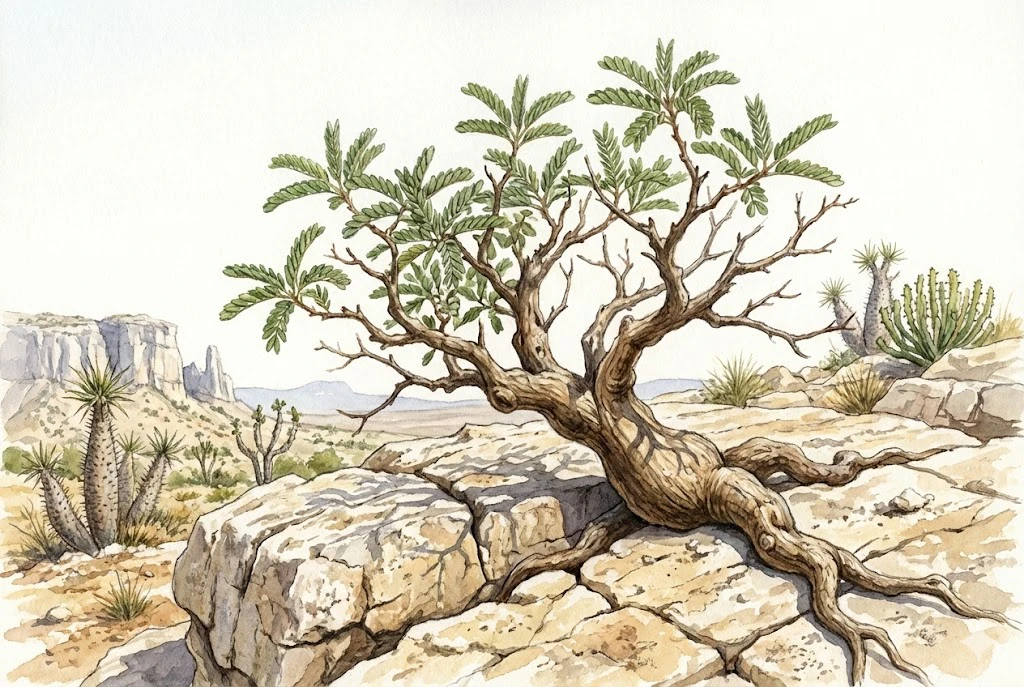
Senna meridionalis is not a generic houseplant legume. It is a deciduous shrub or small tree from Madagascar’s seasonally dry tropics, and official CITES background material records it mainly from calcareous soils in arid and semi-arid forest and thorn scrub.
Those facts give useful starting clues, strong light, a distinct slowdown, and an aerated root zone, but they do not provide a laboratory-tested indoor recipe. The practical work is still done by watching how the actual pot wets, dries, and supports new growth.
Give It Enough Light to Stay Compact
Measure Light Where the Leaves Grow
Start with the brightest window you can provide, then measure at the canopy if the plant continues to stretch. The direction of the window matters less than latitude, season, obstructions, distance from the glass, and the amount of direct sun that actually reaches the leaves.
Increase light gradually
Increase sun or lamp intensity in stages. Leaves formed behind glass can scorch after an abrupt move outdoors, even though established growth handles strong light.
Read the next shoot
Shorter internodes and sturdy growth are more useful signs than a genus-wide PPFD target that has never been tested on this species.
Use a lamp as a measured supplement
The caudex grow-light guide explains canopy measurement and daily exposure. A compact full-spectrum LED lamp can supplement a bright window or cover one small plant. Its useful area depends on mounting distance and canopy spread, so check the edges instead of relying on the wattage.
How Often Should You Water Senna meridionalis?
Let Growth State Set the Watering Interval
Use the plant’s state and the pot’s drying time. A warm plant making leaves under strong light can use water quickly. A leafless plant in a cool room may leave the same mix damp for much longer.
While It Is Growing
Water the usable root zone evenly
After the mix has approached dry, wet the usable root zone evenly and let excess water leave the drainage hole. Do not keep an actively leafing plant dry for an arbitrary extra week, but do not water by weekday either. Root mass, pot volume, particle size, heat, and airflow determine the interval.
A dry-weight baseline is more dependable than leaflet position alone. The caudex watering measurement guide shows how to combine pot weight with lower-mix and root checks.
When It Drops Its Leaves
Reduce water as uptake falls
Stop feeding and lengthen the dry interval as leaf loss and slower dry-down show that uptake is falling. Keep the pot warm enough to avoid chilling and do not give routine full soakings to a cool, leafless plant.
When the roots need inspection
Leafless tissue still loses some water. If the mix is fully dry, the roots are known to be sound, and the trunk is progressively losing firmness in warm conditions, maintenance water may be justified.
A soft area spreading from the soil line, wet mix, collapsed roots, or a bad smell calls for inspection. The root-rot treatment chooser separates cutting, sanitation, and labeled pesticide decisions.
Build an Airy Mix, Then Watch the Water
Use the Habitat as a Clue, Not a Fixed Recipe
The limestone habitat is a reason to test whether an acidic, collapsed peat ball is causing trouble. It is not evidence for one exact potting pH or for adding a fixed amount of limestone to every mix. Irrigation-water alkalinity and fertilizer can change the root zone as much as the ingredients do.
Build an airy mix you can test
Start with a mostly mineral structure built from pumice, lava rock, or stable calcined clay, then add enough coarse bark or coco chips to make watering manageable in your room. Screen out fines. The finished mix should wet through without channeling, retain air after watering, and return near its dry weight on a useful schedule.
| Test-pot result | Adjustment to try |
|---|---|
| Lower mix stays heavy while growth slows | Use a smaller pot, remove fines, or increase stable coarse particles. |
| Water runs down the wall around a dry core | Replace degraded hydrophobic peat and improve even wetting. |
| Pot dries too quickly in hot, dry air | Retain a little more bark or coco chips, or use glazed ceramic or plastic. |
| Crusts form on the pot or mix | Check water alkalinity and salt buildup before adding lime or supplements. |
A mineral component is not a complete recipe
The caudex substrate guide covers particle stability and climate tradeoffs. Screened horticultural pumice can add stable coarse structure when its particle size suits the pot and drying speed. It does not set the root-zone pH, replace the rest of the mix, or protect an oversized wet pot.
Feed the Plant, Not Its Family Name
Feed the Plant Instead of Its Family Label
Not every legume forms nitrogen-fixing nodules. Current phylogenetic work treats Senna and Cassia as non-nodulating lineages. In practical terms, feed the plant through its potting mix instead of expecting a garden-center rhizobial inoculant to supply its nitrogen.
That does not mean the plant needs heavy feeding. Use a complete fertilizer at a conservative label rate only while leaves and shoots are growing. Yellowing can come from low nitrogen, but also from root damage, a seasonal slowdown, high root-zone pH, salt accumulation, or poor light. Diagnose those conditions before increasing the dose.
Match feed to the root zone
There is no need to choose nitrate-only fertilizer or add calcium merely because the plant occurs on limestone. Match the product to the mix and water. The caudex fertilizer guide explains concentration, complete nutrition, and dormancy stop conditions.
Why Do the Leaflets Close?
Read Normal Leaflet Movement in Context
Nightly folding is called nyctinasty. In the general legume model, changing water pressure in motor cells at the pulvinus near the leaflet base drives the movement. If the leaflets close after dark and reopen the next day, that pattern does not call for more water.
Daytime folding needs context
Daytime folding is less specific. Strong light, heat, dry air, water stress, damaged roots, and ordinary leaf tracking can overlap. Check the time of day, canopy temperature, pot weight, roots, and the next day’s movement before changing the setup. Leaf angle is a clue, not a moisture meter.
How Do You Germinate Senna meridionalis?
Use a Controllable Seed Treatment
Growers report a hard seed coat in this species, while controlled studies of other Senna species show that the depth of physical dormancy and the response to hot water vary by species and seed lot. That is a good reason to use a controllable method rather than a universal boiling-water recipe.
Scarify a small test batch
- Rub one small area of the coat with a file or coarse sandpaper, away from the obvious attachment scar.
- Stop when the coat visibly thins. Do not cut into the pale living tissue.
- Hydrate the treated seed only until the lot shows water uptake, then sow swollen seeds in a clean, airy medium with a shallow cover. Compare a small treated and untreated subset rather than treating an overnight soak as a universal requirement.
- If a seed remains hard and unchanged, inspect and lightly extend the abraded patch rather than leaving it submerged indefinitely.
Give seedlings a gentler start
Keep the seed zone warm, lightly moist, and ventilated. A newly emerged seedling needs more even moisture and gentler light than a dormant adult. Record the seed source, treatment, medium temperature, and losses with the caudex seed-germination setup.
Confirm Pests Before Treating
Confirm Pests Before Choosing Treatment
Fine stippling, bronzed leaflets, or webbing can indicate spider mites. Confirm moving mites on the leaf undersides with magnification or by tapping a leaflet over white paper. Root trouble, salt stress, and nutrient problems can also pale a leaf.
Treat confirmed pests
Isolate an infested plant and rinse the foliage where practical. Choose horticultural oil, soap, a biological control, or a miticide only when the product label covers the pest, plant, and growing location. Test sprays on a small area because bright light and heat can increase leaf injury. The spider-mite treatment chooser covers repeat inspections and rotation.
Check below the soil line
Also check for scale, mealybugs, and aphids at shoot tips and leaflet bases. White wax around the soil line warrants a root inspection rather than repeated treatment of the canopy. Use the root-mealybug guide if insects or wax continue below the surface.
Documented Sourcing and Conservation
Keep Sourcing and Conservation Evidence Together
Kew reports the species as Vulnerable on the IUCN Red List, and CITES lists it in Appendix II. The CITES succulent identification guide records the listing as applying without a plant annotation, so international movement can cover recognizable parts and derivatives as well as live plants.
Ask for provenance documents
For a purchase, ask whether the plant was artificially propagated, who produced it, and what documents accompany it if it crossed a border. A small seedling can be legal and well documented. A dramatic old specimen with a vague Madagascar import story is a reason to pause. Domestic possession rules and import requirements vary, so confirm the rules that apply to the actual transaction.
The wild-collected versus nursery-grown checklist provides seller questions and explains why scars and shape cannot prove provenance by themselves.
A Workable Routine
During Active Growth
Provide strong measured light, water after the mix approaches dry, and feed modestly while leaves and shoots are expanding.
When growth slows
Stop feeding and let the longer drying time set the new interval. Treat predictable nightly leaflet closure as a normal pattern. Investigate daytime folding or leaf drop with several signals instead of one.
Keep a short log
Keep a simple log of pot weight, watering date, leaf state, and new internode length. After a few cycles, that record becomes a care guide for the plant in front of you (more useful than an exact recipe borrowed from another grower’s climate).
To separate normal night folding from stress, I photograph the leaflets late in the day and again the following morning while the plant is otherwise healthy. I write down the temperature, pot mass, and whether the leaflets reopen in bright conditions.
That baseline keeps normal nightly movement from looking like an emergency. If daytime folding repeats beside a dry pot, heat, pests, or a loss of vigor, I have a clearer change to investigate.