
CO2 at Night for CAM Plants and Adenia Evidence
Do controlled studies find a night-time CO2 growth effect in CAM plants? The evidence is species- and greenhouse-specific, while home Adenia growers generally benefit more from light, temperature, and airflow.
Derek Kim · 2026-03-23 · Updated 2026-07-15 · 8 min read

Key Takeaways
- Evidence that some CAM species respond to elevated CO2 does not establish an Adenia-wide response. The available Adenia evidence is sparse and identifies no reliable home setpoint.
- Controlled studies can show higher carbon fixation or biomass in particular species and conditions, but they do not turn a review average into an Adenia result. A higher-biomass finding supports a research question, not a home recipe.
- Before treating CO2 as the bottleneck, check light, seasonal temperature, roots, moisture, nutrition, and pests. These ordinary limits explain slow growth far more often than carbon.
- Gentle airflow helps with the leaf boundary layer, heat, and humidity, but a fan changes air movement rather than raising room CO2. A compact circulator is enough for one plant.
- Compressed CO2 is a hazardous greenhouse operation, not a home DIY project. Do not improvise it in a living or sleeping space, and a consumer air-quality meter is not a life-safety or entry-clearance device.
Do not treat a CO2 tank as a routine Adenia purchase. Controlled studies report elevated-CO2 responses in several CAM species, but those experiments do not confirm the same response in Adenia or make a living room equivalent to a monitored greenhouse. The useful question is whether the plant's actual conditions show a carbon limitation after more ordinary causes have been checked.
What is known about CAM in Adenia?
Keep Adenia CAM Evidence Bounded
Whether Adenia species use CAM is poorly documented. A global CAM review identifies one older carbon-isotope report for Adenia with a value near −18.3‰. That is a strong CAM signal for the reported sample, not species-wide proof. Its supplementary estimate gives a point estimate of 6 species, with a rough range of 2 to 27 among 106 species. Those are model-based estimates rather than a confirmed species list. Do not assume that a particular Adenia runs full CAM, and do not use CAM as the sole explanation for slow growth. Light, season, roots, moisture, nutrition, pests, and recent disturbance can all matter.
How does CAM separate carbon fixation?
Understand CAM as a multi-phase process
CAM means Crassulacean Acid Metabolism. In a CAM plant, carbon fixation is divided across Phases I through IV rather than reduced to a simple night-only rule. Phase I commonly includes nocturnal CO2 uptake and temporary malate storage. Phases II and III cover transitions and daytime decarboxylation, while Phase IV can include daytime atmospheric CO2 fixation depending on species and conditions.
PEPCase helps capture carbon during the nocturnal phase, while daytime decarboxylation and Rubisco-based assimilation use stored carbon and any available atmospheric CO2. The balance shifts with species, development, water status, light, and temperature.
CAM can conserve water, but it does not impose one universal growth rate or prove that a caudex has a fixed nightly carbon limit. A CO2 response observed in another CAM species therefore remains comparative evidence rather than an Adenia prescription.
What do elevated-CO2 studies actually show?
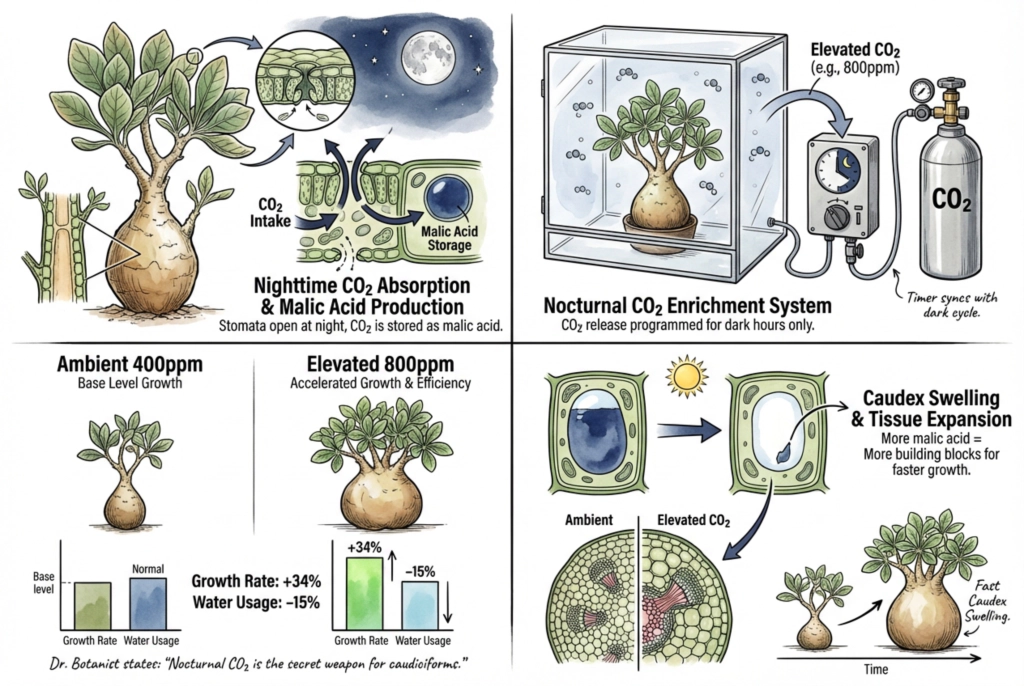
Use elevated-CO2 studies as comparative evidence
Drennan and Nobel's review reports that roughly doubled CO2 increased biomass productivity on average across the CAM species and experiments it summarized. The review also describes increased nocturnal malate storage and contributions from both nighttime PEPCase activity and daytime Rubisco-based uptake. Those are pooled findings from particular species and conditions, not an Adenia trial or a guaranteed night-only mechanism.
Response can change with species, cultivar, light, temperature, water status, duration, and the measurement used. A higher biomass result in a controlled study therefore supports a research question rather than a home recipe.
Do home growers actually need to add CO2 to their Adenia?
Keep Home Enrichment in Perspective
For most home setups, added CO2 is not justified before ordinary growing conditions are checked. Outdoor air is currently in the low-400s ppm range, while occupied rooms vary with people, ventilation, room volume, and cabinet mixing. A single plant does not usually change the room bulk concentration enough to make a home enrichment system sensible.
Common limits are more often light, seasonal temperature, roots, moisture, nutrition, pests, or recent disturbance. These factors should be investigated before treating carbon dioxide as the missing input.
Airflow can help in a stagnant cabinet by thinning the leaf boundary layer and moderating heat and humidity. It changes mixing and leaf conditions rather than raising the room's CO2 concentration.
What is the safe home version?
Use a lower-risk home baseline
Bright light, suitable growing-season nights, and gentle air movement are a lower-risk home baseline. They help a plant use the carbon already available, but they are not an equivalent to an enriched greenhouse trial.
When can a small fan help?
A small circulating fan can reduce a still-air layer and help manage local heat and humidity. A compact desk or clip circulator is enough for a single plant. Place it far enough from the plant to avoid persistent leaf movement or excess drying, start at a low setting, and adjust from leaf response, room humidity, and the enclosure's exhaust rather than a fixed schedule.
Can I run a nocturnal CO2 system at home?
Keep Compressed Gas Out of Improvised Rooms
Do not improvise compressed CO2 enrichment in a living or sleeping space. A home room does not provide the engineered ventilation, monitoring, shutdown, and trained maintenance expected for a gas system.
CAM often relies heavily on nocturnal fixation, but the process is not exclusively nocturnal. Transitional phases and elevated-CO2 conditions can include daytime atmospheric fixation, so a night-only recipe does not describe every CAM plant.
What do controlled studies actually report?
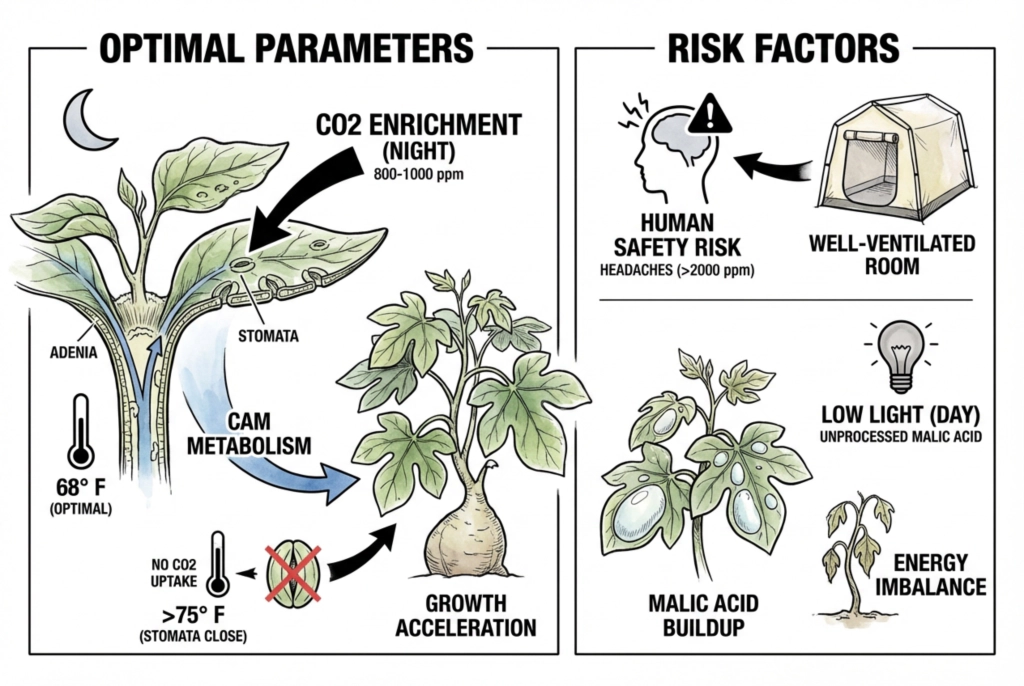
Greenhouse guidance and research often use ranges such as 800 to 1000 ppm, but that is a horticultural example rather than an Adenia optimum or a home instruction. Temperature response also varies with species, habitat, acclimation, light, and water status, so there is no single cool-night value that can be prescribed for all CAM plants.
Extra carbon only matters if the plant can use it under adequate light and suitable growth conditions. The table below separates what a controlled study can measure from what remains unknown for Adenia.
| Question | What a controlled study can show | What remains unknown for Adenia |
|---|---|---|
| Nocturnal carbon fixation | A measured change in the tested species and treatment | A confirmed response in the relevant Adenia species |
| Stored malate (titratable acidity) | A species- and condition-specific acidity response | A universal link to caudex growth |
| Biomass over a season | A result under the trial's light, temperature, water, and duration | A repeatable Adenia growth increase |
| Practical for home use | Nothing about human safety or room suitability | A safe home implementation |
Why is compressed CO2 not a home DIY project?
Understand the people-first safety boundary
CO2 is colorless, odorless, and heavier than air, so it can accumulate in low or enclosed spaces. A professionally designed system requires a secured cylinder, compatible regulator and solenoid, leak testing, low-level mechanical exhaust, make-up air, an independent fixed alarm or interlock, remote or automatic shutdown, documented inspection, trained maintenance, and the supplier's safety data sheet. Purge and re-entry procedures must be site-specific, and a person should not enter to check a consumer meter during a suspected accumulation.
A consumer air-quality meter can help track indoor-air trends within its stated range. Its placement, sampling interval, accuracy, and upper limit do not make it a life-safety alarm or an entry-clearance instrument. Do not use it as a substitute for engineered ventilation, an independent fixed alarm, an interlock, or an approved entry procedure.
What are the real risks of CO2 enrichment?
Separate Plant Response from Human Safety
The most serious risk is to people. High CO2 can cause headache, drowsiness, impaired judgment, unconsciousness, and asphyxiation depending on concentration and exposure time. A 1,000 ppm value is commonly used as a ventilation or occupancy benchmark rather than a strict toxicity line. Occupational exposure limits are separate concepts, and neither set of numbers authorizes a home enrichment setup.
What can go wrong for the plant and enclosure?
Excess CO2 can produce species- and condition-specific plant responses, including reduced yield in some crops at high concentrations. A sealed enclosure also adds heat, humidity, ethylene, gas-source impurity, leaks, and equipment-failure risks. Keeping a room empty or opening a window is not a substitute for engineered ventilation, automatic shutdown, alarm coverage, and a qualified procedure.
For a home grower the practical conclusion is unchanged. Light, seasonal temperature, roots, water, nutrition, pests, and airflow should be corrected before considering a gas system.
How do I troubleshoot slow or stalled growth?
Troubleshoot Slow Growth Before Blaming CO2
Use a differential checklist before blaming CO2. Start with light and photoperiod, then check day and night temperatures, seasonal state, root and media condition, watering, nutrition, pests, disease, and recent import or repotting history.
What to do if there is no visible growth?
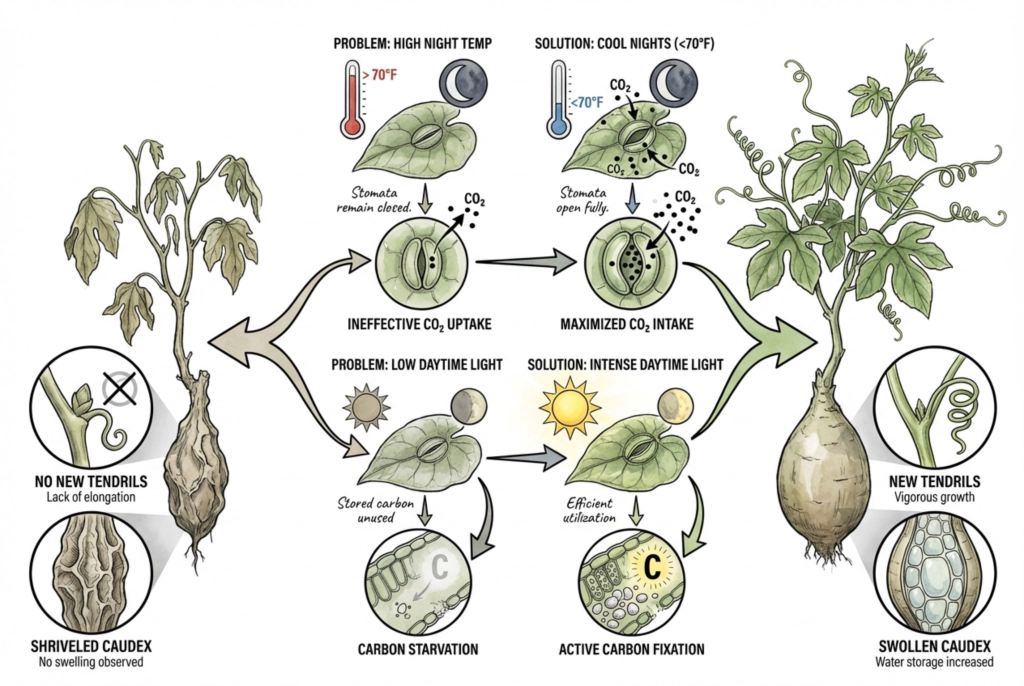
Start with the light level and photoperiod, then record day and night temperatures over several days. A healthy caudex may thicken over seasons rather than weeks, so short-term stillness is not by itself evidence of carbon starvation.
Next check seasonal dormancy, root loss or rot, over- or under-watering, drainage, nutrition, pests, disease, and repotting shock. Use a min-max thermometer and a written trend rather than forcing one temperature setpoint onto every Adenia.
If the ordinary environment is corrected and the plant still declines, reassess roots and moisture before considering any enrichment. CO2 cannot rescue a plant that is short on light or compromised below the soil line, and the safety burden makes home gas use a poor next step.
Instead of treating CO2 as the missing variable, my log pairs the overnight temperature range with an early-morning indoor CO2 reading when a meter is already available. It also includes ventilation and a fixed pot-rim photograph of the newest leaves. The record comes from a normally occupied, open room where I do not add CO2.
One CO2 reading never becomes my explanation for slow growth. A consumer meter cannot diagnose an Adenia problem, but its overnight trend beside light, pot mass, and root-zone observations helps me correct ordinary constraints first.