
Can You Repot Caudex Plants in Fall? Wait for Late Dormancy
Can you repot caudex plants in fall? Summer growers do better at late dormancy, winter growers in early fall. Bud, soil-temperature, and emergency rules.
Rachel Torres · 2026-10-22 · 16 min read
Key Takeaways
- Summer growers like Adenium and most Pachypodium repot best at late dormancy, not in October.
- Winter growers like Dioscorea, Tylecodon, and Othonna repot best at the first new growth in fall.
- Succulent roots stall in cool mix. Opuntia roots barely grew below about 54°F.
- Repot a summer grower when buds swell and the 2-inch root zone holds 60°F for five dawns.
- Rot, root pests, or a broken pot justify a dry October repot with a one-week water hold.
The plant just came in from the patio, the nursery pot looks cramped, and October feels like a good weekend to fix it.
Whether you can repot caudex plants in fall depends on one thing the pot cannot tell you. It depends on which season your plant actually grows in.
For summer growers such as Adenium, most Pachypodium, Operculicarya, and Stephania, you can, but October is one of the riskiest times to do it.
Their roots are slowing down just as you tear them. The better window is late dormancy, when the buds start to swell and the root zone is warm again.
For winter growers such as Dioscorea elephantipes, Tylecodon, deciduous Othonna, and Pachypodium namaquanum, fall is the right time.
Rot, a root-zone pest, or a broken pot can override either calendar.
Which Calendar Does Your Caudex Follow?
Caudiciforms do not share one season. Cambridge University Botanic Garden splits its succulents into two working groups. Winter growers come into growth in autumn, around September, and summer growers are active from March at the earliest to late October.
| Group | Common examples | Active growth in Northern Hemisphere cultivation | Best full repot window |
|---|---|---|---|
| Summer growers | Adenium, Pachypodium lamerei, Operculicarya decaryi, Stephania erecta | Spring to early autumn | Late dormancy, as buds swell |
| Winter growers | Dioscorea elephantipes, Tylecodon paniculatus, deciduous Othonna, Pachypodium namaquanum | Autumn to spring | Early fall, at the first new growth |
| Follow the plant | Fockea edulis, Ceraria pygmaea | Slows but rarely stops | When visible growth resumes |
Sort every plant into a calendar before you pick a repot date, because October suits one group and risks the other.
Summer Growers Rest Through the Cold Months
Most caudiciforms sold in the US grow during the hot months and go dormant in winter.
University of Arkansas Extension describes the group that way, and it fits the plants most people own. A leafless Adenium in November is resting, not dying.
UF/IFAS lists a hot 75 to 95°F preference for Adenium obesum. It advises withholding water through cold winter months and letting the plant rest for 3 to 4 months while all its leaves drop.
Operculicarya decaryi follows the same pattern. The Henry Shaw Cactus and Succulent Society times its propagation for spring or early summer, while the plant is waking up from winter dormancy.
Stephania erecta, botanically Stephania pierrei, wakes in spring and winds down in autumn, then rests through winter.
Winter Growers Wake Up in Autumn
The winter-growing group comes from South Africa’s winter-rainfall regions. SANBI describes Dioscorea elephantipes as summer deciduous, and it grows in the winter and spring months.
Tylecodon paniculatus also drops its leaves for summer and carries them through winter.
Othonna retrofracta is restricted to winter-rainfall regions and drops its leaves when it goes dormant in summer. SANBI even advises transplanting its seedlings by the following autumn.
Pachypodium is the trap genus. Most species grow in summer, but Pachypodium namaquanum is a winter grower. In its Richtersveld habitat its leaves form in early fall and fall off in early spring.
A Pachypodium label alone does not tell you the calendar, so check the species before you plan an autumn repot.
Fockea and Ceraria Do Not Fit a Clean Label
Fockea edulis is usually filed with the summer growers. It shows decreased activity from January to April, but it never goes fully dormant and always keeps some leaves.
Ceraria pygmaea, now often placed in Portulacaria as Portulacaria pygmaea, is sometimes grown as a winter grower.
Yet the llifle encyclopedia says it seems to want to grow all year in a greenhouse.
For both, the plant’s own new leaves and shoots are a better signal than the genus name.
Why an October Repot Stalls a Summer Grower
A full repot always costs roots. The question is how fast the plant can replace them, and in October a summer grower is heading the wrong way.
Succulent Roots Need Warmer Soil Than Tree Roots
Much fall planting advice comes from trees and shrubs. Oklahoma State Extension notes that their roots keep growing as long as soil stays above 40°F, which is why autumn planting works in the landscape.
Succulent roots run on a warmer thermostat. In a study of the CAM succulent Opuntia ficus-indica, roots elongated only between about 12 and 43°C (54 to 109°F).
The fastest growth came near 27 to 30°C (81 to 86°F).
An indoor pot that drifts into the 50s°F at night sits near that floor. University of Arizona Extension reaches the same practical point for cactus transplants. Winter transplants experience delayed root growth because the soil is cool.
The fall-planting rule was built on tree roots, and it does not transfer to tropical caudiciforms whose roots stall in cool mix.
Cut Roots Seal Slowly in the Cold
Every torn root is an open wound until the plant lays down a corky seal. Some of the clearest evidence on cold wound healing comes from potato tubers, another storage organ.
In one study, wounded tubers healed at 4°C formed less protective wound tissue than tubers held at 22°C. The cold suppressed the pathways that build the corky barrier.
A caudex root is not a potato, so treat this as an analogy rather than a measured caudex result.
It still points the same way as the root data. A cut made going into a cold winter likely stays open longer.
Fresh Mix and a Resting Plant Hold Water Too Long
A dormant summer grower drinks very little. Fresh mix watered in after a repot can stay wet for a long time around roots that are not growing.
That is the condition water molds exploit. UC IPM notes that Pythium is present in practically all cultivated soils and attacks roots under wet conditions.
SANBI warns that Adenium is susceptible to root rot when watered too often in cool weather.
Cold plus wet plus fresh wounds is the combination to avoid. The cold wet soil root rot guide lays out the full mechanism.
Keeping the Plant Warm All Winter Is Not a Shortcut
Heating a freshly repotted summer grower through winter sounds like a fix. Cambridge’s growers warn that summer-growing material kept too warm in winter becomes confused and is easily rotted off.
Winter warmth can push weak, out-of-season growth that rots easily. Waiting for the plant’s own season is the safer plan.
Why Late Dormancy Is the Better Window
Late dormancy lines up three things in the plant’s favor. The root zone is warming, the buds are about to push, and the plant still carries few or no leaves.
Arizona Extension notes that cacti carry internal water reserves that sustain the plant while new roots grow. A caudex is the same kind of water store. With no full canopy pulling water yet, a trimmed root system has time to rebuild before demand peaks.
Read the Buds Before the Calendar
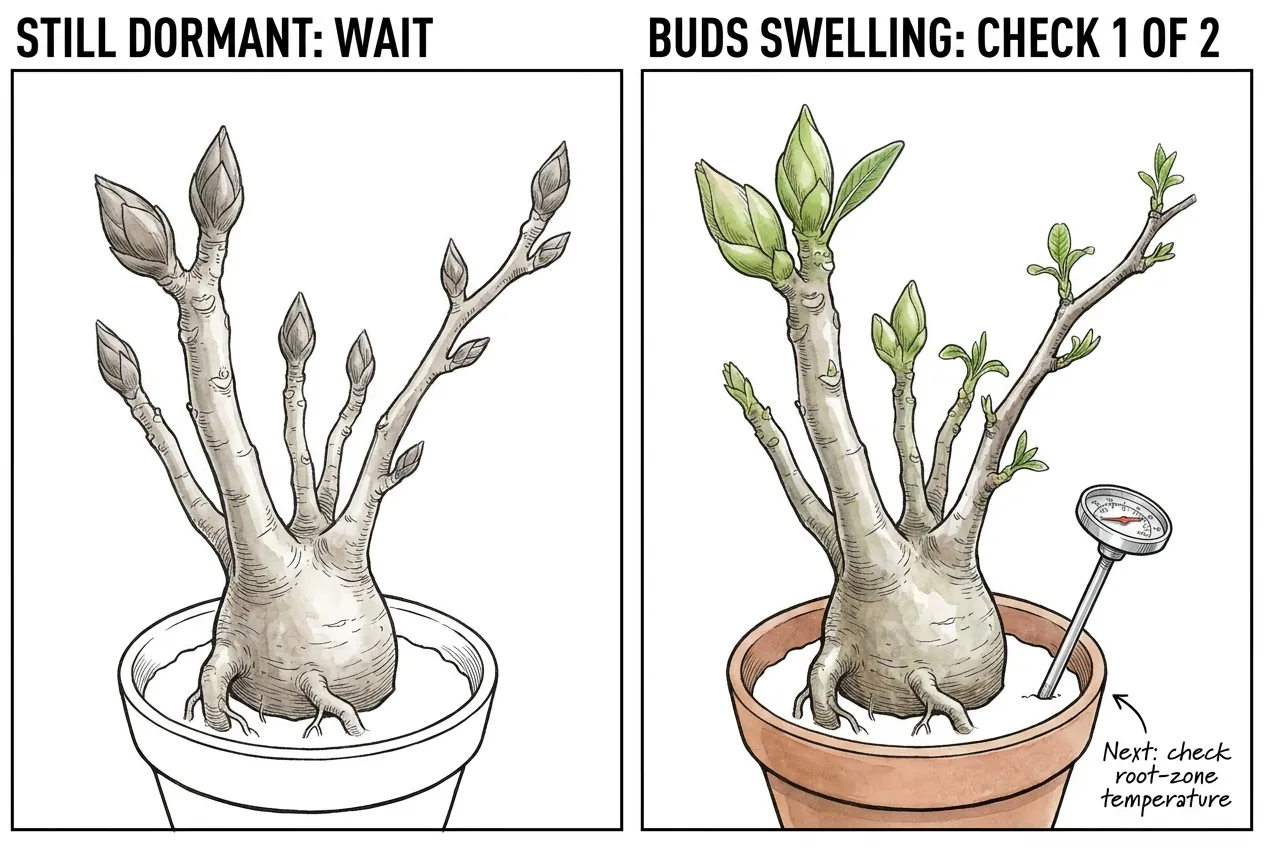
The end of dormancy is visible before leaves appear. SANBI notes that expanding terminal buds signal the end of Adenium dormancy, and watering can increase from that point.
On Adenium and Pachypodium, look for stem tips turning green and fattening. On Operculicarya, look for fresh shoots along the branches. Clemson’s Home and Garden Information Center gives houseplants the same rule and repots them when new growth starts in spring.
Swelling buds signal the end of dormancy, which makes them the first of two checks before a repot.
Confirm the Root Zone Is Warm Enough
A bud can swell on a cold windowsill, so I pair it with a root-zone check.
A probe thermometer from the dormant caudex watering measurement kit stays 2 inches deep in the plant’s own pot, near the wall.
I read it before sunrise, or before any grow lights come on, for five mornings in a row.
The repot goes ahead only when all five readings sit at or above 60°F (16°C) and at least one stem tip shows a swelling bud.
With no swelling bud, the plant stays cool and dry, and I look again next week.
If a bud is swelling but a reading falls below 60°F, I move the pot somewhere warmer or brighter and run the five mornings again.
Sixty degrees is my working rule, not a published standard. It sits above the roughly 54°F floor where Opuntia roots started to elongate. It also matches the night temperature Arizona Extension uses before watering transplanted cacti.
Pre-dawn is the daily low, so five of those readings rule out one lucky warm night.
The same root-zone logic drives the autumn watering break point for caudex plants.
When the Window Usually Opens
Cambridge counts its summer growers as active from March at the earliest. Indoors, heating and grow lights shift that date, so the calendar only tells you when to start checking.
In a cool room, the bud and probe checks may not both pass until mid-spring. In a warm, bright room, they can pass in late winter. Either way, the plant sets the date.
How to Repot a Summer Grower at the End of Dormancy
Once both checks pass, the repot itself is short. Adenium carries toxic sap and Pachypodium adds sharp spines, so set up the protective gear for repotting caudex before you start.
Lift the Caudex and Inspect the Roots
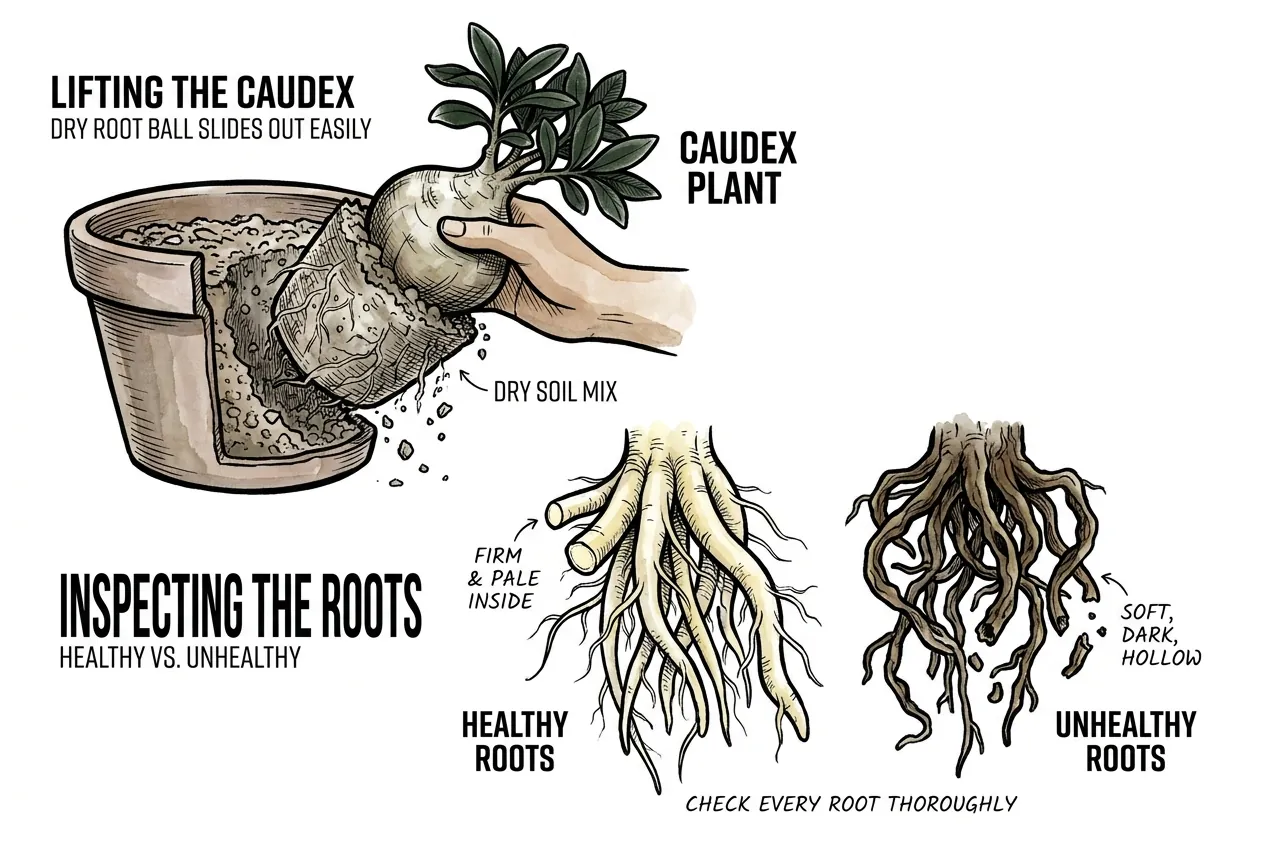
Let the mix go fully dry for a few days first, so the root ball slides out and loosens easily.
Tip the pot, support the caudex at its base, and ease the root ball free rather than pulling on the stem.
Knock away the old mix and look at every root. Healthy roots are firm and pale inside. Soft, dark, or hollow roots that slide out of their skin are dead.
Trim Only Broken, Dead, or Circling Roots
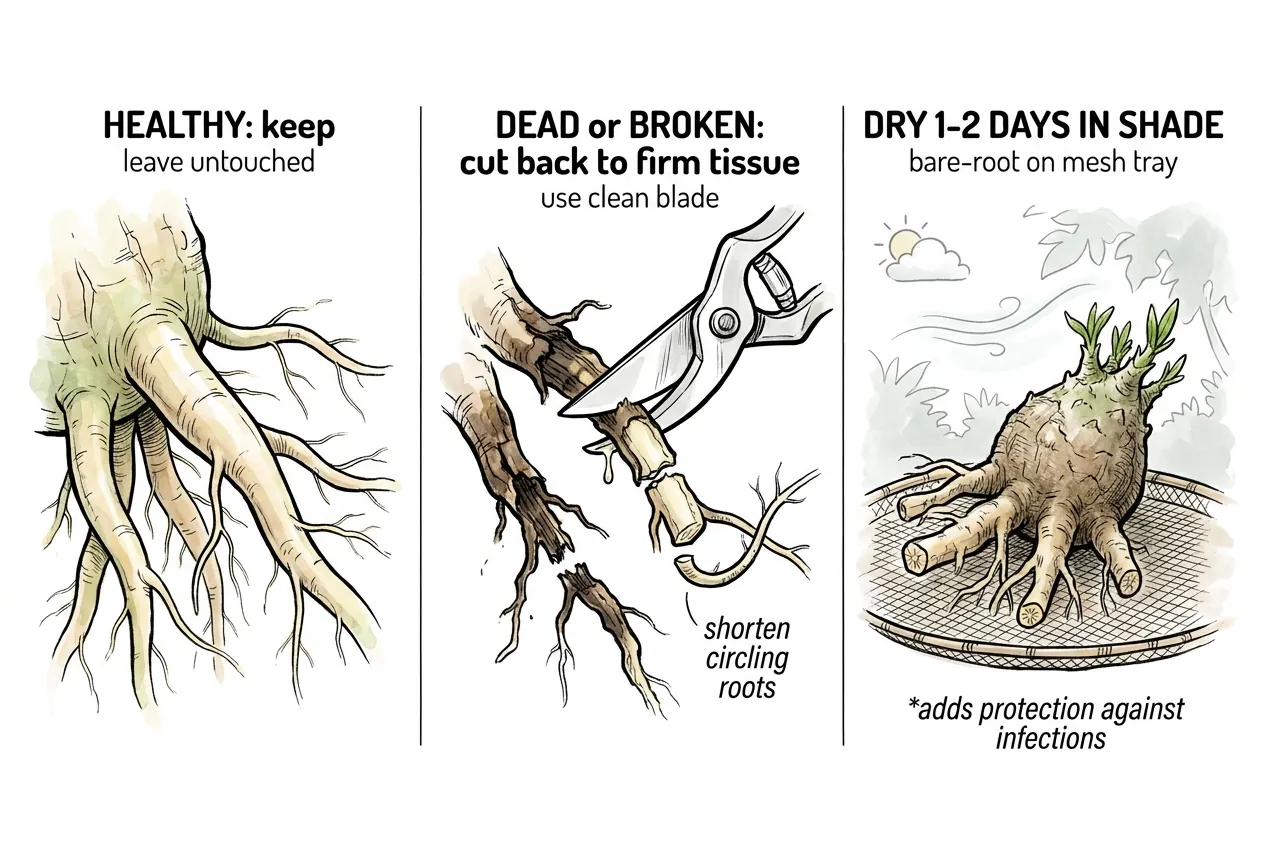
Arizona Extension advises cleanly trimming broken or frayed roots and leaving healthy, undamaged roots in place. Cacti can withstand considerable root loss, but every healthy root you keep is one the plant does not have to regrow.
Cut dead roots back to firm tissue with a clean blade. Shorten roots that circle the pot wall so they point outward again.
Arizona also notes that letting cut roots dry before replanting can add protection against root infections.
Cacti can wait dry and shaded for several days or weeks, so a day or two of drying is well inside that range.
Pot Up One Size Into Dry Mineral Mix
Clemson advises a new pot only 1 to 2 inches wider than the old one. A much larger pot surrounds the roots with mix they cannot reach, and that mix stays wet.
Plant into dry, fast-draining mineral mix and keep the caudex at its existing soil line unless you are deliberately exposing it.
Container material changes how fast that mix dries, which the best pot for caudex plants guide compares in detail.
Hold Water for a Week, Then Restart Gradually
Arizona Extension tells growers not to water a transplanted cactus immediately. It recommends waiting a week so roots damaged in the move can dry.
After that week, give a light first watering and let the pot dry before the next one.
Increase the volume as leaves expand and the plant starts drinking on its own.
Winter Growers Get Their Repot in Early Fall
For Dioscorea elephantipes, Tylecodon, and deciduous Othonna, October is their spring. The same logic applies in mirror image. Repot as growth starts, not as it ends.
Signs a Winter Grower Has Started Its Season
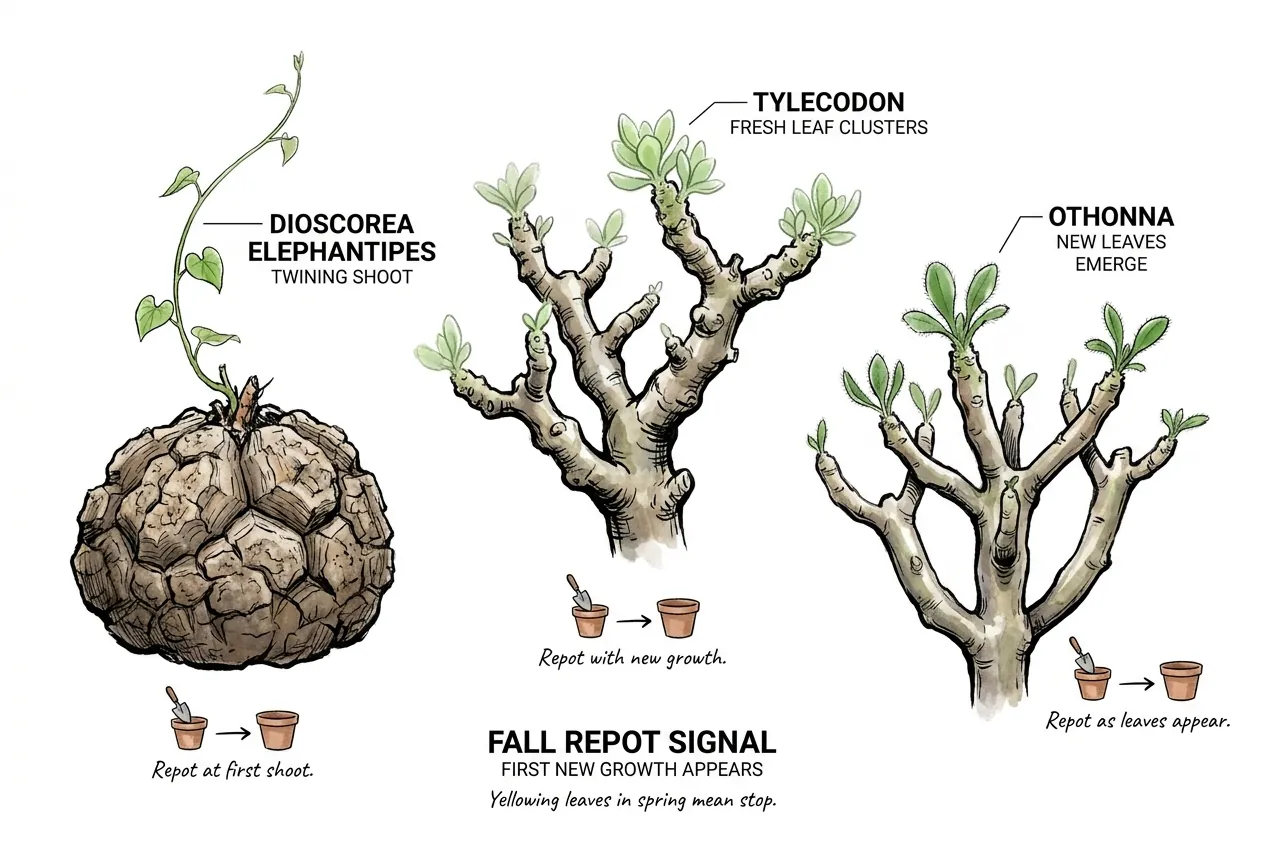
Dioscorea elephantipes sends up a thin green twining shoot from the top of the caudex. Tylecodon and Othonna push fresh leaves at their branch tips after a bare summer.
Repot as soon as those first leaves or shoots appear, before you return to regular watering. Cambridge waters its winter growers mainly in autumn and spring.
Avoid the reverse mistake in spring. SANBI notes that Othonna herrei must have a complete resting period in summer. A repot as leaves yellow puts fresh wounds into a dry, dormant season.
For a winter grower, the first new leaf in fall is the repot signal, and yellowing leaves in spring are the stop signal.
The full seasonal routine for this group is in the winter-growing Othonna and Tylecodon care guide.
When to Repot in October Anyway
Some problems will not wait for spring. In these cases, the risk of leaving the plant where it is outweighs the risk of a cold-season repot.
Problems That Override the Calendar
Act now if you see any of these.
- Soft, dark, or sour-smelling roots at the drainage holes, or a soft spot on the caudex that dents under gentle thumb pressure
- Mealybugs or other pests living in the root zone
- A cracked or shattered pot
- Mix that has broken down into a dense, wet sludge that never dries
UC IPM notes that under wet conditions more and more roots are killed, and the plant may wilt, stop growing, or collapse. Rot in a summer grower does not pause for dormancy.
The Dry Emergency Repot and the First Drink
Work dry from start to finish. Lift, inspect, and trim as in the late-dormancy steps, but skip the few-day dry-down if the old mix is wet or rotting. Then plant into dry mix.
After an emergency fall repot, the first drink waits 7 days, the interval Arizona uses for damaged roots to dry.
On day 7, a pre-dawn reading from a probe 2 inches deep decides the next step.
At or above 60°F, a plant still in leaf gets a light watering. A leafless plant stays dry even at 60°F until its buds swell. Below 60°F, the pot stays dry.
After day 7, while a pot stays dry, I repeat the pre-dawn probe reading once a week and give the caudex a gentle press at the same visit. Each new reading follows the same 60°F rule.
The press separates thirst, the only early exception to the dry hold, from rot. Slight, even give or fine wrinkling all over, with a firm base and intact skin, is thirst.
A localized soft, dark, wet, or sour-smelling spot is rot, so the plant gets no water and comes out for another root inspection.
A thirsty caudex gets a sip of roughly a quarter of its usual summer volume. I chose that small amount because it moistens the outer roots without soaking a cold, idle core.
Slip-Pot When the Pot Is Simply Too Small
A cramped pot alone is not an emergency. Slip-potting moves the whole root ball, untouched, into a pot one size larger and fills the gap with dry mix. The plant then stays on its usual dry winter schedule.
No roots are cut, so there is nothing to heal in the cold. Hold the full root work until the late-dormancy checks pass.
Your October Decision, Plant by Plant
The question was never whether a caudex can survive a fall repot. It was whether its roots can regrow in the weeks that follow.
| Your situation in October | What to do now | When to do the full repot |
|---|---|---|
| Healthy summer grower in a tight pot | Slip-pot or leave it | Late dormancy, when buds swell and the root zone holds 60°F |
| Summer grower with rot, root pests, or a broken pot | Dry emergency repot | Now, then hold water 7 days and follow the 60°F probe rule |
| Winter grower showing new leaves or shoots | Full repot | Now, at the start of its season |
| Fockea or Ceraria | Watch for new growth | When active growth resumes |
If your plant is a summer grower and nothing is wrong, the best thing to do with it this October is leave its roots alone. Set a reminder to start the bud and probe checks in late winter instead.
Key Takeaways
- Summer growers like Adenium and most Pachypodium repot best at late dormancy, not in October.
- Winter growers like Dioscorea, Tylecodon, and Othonna repot best at the first new growth in fall.
- Succulent roots stall in cool mix. Opuntia roots barely grew below about 54°F.
- Repot a summer grower when buds swell and the 2-inch root zone holds 60°F for five dawns.
- Rot, root pests, or a broken pot justify a dry October repot with a one-week water hold.