
Shade Cloth for Caudex Plants
Compare shade density, measure bark temperature, and choose reflective or knitted fabric for a caudex plant's light and heat response.
Rachel Torres · 2026-06-21 · Updated 2026-07-18 · 35 min read
Key Takeaways
- Scald tracks bark surface temperature, not air temperature. Sunlit bark runs much hotter than the surrounding air, so use a surface reading as a warning signal rather than a species cutoff.
- For many full-sun caudex plants, moderate knitted cloth is a starting point. Heavier shade may reduce compact growth, so verify the density against the plant, season, and measured light.
- Reflective aluminized cloth can keep a surface cooler than black cloth at a similar rating. Weigh the extra cost when measurements show that heat remains the limiting problem.
- An adjustable-emissivity IR thermometer, used with a consistent setting and a measure-then-verify habit, is a useful shade check. Use it alongside, not instead of, watching the plant.
- Match the fix to the problem. A light-colored pot helps hot roots, gradual acclimation reduces scald risk, and an air gap keeps the cloth off the plant.
Your patio thermometer can read 33 °C while the south face of a sunlit caudex runs much hotter. That gap is why shade selection should be tied to a surface measurement rather than air temperature alone.
For caudex and succulent growers, the useful decisions are which density fits the light budget, whether reflective material is justified by heat, and how to verify the installed cloth at the plant.
What should you actually buy for summer caudex shade?
Choose a rated shade cloth, measure the plant’s light and sunlit bark temperature, and compare black knitted fabric with reflective material only when heat remains the limiting problem. Density is a starting hypothesis, not a universal answer.
Percentage is the first lever because a knitted net removes incident radiation roughly in proportion to its shade factor, but scald tracks bark surface temperature rather than air temperature. Reflective material is a conditional upgrade that may lower surface temperature more than black at a similar shade percentage, so use bark reading, canopy light, and plant response together to decide whether the extra cost is justified.
The small kit
A practical shade setup needs a rated cloth, a way to measure the plant’s response, and UV-stable fastening that keeps an air gap.
Black HDPE and aluminized fabric solve different problems. Select between them after measuring heat and light at the canopy.
A quantum PAR or lux meter is optional. It becomes more useful when heavier shade or an indoor move could push a high-light caudex toward etiolation.
A single-plant grower may be able to work from plant response and surface measurements.
Why does summer sun scorch a caudex, and what does shade actually reduce?
Sun scald is a surface-temperature injury, and a sunlit succulent surface can run far hotter than the air around it.
Studies on desert succulents and fruit crops show that tissue damage can occur in the mid-50s °C under sustained exposure, but those values are analogues rather than a universal caudex threshold. Scald is therefore better assessed from the sunlit surface than from air temperature alone.
The decoupling is documented across systems. In citrus, sunburn develops when ambient air is only 30-36°C but the fruit surface climbs to 38-48°C. Similar physics applies to succulents. Soil-surface temperatures can reach very high values in habitat, and a thick, low-transpiration succulent body sheds heat by evaporation far less than a thin leaf does.
Not all caudex plants discussed here are CAM. Adenium, for instance, is reported to use ordinary C3 photosynthesis, but the surface-heating point holds regardless of photosynthetic pathway.
The thermal threshold
For desert succulents, one classic assay found substantial tissue injury near the mid-50s °C after a one-hour exposure.
That result comes from a different material and should be treated as a warning band, not a Pachypodium or Adenium prescription.
Cultivated ornamental caudex plants may be less acclimated than the toughest desert species. Use a conservative surface-temperature margin below the analogue injury band, then verify new growth and colour rather than enforcing a universal 45–50 °C target.
Two damage pathways, two wavebands
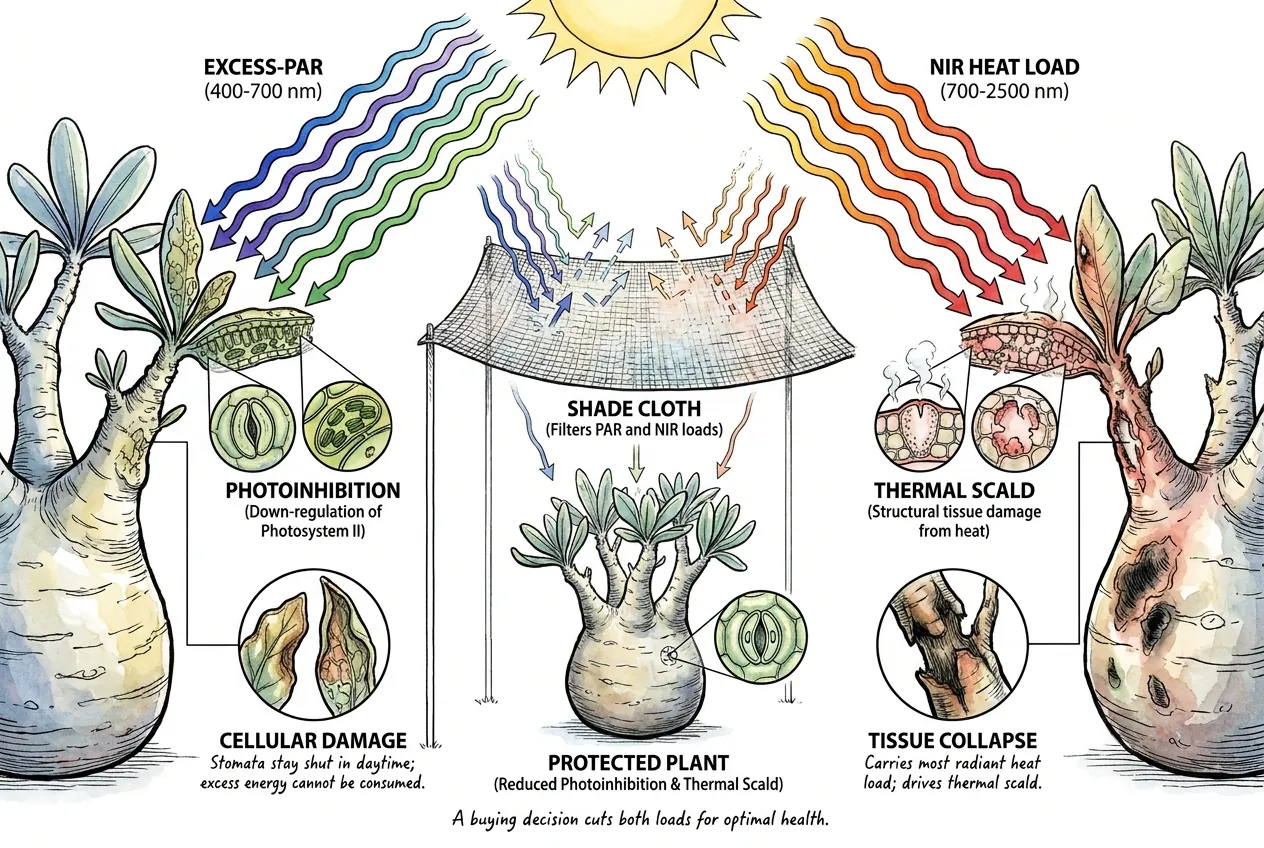
Heat is not the only damage route. Even at a thermally survivable surface temperature, light quantity above what the photosystems can use causes photoinhibition, a measurable down-regulation of Photosystem II.
This can be pronounced in strict-CAM succulents whose stomata are largely closed by day, where midday can deliver more absorbed light than daytime photochemistry can use, though many caudex plants aren’t strict CAM, and CAM plants can also take up some CO₂ by day, so treat this as one mechanism among several rather than a universal rule.
The classic field case is Opuntia basilaris in Death Valley, where Fv/Fm stayed chronically depressed and fell further as photon flux rose.
This is excess-PAR damage in the 400-700 nm band, distinct from the near-infrared, roughly 700-2500 nm, that carries most of the radiant heat load.
A buying decision has to cut both loads, the PAR overload that drives photoinhibition and the NIR heat load that drives thermal scald.
How shade percentage cuts the load
A knitted net intercepts a fixed fraction of incoming radiation set by its shade factor. The plant-relevant result is a proportional drop in PAR and solar radiation and, depending on installation, a lower surface temperature.
In a measured trial, a reflective net rated 40% reduced solar radiation by 46.3% and PAR by 48.3%.
Canopy temperatures fell significantly even though air temperature under the shade barely moved.
Field studies show that shading can lower exposed surface temperature, but the size of the change depends on cloth, wind, background, and sun angle.
A rated shade percentage describes intercepted light, not a guaranteed temperature drop. Measure the bark or leaf surface to see the plant-level result.
Why reflective beats black at the same shade percentage
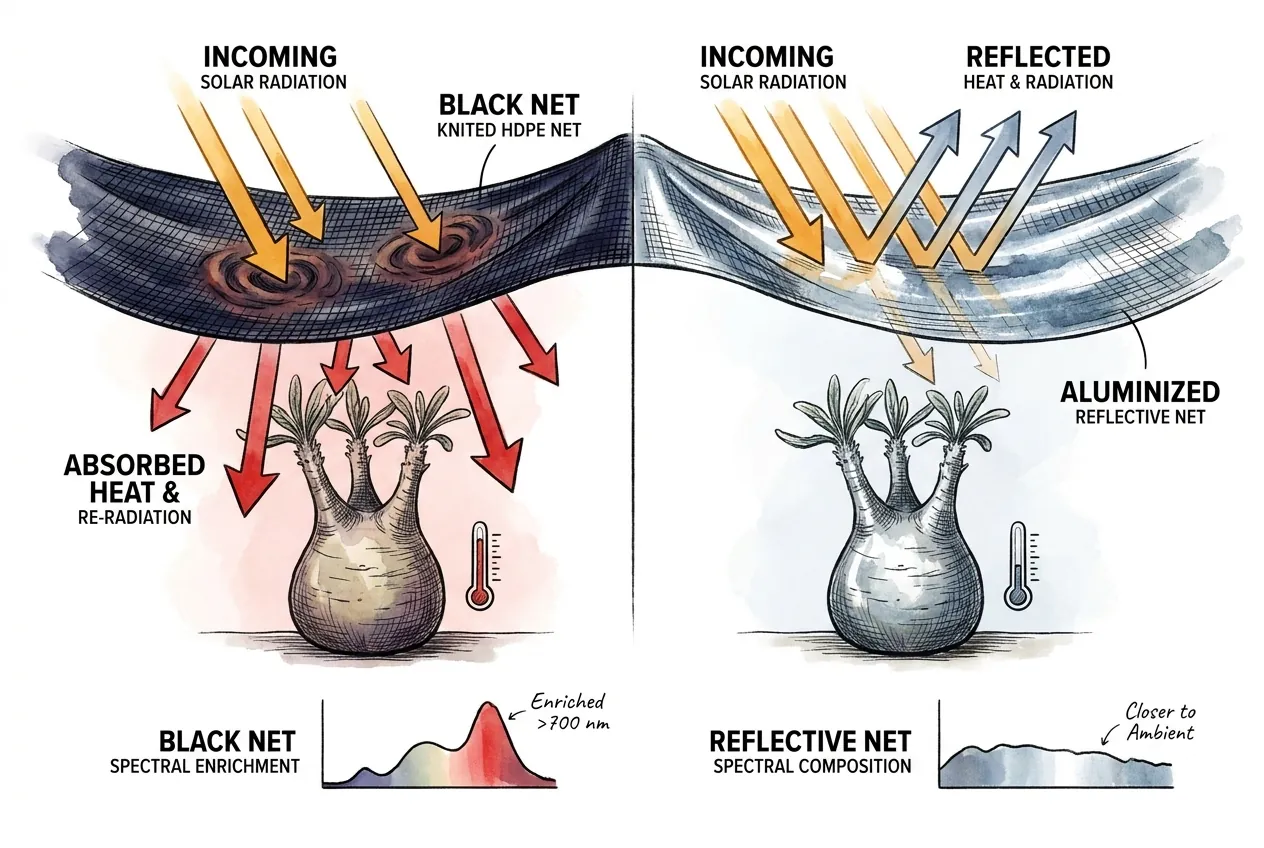
Compare how each cloth handles intercepted energy
At a similar nominal shade rating, black knitted HDPE and aluminized reflective net block a broadly similar fraction of light, but they handle the intercepted energy differently.
Black HDPE absorbs intercepted sunlight and heats up. It then releases that energy as long-wave thermal infrared radiation, including some directed toward the plant.
The aluminized net reflects a large share of incoming solar radiation back upward, so less energy is absorbed and re-emitted as heat near the plant.
The warm cloth re-emits mostly long-wave thermal infrared, which is not the same as the near-infrared band in incoming solar radiation. Saying that it re-radiates NIR downward is therefore a simplification.
Use surface temperature to choose between materials
Black cloth often has a warmer underside than reflective cloth.
The measured record shows black nets can transmit somewhat less PAR at a given rating (around 52% versus roughly 55–58% for some colored/reflective constructions), yet aluminized screens still tend to deliver lower leaf temperature and better-functioning PSII.
The cited spectral study adds an important limit. Black nets only shifted the balance toward wavelengths beyond 700 nm at very high shade factors (around 95%), not at the 40–50% grades recommended here, so don’t assume a moderate black net meaningfully enriches the heat band.
The net result is that at the same shade percentage, a reflective net may produce a cooler plant surface even though it can transmit slightly more visible light.
For a grower whose measured failure mode is surface-temperature scald, that difference may justify the premium. For a grower who only needs to cut PAR, black can be the simpler lower-cost choice.
How do you choose the right shade percentage?
Shade percentage is a light-blocking rating measured under the maker’s test conditions. It is not a temperature-reduction figure.
Extension guidance gives broad ranges for sun-loving crops, while seedling acclimation and heat mitigation may call for different densities.
Use those ranges as starting points, then confirm with canopy light, surface temperature, and new growth for the actual genus.
The selection-criteria table
| Shade % | Approx. light transmitted | Typical use case | Reflective vs black note | Caudex fit |
|---|---|---|---|---|
| 30% | ~70% through | Vegetables, light scald protection, hardened full-sun plants in milder climates | Black-vs-reflective gap is small but real at 30%. Reflective still runs cooler | Lower bound for very-high-light caudex in cooler regions. May be too little in peak hot sun |
| 40% | ~60% through | Possible starting point for full-sun caudex in hot summers | Reflective may lower bark surface temperature at an equal nominal % | Compare against measured light and heat. Not a universal baseline |
| 50% | ~50% through | Full-sun caudex in extreme heat. Mild import acclimation | Reflective may provide a larger bark-temperature advantage here | May suit short acclimation or extreme heat. Verify the PPFD for the species |
| 60% | ~40% through | Sensitive succulents, seedlings, fresh-import acclimation | Black may suit short acclimation. Reflective if heat remains the limiter | Use cautiously for caudex and verify DLI. Often better as a temporary stage |
| 70-90% | ~10-30% through | Ferns, hosta, deep-shade benches, propagation | Color less critical. Light reduction dominates | Often too dark for high-light caudex. Verify before use |
The over-shading and etiolation trap
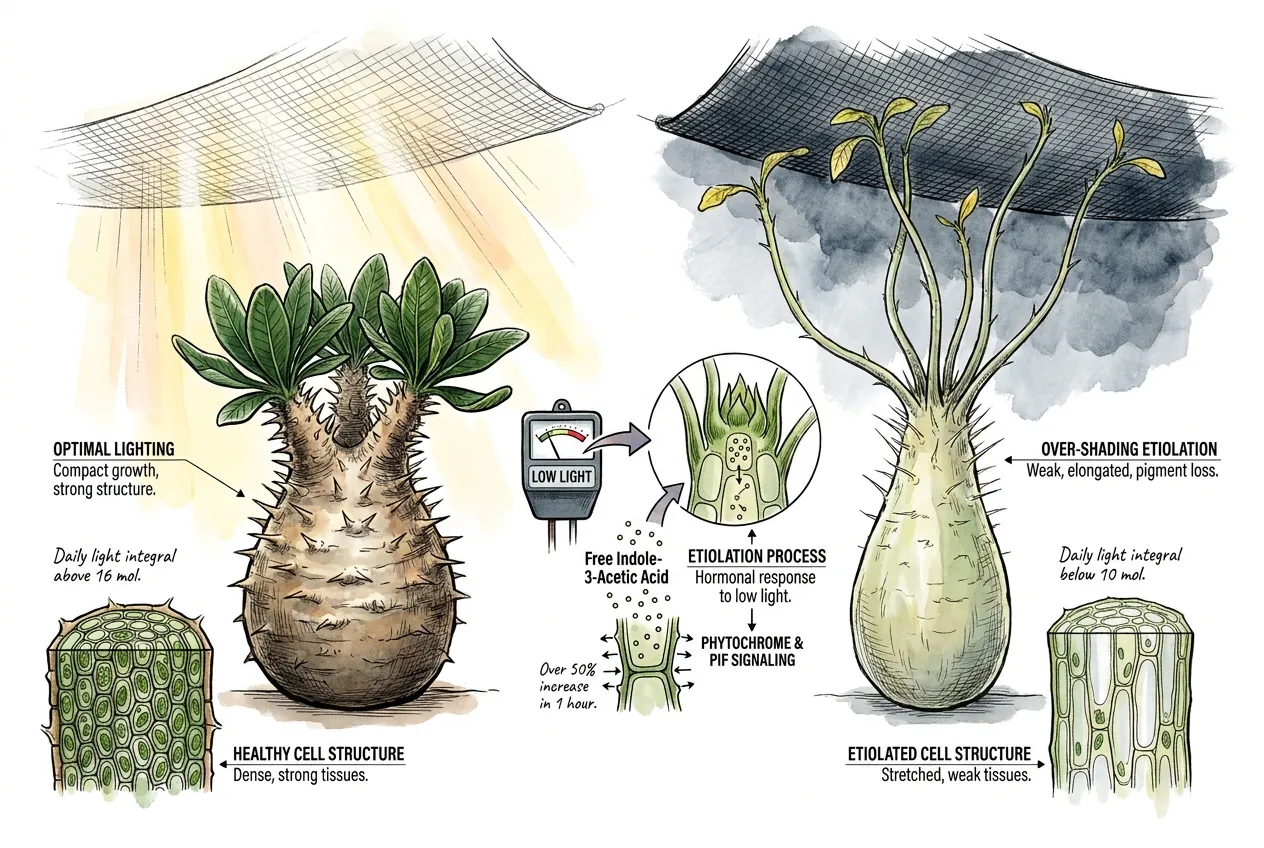
Buying too much shade is its own failure mode. If the plant’s daily light falls below what its species and growth stage can use, shade-avoidance may produce longer internodes, weaker tissue, or slower growth.
Use published crop ranges as context, not as a universal caudex floor.
In related crops, lower DLI and low red-to-far-red treatments produced more elongated stems, with auxin and phytochrome/PIF signalling implicated in the response.
Those studies are not caudex trials, but they explain why already-stretched tissue does not shorten while new growth can become more compact after light is restored.
The PPFD floor caps how much shade to buy
There is also a lower limit. Do not shade a high-light plant below the light it needs to stay compact.
Use the companion Pachypodium brevicaule PPFD analysis as a reasoned, species-specific starting point, not a measured threshold for every caudex.
As a rough check, clear-sky summer sun can supply a high DLI outdoors, but the amount remaining under 40–50% cloth depends on cloud, sun angle, orientation, and season. Very heavy shade can push a high-light plant toward a range where it stretches.
Daily light integral is accumulated over the whole day, so multiplying one midday PPFD number by the shade fraction is only a ballpark, not a verified plant-level DLI.
Reflective aluminized vs black knitted HDPE: which cloth should you buy?
Black knitted HDPE can suit a budget-focused light-reduction problem, while aluminized reflective cloth may suit surface-temperature scald under intense clear-sky sun.
At a similar nominal shade percentage, the reflective construction can reject more incoming radiant heat, but the plant-level difference depends on installation.
Use an IR reading and canopy-light check before paying a premium.
Reflective treatments have lowered leaf and fruit temperatures in peer-reviewed crop studies. One apple trial reported an 8°C reduction after a kaolin treatment. That result supports the heat-rejection mechanism, but it is an analogue rather than a caudex measurement.
Netting research on fruit, an analogue rather than a caudex trial, shows that a properly installed cover can lower surface temperature under hot air conditions.
How big is the reflective-minus-black delta?
The reflective-minus-black surface-temperature advantage is directional, but the caudex-specific size of that advantage is not precisely quantified.
Documented analogues span a wide range, from about 0.2°C in a mild citrus reflectant trial up to roughly 8°C for a strong reflective treatment on apple.
Manufacturer claims of double-digit improvements are product-specific claims, not a guarantee for a caudex installation.
A practical decision rule is to consider the aluminized premium when an IR thermometer shows sunlit bark in or near the warning band under black cloth.
Choose black knitted HDPE when the goal is PAR reduction and measured bark temperatures are already acceptable.
Why knitted, not woven
Both example cloths are knitted lock-stitch, not woven, and that matters for a cut-to-fit buyer. Lock-stitch knit is generally less prone to unraveling when cut, but edge reinforcement still matters. Woven shade cloth can fray when cut between threads, making field-cut sizing more demanding.
Some knitted HDPE products carry rated service lives around 7-10 years, while premium lines may carry a 5-year UV degradation warranty.
Reflective net products are often rated shorter, roughly 4-5 years outdoors, because the metallized coating and finer reflective structure can degrade sooner.
Use the specific product warranty and condition of the cloth to decide when replacement is needed.
Which reflective aluminized cloth meets the spec?
For a heat-led installation, look for an aluminized knitted construction and a density that keeps the species’s measured light above its working floor.
Reflecting incident solar radiation may lower bark surface temperature at a similar shade percentage versus black.
The Agfabric Aluminet, in a roughly 40% grommeted version, is one conditional example. It is aluminized knitted with a reinforced grommeted edge for tensioned mounting. Confirm the current density and dimensions.
It fits a full-sun bench of Adenium or Cyphostemma where the bark reads hot, mounted with an air gap so the reflective benefit is not lost to contact.
It costs more than black HDPE, may age out sooner, and can create glare.
Skip it if your bark surface already sits below the warning band, because the extra reflectivity may not solve a problem you have measured.
For very intense exposure or brief acclimation of fresh imports, the denser Agfabric 60% shade cloth, in a 7-by-14-foot panel, is an option.
It may suit short-term heavy shade over a soft import during its first outdoor exposures. The catch is that 60% can be too dark for some Pachypodium or Adenium setups, so confirm the measured light before leaving it in place for a full season.
Which black knitted HDPE cloth meets the spec?
For a budget light-reduction installation, look for UV-stabilized knitted HDPE with a density matched to the measured canopy light.
Lock-stitch construction can make cut-to-fit work easier, but edge reinforcement and fastening still matter.
The Agfabric 50% shade cloth is one conditional example of knitted lock-stitch HDPE. Confirm the current size, density, and included clips.
It suits a cost-sensitive grower covering a large bench where light, not surface temperature, is the limiting threat, cutting the panel to odd dimensions without fraying.
The downside is that black absorbs intercepted solar energy and re-emits heat, so it may give less surface-temperature benefit than reflective at the same percentage.
The included clips are light-duty, so a windy site needs proper UV-rated fastening, and 50% can over-shade a sensitive caudex.
For a larger continuous run, the Coolaroo 50% shade cloth, the 6-by-100-foot black roll, covers more area per purchase.
Use it for covering several benches or a long span from one roll, cut to fit.
The downside is that a 100-foot roll is far more than a single-plant grower needs, and like other black cloth it absorbs intercepted energy rather than reflecting as much of it away.
Confirm you want the black SKU rather than a colored colorway before ordering.
A smaller middle option is the Agfabric 50% panel, the same knitted HDPE line in a larger single panel than the 10-by-20.
It is best on one wide bench that the 10-by-20 panel does not quite cover. Just note that it is still black, so it still absorbs and re-emits more heat than a reflective construction.
Skip it if surface-temperature scald rather than light is your documented threat.
How do you verify the shade is working with an IR thermometer?
Point a non-contact IR thermometer at dry, sunlit bark and record the surface temperature consistently. Air temperature is a poor proxy for scald risk because a sunlit caudex surface can run much hotter than the surrounding air.
A surface reading is the most direct way to check whether the shade changed the plant-level risk, but it still needs to be interpreted with the species and tissue condition.
A cactus surface-temperature study found shortwave radiation was the single most important variable setting maximum stem temperature.
In that study, a 70% reduction in shortwave radiation by shading lowered stem surface temperature by 17°C on a 2 cm plant.
Use the before-and-after bark readings to judge whether the cloth provides useful margin. Do not assume a double-digit drop or a universal pass/fail value. Measure the same surface under comparable conditions.
Match emissivity to the plant surface
An IR thermometer infers temperature from emitted thermal radiation, and how much a surface emits is its emissivity.
If the instrument’s setting does not match the target, the reported temperature is biased. Measured leaf emissivity often runs high, about 0.978-0.985, while some horticultural protocols use 0.95 as a practical default. Treat the manufacturer’s guidance and the target surface as the starting point rather than assuming one value is universal.
For dry bark and leaf, start with the manufacturer’s recommended emissivity and keep it consistent.
Published leaf measurements suggest values near 0.98, but bark, wetness, gloss, and angle can change the error.
The danger is shiny, wet, or metal surfaces. A gun set to 0.95 on bright metal or a glassy wet film can be off by tens of degrees.
Avoid relying on readings from freshly misted or dewy bark.
Distance-to-spot ratio decides what you measure
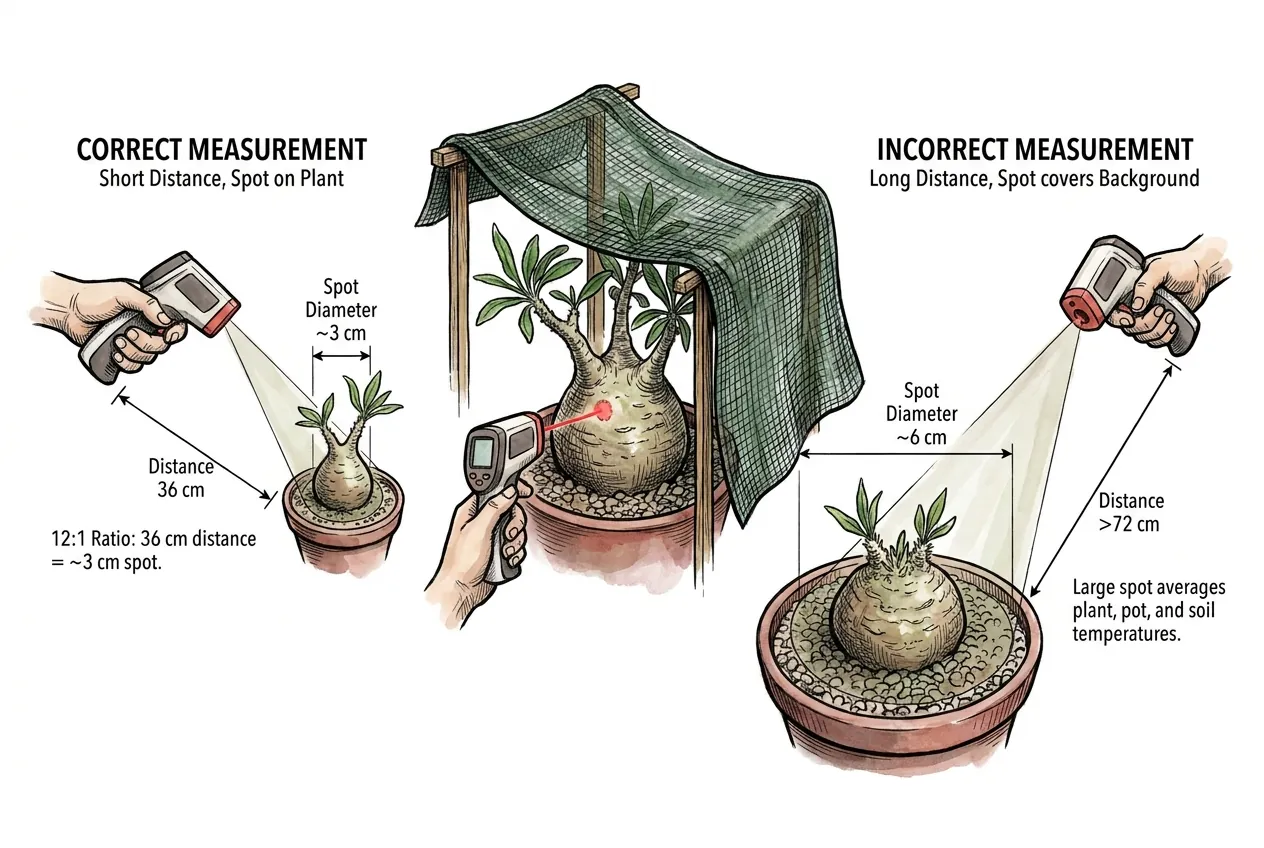
An IR thermometer averages temperature over a circular spot whose diameter grows with distance. The distance-to-spot ratio sets the spot size. At 12-to-1, a target read from 12 inches away is averaged over a roughly 1-inch spot.
If the spot is bigger than the caudex, the reading is contaminated by hot pot rim, gravel, or background.
For a small caudex, a high ratio around 12-to-1 or greater is useful. That lets you stand back from your own shadow and body heat yet keep the whole spot on the plant.
For a 3 cm caudex with a 12-to-1 gun, a roughly 3 cm spot occurs at about 36 cm. Stand at or just inside that distance, keep the laser on dry sunlit bark, and compare repeated readings from the same spot.
Which IR thermometer meets the spec
Choose a surface-temperature tool by its limits
Useful specifications include adjustable emissivity and a high distance-to-spot ratio. The Etekcity Lasergrip 1080 is one budget option that offers both. It lists emissivity adjustment from 0.1-1.0, a 12-to-1 ratio giving a roughly 3 cm spot at 36 cm, and a range wider than a typical sunlit-bark scenario.
In practice, use a consistent manufacturer-recommended emissivity, stand at the working distance, read the hottest dry sunlit face, then re-read under the cloth.
It is a budget consumer gun rather than a calibrated lab instrument, and like all IR guns it is fooled by wet, glossy, or foil surfaces.
Avoid relying on readings from misted tissue.
For tighter accuracy, the Fluke 62 MAX offers plus or minus 1.5°C, adjustable emissivity, and IP54 dust and water resistance.
This suits a grower who wants a more precise consumer reading on a hot patio bench. Its distance-to-spot ratio is 10-to-1, not 12-to-1, so the measured spot is slightly larger at a given distance.
Stand closer, about target size multiplied by 10, to keep the spot on a small caudex, and weigh that convenience against the higher price.
A fixed-emissivity alternative is the Etekcity 774. It is a basic option for rough checks on dry bark and leaf.
Use it where tissue emissivity is relatively high.
A fixed-emissivity gun cannot be corrected when you point it at foil-faced Aluminet, pot metal, or a wet surface, where the error can be large.
Buy it only if you accept that you cannot tune the setting. Otherwise the adjustable Lasergrip 1080 above provides more flexibility.
How do you mount shade cloth so it helps instead of harms?
Suspend the cloth on a frame with an air gap, tension it taut, and fasten it with explicitly UV-stabilized hardware.
A net that sags into contact can add wind-driven abrasion and change the local thermal conditions at the caudex surface.
The air gap provides the clearance and airflow needed for the cloth to work as a shade layer.
University-extension sources document the abrasion risk from unsupported covers. Hoop support keeps the cover above the plant and reduces rubbing.
A net touching the caudex can also make the local temperature harder to interpret, especially where the cloth sags lowest.
Why bare zip-ties fail
Zip-ties are a common field fastener but a poor choice for exposed, long-term spans. Standard zip-ties are nylon, which is susceptible to UV degradation through photo-oxidation, leading to embrittlement, cracking, and sudden failure.
A brittle tie does not flex with the cloth in wind. It holds rigidly until its thin edge saws through the knitted HDPE, or it simply snaps and releases the panel.
The same chemistry attacks unstabilized plastic clips. Prefer fasteners with a stated outdoor or UV-stabilized rating, since generic plastic hardware can embrittle and fail sooner.
Match the fastener to the install
Over-tensioning is its own failure mode, because lightweight low-GSM cloth has finite edge strength. The hardware should track the install type. Fixed conduit or PVC frames take UV-stabilized snap clamps that distribute hold along the pipe and pop off for seasonal removal.
Open or temporary spans can use ball bungees threaded through grommets, so gusts flex the elastic cord instead of pulling a rigid fastener.
A cut-to-fit panel may need reinforced eyelets or a hem before it is loaded. A raw edge can tear under wind.
Which fastening hardware meets the spec
Match fasteners to the mounting span
For a temporary or open span, ball bungees can suit a setup where their elasticity absorbs gust shock. The AOPRIE bungees are one conditional example. Match the cord and loop to the panel and frame.
They fit a panel stretched between two posts that would flog in wind if fastened rigidly.
The catch is that the small balls cannot bear heavy loads, and over-tensioning a lightweight panel through un-reinforced holes can still tear it.
Pair them with grommets and do not pull drum-tight.
For a fixed conduit or PVC frame, snap clamps distribute the hold and remove in seconds.
The Bootstrap clamps, 1/2-inch, 50-pack, are reinforced ABS, UV-stabilized and frost-resistant, sized for 1/2-inch EMT conduit.
They suit a season-long shade structure over a bench of caudex pots with fast on-off for teardown.
The downside is that they need a rigid 1/2-inch frame to clamp onto, so they are useless on an open span with no pipe at the edge.
Verify your pipe outer diameter before ordering 1/2-inch versus 3/4-inch.
For cut-to-fit panels, a grommet kit lets you add eyelets to a raw edge so it can be laced or bungeed.
The Grommet Tool Kit, 1/2-inch, 100 sets, includes a punch and setting tool.
Check the eyelet material in the full listing before buying. Some kits say stainless in the title but describe copper or brass eyelets in the details, which can change their corrosion resistance and suitability for a humid setup.
Setting grommets helps, but understand that an eyelet punched into a raw knitted edge is not true reinforcement, without a hem, webbing, or reinforcing patch and enough edge distance, the hole can still tear out under load.
So don’t pull a grommeted raw edge drum-tight, and for a load-bearing span consider a hemmed or factory-grommeted panel.
It’s unnecessary at all if your cloth already has factory grommets.
How do you avoid over-shading with a light meter?
Verify midday light under the cloth against the species’s working range, using a quantum PAR meter or, with caveats, a lux meter.
This tool is optional and supporting, not required for a basic setup. It becomes more useful when shading hard enough to stop scald could push a high-light caudex below its compactness range.
The over-shading failure mode is measurable. In a controlled study on two Echeveria succulents, the tallest and most elongated plants were grown under the lowest light, 35 micromol per square meter per second.
Compact form held at 75-150 micromol per square meter per second in that study.
For a high-light caudex such as Pachypodium brevicaule, the companion reference offers a provisional measured range. It is not a universal floor for every caudex.
PAR meter vs lux meter
A quantum PAR meter reads photons in the 400-700 nm band directly in micromol per square meter per second, the unit the PPFD floor is written in.
A lux meter measures visible brightness weighted to the human eye, so it only approximates PAR.
Under sunlight, Apogee’s calibration is about 0.0185 micromol per lux, but that factor is spectrum-dependent and spans 54 to 82 across light sources, a 52% spread.
For a defensible number against a published floor, use a PAR meter and skip the conversion. For a rough sunlight comparison, a lux meter with a sunlight factor can support relative adjustments, but the error may be material.
Avoid converting lux readings taken under aluminized or photoselective cloth, which shifts the transmitted spectrum.
Which light meter meets the spec
Choose a light meter for repeatable comparisons
One premium PAR option is the Apogee MQ-500, which lists a 0-4000 micromol range, plus or minus 5% calibration uncertainty, and direct DLI logging.
It can fit a serious collection under heavy or photoselective shade, where direct PPFD and DLI measurements justify the cost.
It is more expensive than a simple relative check and may be unnecessary for a single caudex or light shade.
A lower-cost PAR option is the Hydrofarm LGBQM, a handheld measuring 400-700 nm in micromol with sun and electric calibration modes.
This suits a grower who wants a true PAR number against the floor without paying research-grade prices.
Its stated accuracy and logging features are below the Apogee, and you need to select the sun calibration mode outdoors.
Skip it if you only need a one-time sunlight check.
A lower-cost sanity check is the Dr.meter LX1330B Lux meter, which covers a broad visible-light range but does not measure PAR.
Use it only when a rough outdoor comparison is enough and the fixture spectrum is close to the calibration basis.
The meter does not read PAR, and conversion is unreliable under aluminized or photoselective cloth, so treat the result as a trend rather than a floor verification.
What is the step-by-step setup protocol?
Treat the install as a measurement loop rather than a one-time hang. Measure baseline bark temperature, choose a density, mount with an air gap, re-measure, adjust, then verify the canopy light.
- Measure the baseline. Use a consistent emissivity setting, read the hottest dry sunlit face of the caudex at a representative hot period, and repeat the same spot for comparison.
- Pick the density and cloth type from the measured problem. Use moderate knitted fabric as a starting point, and choose reflective aluminized material when surface heat remains high at a comparable light reduction.
- Mount with an air gap. Suspend the cloth on a frame several inches clear of the tallest growth, tensioned taut so wind flexes the span instead of slapping it onto the plant.
- Re-measure under the cloth at the same spot after conditions have settled. Compare the surface trend with the warning band, rather than assuming a double-digit drop or a universal safe temperature.
- Adjust. If the bark is still too hot, step up the percentage or switch black to reflective. If you over-shot, step down.
- Verify the light. Confirm that canopy PPFD and daily exposure still support the species and growth stage, so you did not trade scald for etiolation.
Before changing a cloth, I mark the pot rim and photograph the hottest exposed caudex face, cloth height, and pot position. The same card records that face’s surface temperature, sky condition, time window, and nearby reflective hardscape. A post-installation temperature can then be compared with the actual unshaded problem instead of a cooler hour or different face.
I take shielded air-temperature and handheld wind readings every five minutes during continuously sunlit 30-minute windows at the recorded clock time. I accept windows only when mean air temperatures differ by at most 2°C and mean wind speeds by at most 0.5 m/s.
The temperature and wind limits reduce weather bias rather than define plant safety. A cooling surface with longer new internodes separates heat relief from low light, while little cooling sends me to the air gap, pot heat, and sun angle.
Stage every light change
Light changes should be staged, because long-term photosynthetic acclimation can take days to months. A plant kept in deep shade or a soft import is least prepared for a sudden return to sun.
Related acclimation work suggests holding each increase long enough to observe the tissue. The interval depends on the plant and weather rather than a universal UV-B schedule.
The staging that matters is increasing light. Move a shade-grown or freshly imported plant toward full sun gradually so it can build photoprotection.
Going the other way, adding shade, is protective, so during a heat wave you can put shade up promptly rather than ramping it in slowly.
When you remove protective shade in autumn, do that gradually so the plant re-acclimates to stronger light. Ramp up in light slowly, while adding shade for protection can be immediate.
For a fresh or recently shaded import, begin with a conservative exposure and step toward stronger light as new tissue hardens.
The pace depends on plant condition and weather, not a fixed percentage schedule.
How do you maintain shade cloth and recognize the failure modes?
Inspect annually for embrittlement and follow the current manufacturer warranty or service guidance for the specific cloth.
UV photo-oxidation can weaken polyethylene over time, so look for lost stretch, edge cracking, or brittle fastener points before a visible tear.
Reflective coatings and knitted HDPE can have different outdoor lifetimes. The product specification is the relevant source.
Replace or reinforce the cloth when its condition no longer maintains a taut air gap.
The failure-mode table
| Failure mode | Diagnostic sign | Mechanism | Fix |
|---|---|---|---|
| Sag-contact scorch | Brown or abraded patch on the caudex directly under a drooping seam | Cloth sags onto bark, creating a conductive hot spot plus abrasion with no air gap | Re-tension to a taut air gap. Add a hoop or spreader so cloth does not touch the plant |
| Wind tear | Ripped grommets, flapping panels, frayed edges | UV-embrittled polymer tears at stress points. Bare zip-ties saw through the knit | Replace embrittled cloth on schedule. Use UV-rated fasteners and relieve wind load |
| Over-shade etiolation | Lime-green, soft, elongated new growth. Loose apex | PPFD may be too low for the species and growth stage, allowing shade-avoidance growth | Step the percentage down or switch material. Verify the measured range for the species and ramp the change |
| Hot-soil root rot under shade | Plant looks shaded yet wilts or softens. Sour smell at roots. Warm pot | Canopy shade does not cool a sun-baked dark pot. Hot, wet substrate can reduce root oxygen | Shade or lighten the pot, raise it off hot surfaces, and treat the root zone separately from canopy shade |
The root zone is a separate fix
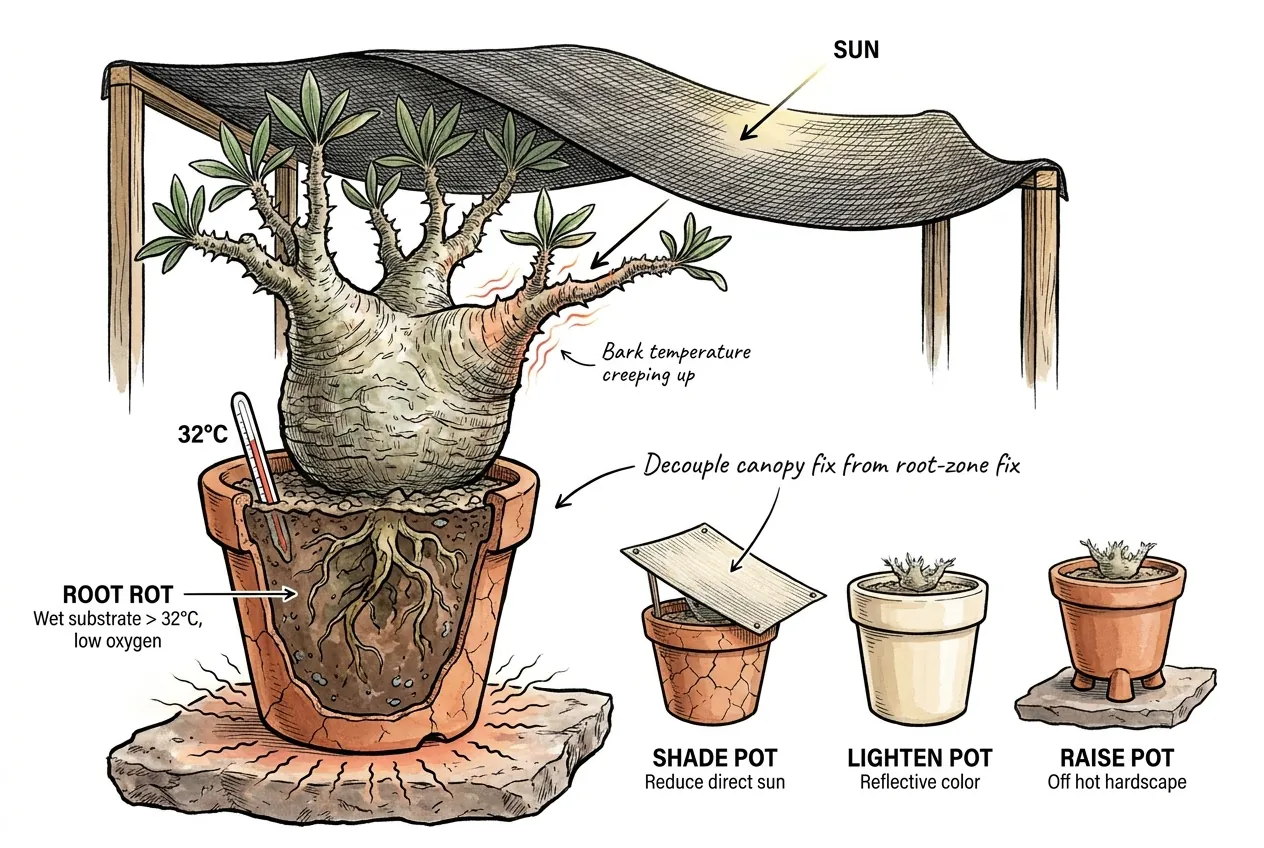
A heat wave under existing shade exposes the limit of canopy shade. If bark temperature creeps up even under cloth, re-measure and step up the percentage or switch to reflective.
But a baking pot is a different failure. Shade aimed at the canopy does not protect a baking root zone.
Hot, wet substrate is the risk here. As the root zone warms, roots need more oxygen while warm, saturated mix holds less, which favors root rot.
There is no single validated temperature switch across species, so treat hot-and-wet conditions as a warning rather than a hard 32 °C line.
Cool the root zone separately from the canopy
Shade the pot, lighten its color, raise it off hot hardscape, and address the root zone separately from the canopy shade.
When is shade cloth not the right fix?
Match the Purchase to the Failure Mechanism
The right purchase is not always shade cloth. If the problem is root-zone heat or a single movable plant, re-siting it or swapping a black pot for a white one is cheaper and addresses the correct failure mechanism.
Peer-reviewed nursery data show black containers reach 50.3°C at the sun-facing root zone versus about 36°C in white.
That roughly 14°C swing can be difficult for canopy shade alone to match in a root-rot failure mode.
For a single tall or wind-exposed specimen where a frame is impractical, a reflective calcined-kaolin particle film can be a spray-on alternative. Use a registered product only according to its label for rate, coverage, reapplication, and protective equipment, and test a small area first because it leaves visible residue and species tolerance varies.
Apple trials show that kaolin film lowers fruit surface temperature and solar injury, which is an analogue for bark rather than a caudex-specific result.
Diluted white latex paint on dormant bark is a related trunk-protection idea. See the Cyphostemma juttae bark-split prevention approach, keep paint off living green tissue, use a conservative water-based dilution, and patch-test first because paint can be hard to remove and is not suited to every genus.
Try slower acclimation before buying hardware
Import scald can reflect an acclimation-rate failure rather than a shade shortage, because high-light photoprotection develops over time.
Before assuming you need hardware, check that the symptom is even a shade problem. If a Cyphostemma is dropping leaves in summer, that may be forced heat dormancy rather than a shade or water problem, and no purchase fixes a normal dormancy.
Do you really need reflective aluminized cloth?
Black knitted HDPE can suit the PPFD-reduction job at lower cost. Pay the reflective premium only if your goal is a lower surface temperature at a given shade percentage, because reflective material rejects more incoming radiant energy instead of absorbing as much of it.
If you verify with an IR thermometer and black already keeps bark below your warning band, you may not need the upgrade.
Is an IR thermometer overkill?
Not if scald risk is your actual question, because air temperature is a poor proxy and sunlit surfaces run well above air.
A grower in a mild summer who keeps plants in long-acclimated partial shade can skip it.
A grower who needs to compare bark temperatures before and after shading may benefit from one. It converts an assumption into a repeatable surface reading.
Woven or knitted, does it matter?
Yes, mainly for cut-to-fit use. Knitted HDPE uses an interlocking loop structure, so it can be cut without unraveling, while woven polypropylene frays when cut.
Woven is heavier and may last longer on a fixed frame, but it is less convenient if panels need trimming.
For a hobby caudex setup that is cut and re-rigged seasonally, knitted fabric is often easier to handle.
What percentage for Adenium vs Pachypodium vs Cyphostemma?
All three are often grown in bright conditions, but a single 30–50% band is not a species prescription.
Use the plant’s measured PPFD range, bark temperature, acclimation history, and season to choose density.
Set the exact percentage from those observations rather than buying heavier cloth by default.
Can you just use a bedsheet, window screen, or umbrella?
It is a gamble, for three concrete reasons. An improvised cover has an unknown shade factor, so you cannot tell whether you blocked 20% or 70%, risking either etiolation or scald.
It has no UV stabilization, so cotton rots and synthetic screens embrittle and shed mid-season.
A draped sheet that sags into contact can create a hot abrasion spot on the caudex and a wet-rot trap after rain.
A rated knitted panel makes the shade factor and mounting behaviour easier to verify, but it still needs an air gap and measurement.
Affiliate Disclosure
This article contains Amazon affiliate links. As an Amazon Associate I earn from qualifying purchases. If you use these links, the site may earn a commission at no extra cost to you. Product availability, price, and specifications can change. Check the current listing before buying.