
Caudex Plant Freeze Damage: A 72-Hour Check Before You Cut
Caudex plant freeze damage can look worse than it is. Score firmness at 4 points over 72 hours, skip water, heat and pruning, then cut only to live tissue.
Rachel Torres · 2026-11-02 · 23 min read
Key Takeaways
- Move the pot to a shaded 50 to 65 °F spot and keep it dry, unpruned and away from heat for 72 hours.
- Thumb-score four marked caudex points at 0, 24, 48 and 72 hours, and act only on change between checks.
- Start the watch after a night at or below 32 °F, or a clear calm night forecast at or below 36 °F.
- A glassy, water-soaked patch at hour 0 is a question, and its direction across the checks is the answer.
- Cut only soft or wet dead branch sections, 1 to 2 cm below a live line that holds for 7 days.
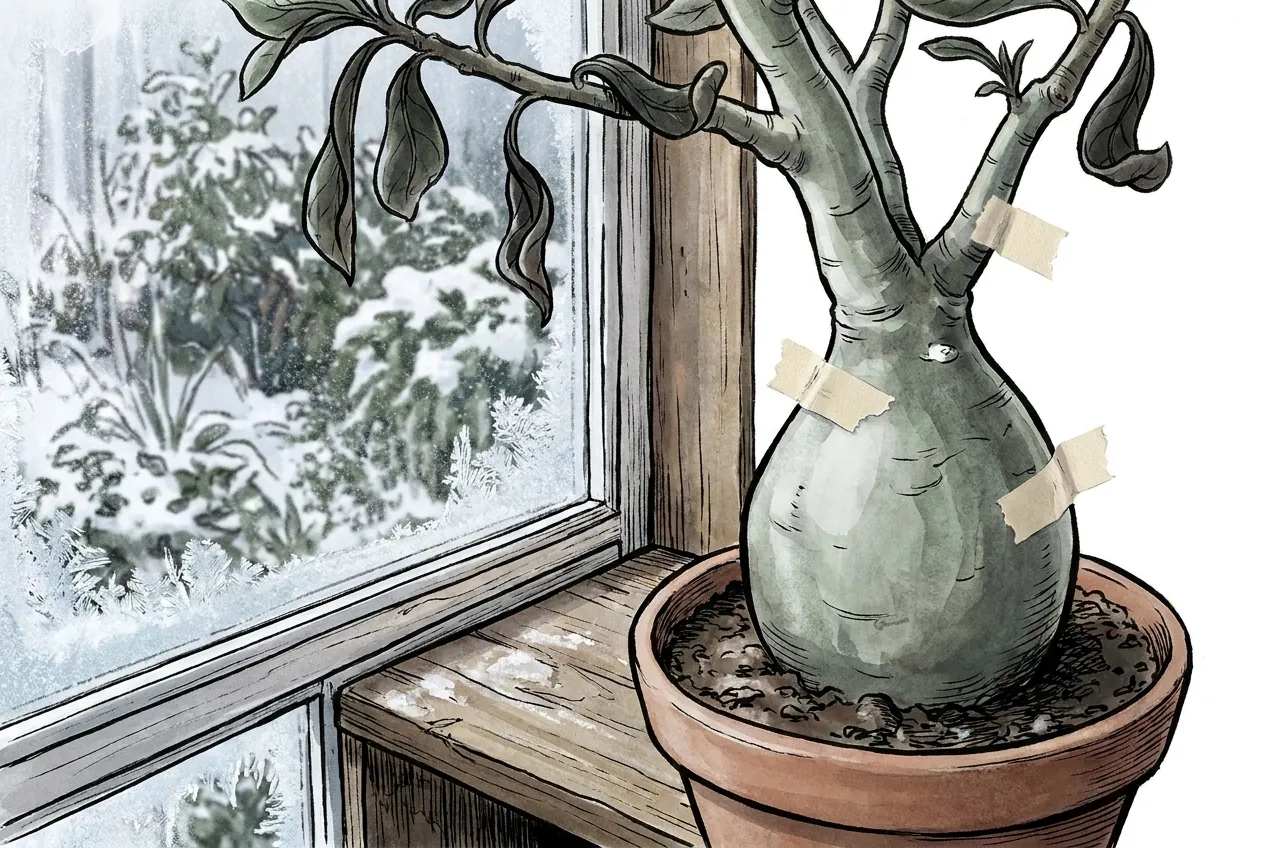
Found your adenium on the patio after a frost night? Carry the pot once to a cool, shaded room, then keep your hands off it for 72 hours. No pruning, no watering can, and no heater.
That pause is not passive, because caudex plant freeze damage takes days to reveal itself. Over the next three days you score the caudex at four marked points and watch which way the tissue moves.
The result tells you whether the damage stopped at leaves and twigs, or whether the caudex itself took the hit.
The first hour is a move, not a rescue
The first job is to stop further cold and sun exposure without adding new stress. Everything else waits for the scored checks.
Carry the pot to a cool, shaded holding spot
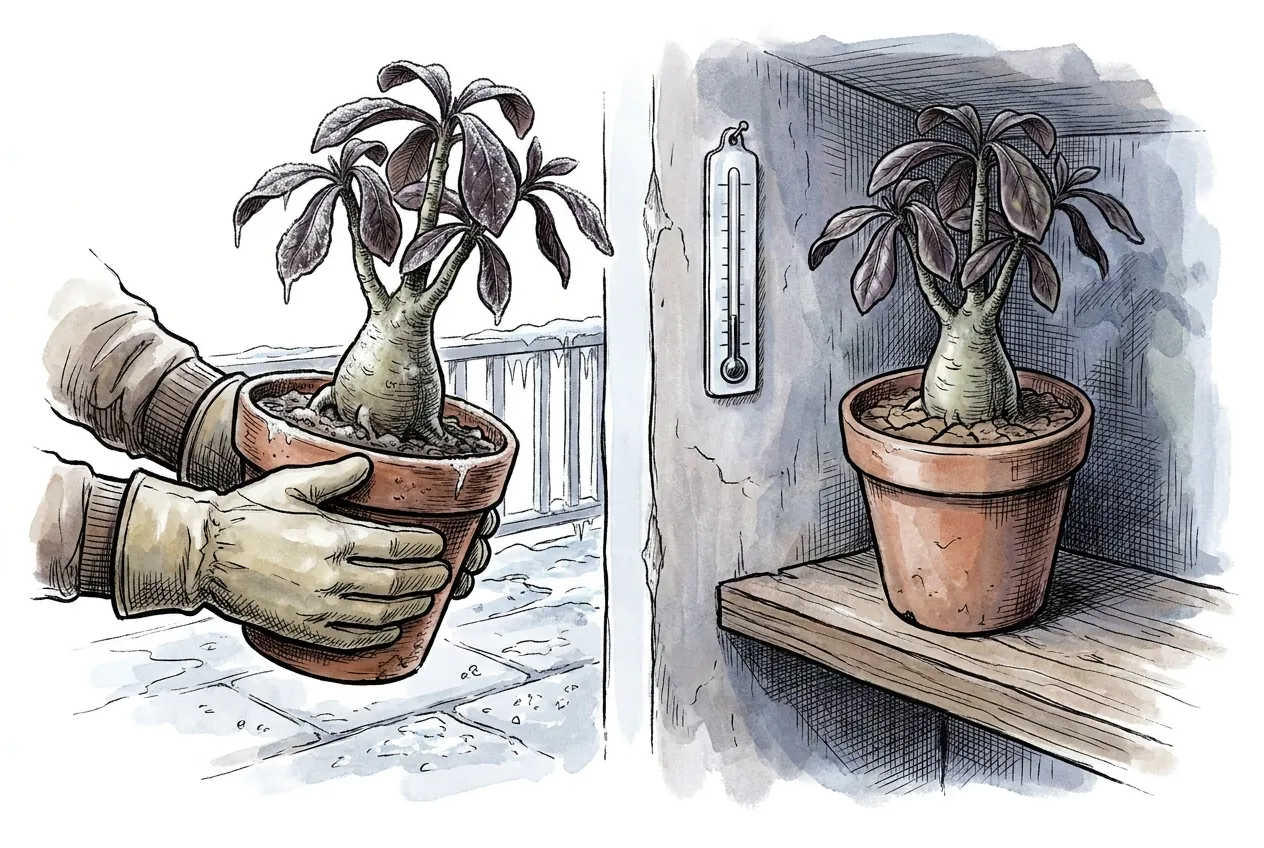
Put gloves on before you touch anything. Adenium sap is toxic, euphorbia latex irritates skin and eyes, and pachypodium spines puncture. Lift the plant by the container, never by the caudex or a branch.
Carry it to an unheated garage, an enclosed porch, or a cool spare room out of direct sun.
Keep it an arm’s length from vents, space heaters, radiators and heat mats. Leave any frost to melt where it is, with no brushing, rinsing or leaf peeling.
My holding rule is 50 to 65 °F at the plant, and I aim for the cooler half of that band.
The floor matches the 50 °F line below which UF/IFAS says many tropical plants suffer chilling injury.
The ceiling keeps damaged tissue out of the warm range where soft rot moves fastest, and well below the temperatures that wake an adenium into growth.
A basic min/max thermometer beside the pot at caudex height tells me whether the spot held overnight.
If the low drops under 50 °F or the high passes 65 °F, I move the plant and note the change.
A firmness shift during that interval is no longer a clean freeze signal.
Bright indirect light is fine, but a cold, sunny south window adds winter sunburn risk.
Gear for the rest of winter belongs to the caudex overwintering setup once the watch is over.
A slow thaw is a cheap precaution, not a cure
N.C. Cooperative Extension in Wilkes County warns that much frost damage happens when morning sun thaws frozen tissue too quickly. The controlled evidence is narrower than that warning suggests.
Kane and McAdam found that honeysuckle leaves frozen and rewarmed slowly in an insulated box recovered photosynthesis, while leaves frozen and thawed fast in open air did not.
Older rhododendron experiments by Havis found that plunging a frozen leaf into warm water caused injury.
He concluded that ordinary morning sun did not warm frozen leaves fast enough to harm them.
A caudex also has so much mass that its core thaws slowly anywhere indoors.
So a shaded, unheated thaw costs nothing and may spare some leaf and twig tissue. A slow thaw will not reverse ice damage that already happened overnight.
How cold your plant actually got
The low on your weather app is an air reading taken well above the ground. Your plant sat lower and, on a clear night, ran colder. Five minutes with station data sets realistic expectations before the first squeeze.
Match your night to the NWS severity ladder
The National Weather Service notes that frost often forms while the thermometer reads in the mid-30s.
Surfaces radiate heat to a clear sky faster than the air around them cools. Harvard’s BioNumbers database records leaves under a clear night sky running 3 to 5 K colder than the surrounding air, roughly 5 to 9 °F.
Clouds, fog and overhead cover shrink that gap. A plant under a porch roof sits closer to the station reading than one on an open deck.
Wind changes the picture again, because a windy, cloudy freeze cools everything toward air temperature and cover helps much less.
The NWS Aberdeen office issues frost advisories for expected lows of 33 to 36 °F and freeze warnings below 32 °F.
It labels 28 °F a hard freeze, and other offices may draw these lines differently. The NWS Time Series Viewer loads the last 72 hours of observations from a nearby station by default, which neatly covers the watch window.
| Your night | NWS label | What a tropical caudex may show |
|---|---|---|
| 33 to 36 °F, clear and calm, open sky | Frost advisory range | Leaf and tip damage likely, caudex often spared |
| 29 to 32 °F | Freeze | Leaf loss expected, caudex points at real risk |
| 28 °F or lower, or several hours below freezing | Hard freeze | Core damage likely on adenium, pachypodium and euphorbia |
I start the full 72-hour watch after any night that reached 32 °F or lower at the plant. I also start it after any clear, calm night forecast at 36 °F or lower when the plant sat under open sky.
Radiative frost can freeze surface tissue while the station still reads above freezing.
Write the station low and the hours at or below 32 °F next to your hour-0 scores.
Pots and wet plants take the cold harder
A pot has air on every side and no ground heat beneath it. In a classic container study, a 2-gallon pot stayed below 21 °F for more than 500 hours in one winter while field soil at 4 inches never dropped that low.
The same work found that root and shoot hardiness of one plant can differ by as much as 50 degrees.
Those were hardy shrubs, so only the direction transfers. Assume your root zone saw roughly the night’s air low.
Wet tissue is the other multiplier. A 2004 infrared imaging study by Gusta and colleagues showed that wetted leaves and water-rich, unhardened leaves supercooled less before ice formed.
A plant watered the day before, wet with dew, or still in full leaf deserves one notch more concern than a dry, dormant neighbor.
Why the first look can mislead you
Hour 0 is the least reliable moment to judge a frozen plant. Two different injuries may be in play, and frozen tissue can still swing toward recovery or toward death over the following days.
Chilling injury and freezing injury are different events
Chilling injury happens above freezing. UF/IFAS places it below about 46 to 54 °F for sensitive foliage plants and ties it mainly to disrupted cell membranes.
It often shows as wilting, water-soaked areas and browning that appears after the plant warms back up.
Freezing injury needs ice in the tissue. Ice forms first in the spaces between cells and pulls water out of them until the cells dehydrate past recovery.
A first-frost night can deliver both, which is one reason leaves often look worse than the caudex.
Glassy tissue means leaking membranes, and it can still go either way
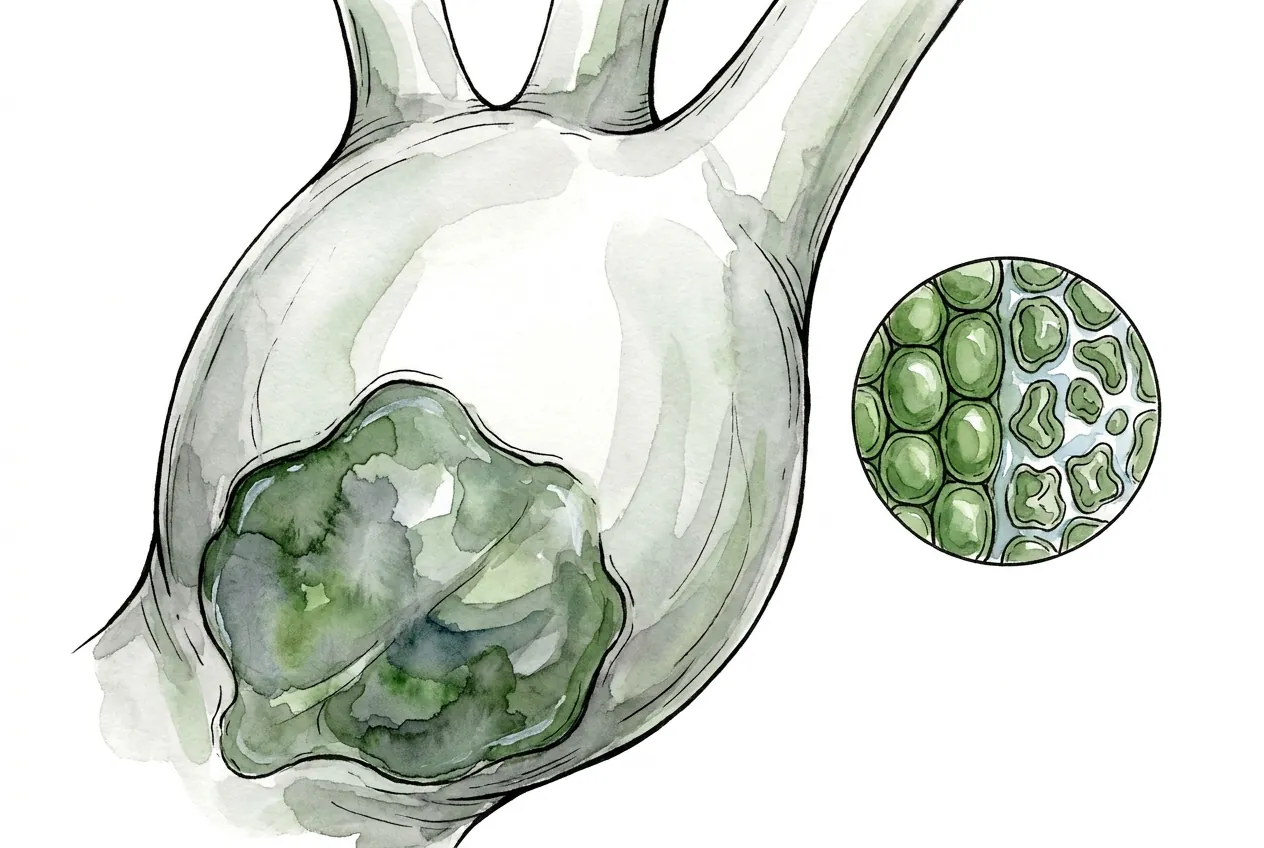
When membranes fail, cell sap floods the air spaces inside the tissue. Those air spaces normally scatter light, so a flooded patch looks dark green and glassy, like a thawed lettuce leaf.
UF/IFAS Extension in Putnam County lists translucent, water-soaked tissue as a common freeze sign in succulents, often turning brown later.
The clearest evidence comes from a 1977 onion experiment. Palta, Levitt and Stadelmann froze onion bulb tissue moderately or severely and found every cell alive right after thawing.
Over the following days, the moderate injury repaired itself while the severe injury kept progressing.
Onion scale is not a caudex, so treat this as the principle rather than caudex data. A glassy patch at hour 0 is a question, and its direction across the later checks is the answer. That direction is exactly what the timed check measures.
The 72-hour firmness check
This is the core routine. It turns wait-and-see into a scored comparison, so a change between checks triggers action instead of one worrying squeeze.
The scale and the trigger are my own house rules, not a published standard.
Mark four points at hour 0
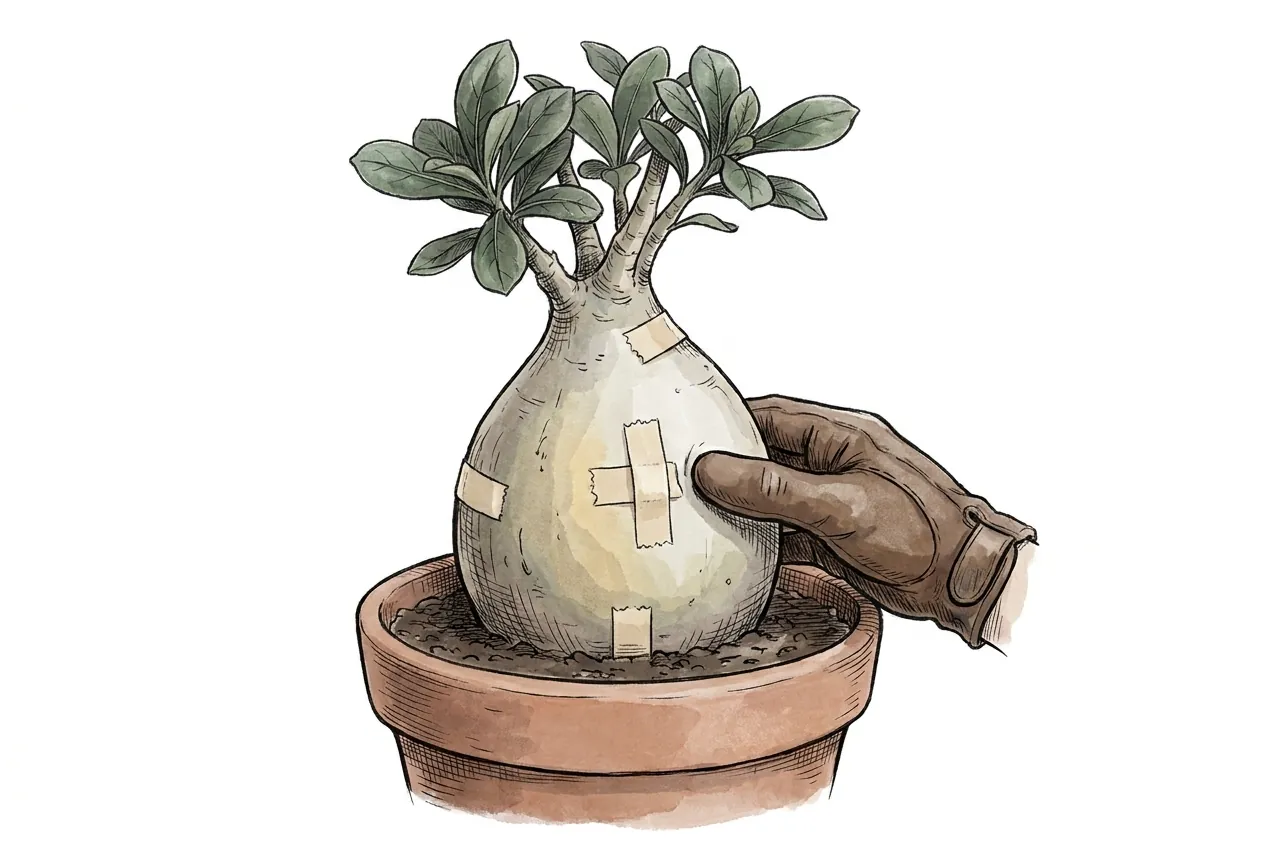
Hour 0 is the first check after the caudex skin has thawed and no longer feels icy to a gloved touch.
With gloves on, I stick a removable tape tab beside each of four points on the caudex, never on top of a glassy patch.
- The soil-line base, which sits in the coldest air and the coldest mix.
- Mid-caudex on the side that faced open sky.
- The shoulder where branches leave the caudex. On a pachypodium, this point moves to just below the leaf crown.
- The sheltered side, which acts as the plant’s own control.
The firmest point at hour 0 becomes my feel reference for the rest of the watch.
A healthy plant of the same genus with about the same caudex width, pressed once, makes a useful second reference if you have one.
Score each point at 0, 24, 48 and 72 hours
Pressing with the flat pad of my thumb, never a fingernail, I score each point on a three-step scale.
- A score of 1 is rock firm, like a raw potato.
- A score of 2 is a slight give that springs back.
- A score of 3 dents and stays dented, or feels spongy.
Beside each score goes a yes or no for translucent, water-soaked skin, plus any darkening, weeping or sour smell.
I sniff from normal handling distance and never put my nose to wet tissue. A phone photo of each tab, in the same light and at the same distance, keeps the comparison honest.
The checks run at hours 0, 24, 48 and 72, each within about an hour of the hour-0 clock time.
The plant stays dry and inside the holding band, so warmth or fresh water cannot fake or hide a change.
Clemson Extension notes that foliage damage shows within a few days while damage to larger limbs can take months, so this window catches fast failures rather than every failure.
Read the result at hour 72
At hour 72, each marked point lands in one of four outcomes.
- A point that keeps the same score of 1 or 2 from hour 0 through hour 72, with no translucent skin, counts as uninjured. When every point lands here, nothing gets cut.
- Any point rises one step between two consecutive checks, or its glassy area grows or darkens. That point stays uncut, and its daily check continues in the cool, dry holding spot.
- A point that scored 3 at hour 0 and stays at 3 without spreading keeps its daily check for 7 more days. A glassy patch that stays unchanged through hour 72 gets the same 7 days.
- A glassy patch that shrinks or firms between checks looks like repair. I keep watching and cut nothing.
A caudex point that holds the same score for 7 straight days is a contained injury, and I leave it uncut until spring.
Tissue that keeps softening, spreads, weeps or smells sour is handled with the adenium root rot rescue steps.
Branches follow a separate scratch walk after hour 72, and the caudex itself is never scratched.
One step is the smallest change a thumb can repeat reliably. Requiring change between checks screens out the even, springy softness many caudices already carry in winter. For a single-read reference on that difference, see the caudex firmness map for rot versus dormancy.
| Sign | Dormancy or dry-season softness | Freeze-damaged tissue | Secondary rot |
|---|---|---|---|
| Distribution | Even over the whole caudex | Patchy, worst on the sky side, shoulder or base | Starts in a damaged patch and spreads |
| Skin | Matte with fine wrinkles | Glassy or dark green, later tan or black | Wet and dark, may weep or split |
| Thumb press | Slight give that springs back | Dents and stays, or feels spongy | Mushy and collapsing |
| Smell | None | None | Strong and disagreeable |
| Across checks | Stable | Stable or worsening | Worsening, faster in warmth |
Leaf and twig damage versus caudex-core damage
Leaves report first and say the least. The caudex, and the weak spot of each genus, decide whether the plant is in real trouble.
Leaf drop alone does not mean caudex damage
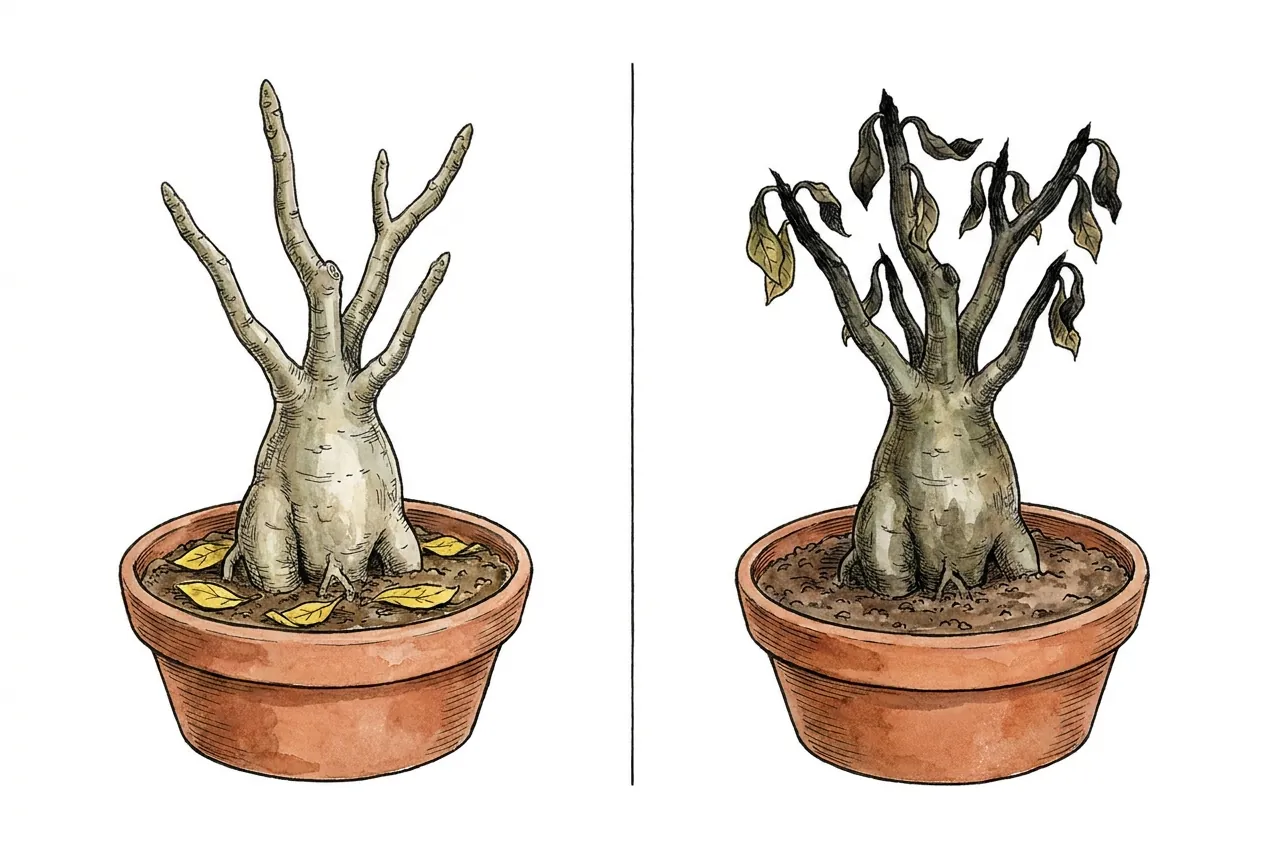
UF/IFAS rates adenium as chill tolerant from 35 to 55 °F, with possible leaf yellowing and leaf drop, but not freeze tolerant below 32 °F.
The same fact sheet says adenium drops all its leaves during its normal winter rest. UF/IFAS Gardening Solutions adds that desert rose may droop in winter and re-leaf once the cold season passes.
Clean leaf drop needs living twig tissue, because the plant must build a separation layer at each leaf base.
Black leaves that cling to a twig hint that the twig died too fast to shed them.
That clue comes from citrus guidance, so I treat it as a reason to check the twig later rather than as a verdict.
Black, limp leaves are dead, but they can stay on for now. If the drop looks more like dormancy, see daylength versus cold as a dormancy trigger.
Check each genus at its weak spot first
Every genus here is rated tender by the references that list them. Published numbers disagree by several degrees, and none comes from a controlled freeze test on these plants. Treat the table as a rough tier, not a survival guarantee.
| Genus | Commonly cited floor | Check first | Handling |
|---|---|---|---|
| Adenium obesum | Bring indoors at 55 °F | Branch tips, then the soil-line base | Toxic latex, wear gloves |
| Pachypodium lamerei | Most tender RHS rating, under glass all year | Apex and the stem just below the crown | Spines, wear gloves |
| Euphorbia milii | Dislikes temperatures below 35 °F | Glassy patches on green stems | Caustic latex, gloves and eye protection |
| Operculicarya decaryi | Avoid any frost | Trunk base and fine twig tips | Wear gloves |
| Cyphostemma juttae | Mature plants about 27 °F (minus 3 °C) | Firmness of the swollen stem | Wear gloves |
| Fockea edulis | About 28 °F for a short time | Firmness of the tuber top | Wear gloves |
| Dioscorea elephantipes | USDA zone 9b and warmer | The corky caudex, not the vine | Wear gloves |
NC State warns that euphorbia sap in the eye can cause temporary to permanent corneal damage.
Eye protection is not optional when you handle a frost-hit euphorbia. Pachypodium spines also break off in skin, so gloves stay on for every check.
Southern African genera have a small margin
The southern African group earns its margin only when the plant is dry, mature and briefly exposed.
LLIFLE advises keeping young Cyphostemma away from freezing altogether, and wet soil erases the advantage for all of them.
Dioscorea grows in winter, so its soft, active vine is likely to suffer before the corky caudex does.
That expectation comes from tissue type, not a freeze trial, so the caudex still gets its own firmness score.
Its separate winter water needs are covered in Fockea and Dioscorea winter watering.
What not to do before hour 72
Each classic rescue move hands rot organisms something they need. A cut supplies the wound, water supplies the moisture, and heat supplies the speed.
Six moves to skip during the window
- Do not cut leaves, twigs or caudex skin. Damage is still revealing itself, and some tissue may still be repairing.
- Do not pull off frozen leaves that are still attached. Each torn leaf scar is a fresh wound beside an existing freeze injury.
- Do not water, even if the mix feels bone dry or the caudex wrinkles. Cold, wet mix around possibly injured roots is the classic rot setup.
- Do not set the plant on a heat mat, beside a heater, or in a hot sunny window. The 50 to 65 °F holding band applies for the whole window.
- Do not fertilize. A dormant, injured plant cannot use it.
- Do not scratch, pierce or seal the caudex. Keeping its surface dry and intact is the whole point.
The no-cut rule has exactly one exit. Tissue that is actively spreading, weeping and foul-smelling at any check is a rot emergency rather than freeze triage.
It leaves the clock early and follows the same rot rescue route as the hour-72 rule, with no home trimming first.
If the plant already got water or sat by a heater, move it to the cool holding spot now and empty any saucer.
Once the mix thaws, tip the pot to let free water drain, then log what happened.
A soft reading in the next 24 hours may reflect that water or warmth, so weigh it cautiously rather than calling it pure freeze damage.
Why landscape freeze advice does not fit a potted caudex
Many extension pages say to water after a freeze. That advice targets leafy in-ground plants losing water in sun and wind. A frosted caudex indoors stores its own water and sits in cold mix that dries slowly.
UGA Extension adds that plants must be actively growing to use fertilizer, and that freeze damage can take a few days to show.
The PNW disease handbook notes that Pythium root rot is strongly favored by abundant moisture and that damaged plants are more easily infected.
The post on cold, wet soil and caudex root rot explains why cold mix stays wet so long.
Heat is the third accelerator. The UW-Madison clinic places the worst soft-rot decay between 70 and 80 °F and notes there is no treatment once bacteria infect tissue. Holding the plant cool and dry slows any rot that has started, so the timed checks can catch it while it is small.
After hour 72, map the live line before you cut
For branches, hour 72 starts mapping, not cutting. Extension guidance consistently says to wait until the extent of damage is clear, because branch dieback keeps revealing itself for weeks.
Walk a scratch test down each damaged branch
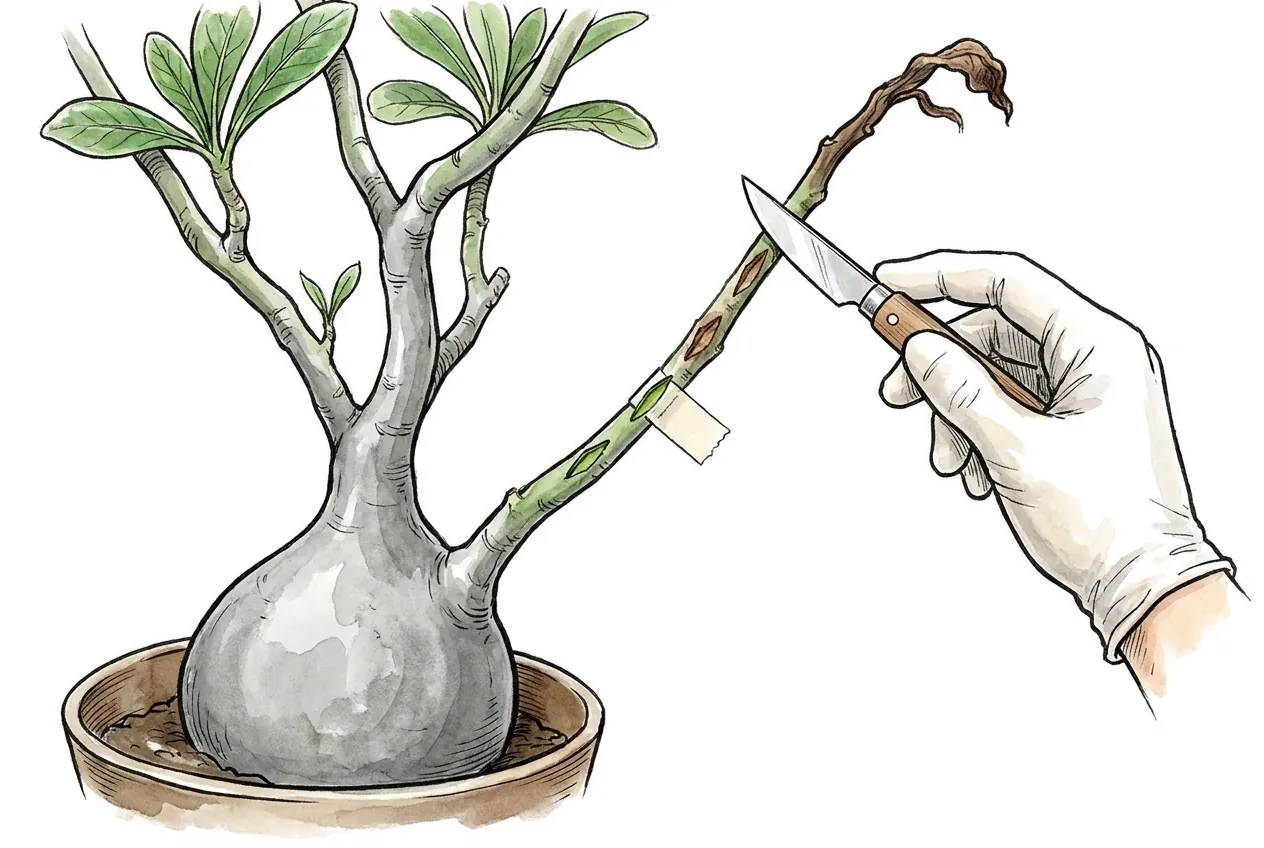
UF/IFAS Miami-Dade recommends waiting at least 3 to 7 days before assessing cold injury, then using a scratch test.
Living tissue under the bark shows green, while damaged tissue shows brown or black. UF/IFAS Marion County describes the same contrast, with dead tissue ranging from tan to black.
I use this test on branches only, never on the caudex itself. The caudex is water-rich storage tissue, and every scrape there opens a new rot entry point that the firmness check already makes unnecessary.
My walk follows the same order on every branch.
- With gloves and eye protection on, I wipe a small knife tip with 70% isopropyl alcohol.
- I scratch one healthy branch once to learn this plant’s live color.
- Starting just below the visibly dead tip, I scrape a fingernail-width patch of outer skin, then move 2 cm toward the caudex and repeat.
- At the first moist green or cream tissue, I stop and mark the spot with a tape tab.
Translucent or water-soaked tissue counts as dead or dying, even when it still looks greenish. The scrapes stay small and shallow, never a ring around the stem. The 2 cm spacing is my choice to keep wounds per branch low, not a published interval.
Cut only when the line holds for 7 days
Seven days after the first walk, I make one new scratch just below the tape, never on the old wound.
If the tissue there is still green and firm, the line has held. If it has browned, the boundary moved toward the caudex, so I re-mark it and wait another 7 days.
When the line holds across two checks 7 days apart, I cut 1 to 2 cm below the tape into live tissue. The cut happens on a dry day, with the plant still in its 50 to 65 °F holding spot, using a freshly sterilized blade.
The cut face stays open and dry, with no sealant and no water on it.
The 7-day interval and the 1 to 2 cm margin are my operational rules. Seven days is long enough for slow cell collapse to show, and short enough that a dying branch does not rot back unattended.
The margin exists because a freeze boundary is a diffuse zone rather than a sharp line.
Gloves and eye protection stay on until the blade is cleaned, because sap beads on a fresh cut.
If the line creeps all the way to the caudex shoulder, I stop cutting and switch that spot to the daily caudex firmness check.
The winter cut is only for dead sections that stay soft or wet, because those can rot back toward live wood. Dry, black, brittle tips can simply stay on until spring.
Recovery shows up in spring, not next week
A dormant adenium or pachypodium that lost only leaves usually stays bare until spring warmth returns.
A bare, firm caudex in winter is usually alive, and firmness rather than foliage is the life signal.
A pachypodium whose apex died can often branch below the dead zone, provided the stem beneath stays firm.
LLIFLE notes that branching in Pachypodium lamerei is usually a response to injury, though young single-stem plants often branch only after they first flower.
Research on apical dominance in pea shows buds below a lost tip are released as sugars redistribute, so branching is plausible but not guaranteed.
Do not water or fertilize to push recovery. The caudex winter warmth setup covers safe heat and monitoring once the watch is over.
Can I take a cutting if the caudex is failing?
Only as insurance, when the caudex shows spreading softness and a firm branch or top remains.
A review in Ornamental Horticulture notes that adenium cuttings rot easily because of their high water content. Seed-grown plants also form a more swollen caudex than cutting-grown ones.
Winter cuttings from a dormant plant root slowly, so treat success as uncertain. The caudex root rot fungicide chooser applies only once rot is confirmed.
Can an adenium survive a freeze?
Often yes, when the exposure was short and only leaves and tips froze. A brief radiative frost on a dry, leafless plant is a very different event from several hours at a hard freeze. Survival depends on whether the caudex holds its firmness across the timed checks.
A caudex that stays firm through hour 72, or a changed point that then holds for 7 days, needs only cool, dry patience until spring growth confirms it.
Only caudex tissue that keeps softening needs the rot rescue route, while damaged branches wait for a live line that holds 7 days before any cut.